Political Affairs Committee Bill Subcommittee Amendment Submission
Democratic Party Compiles Rebuttal Materials Against 'Windfall Tax Legislation'
"Should Banks Get the Share When Supported in Hard Times and Profiting"
Kim Seongju: "We Must Coexist Through Legislation, Not Government-Controlled Finance"
Legislation discussions have begun on the so-called 'windfall tax,' which would collect a shared growth contribution from the excess profits that the financial sector has earned due to interest rate hikes. The Democratic Party of Korea has proposed a bill to collect a shared growth contribution of up to 40% of the excess profits, targeting the banking sector's 'interest business.' With the ruling party also pressuring banks by emphasizing shared growth finance, attention is focused on whether the legislative process will accelerate.
On the 21st, the National Assembly's Political Affairs Committee held the first subcommittee meeting to review bills, discussing amendments to the Financial Consumer Protection Act centered on the introduction of the windfall tax. The amendment stipulates that if a financial company earns excess profits exceeding 120% of the average net interest income over the previous five years, it must pay a 'shared growth contribution' not exceeding 40% of that excess. Kim Seong-ju, the senior deputy chairman of the Democratic Party's Policy Committee, introduced the bill on the 14th, and it was directly referred to the subcommittee the day before under Article 58 of the National Assembly Act as a supplementary bill to the revenue budget.
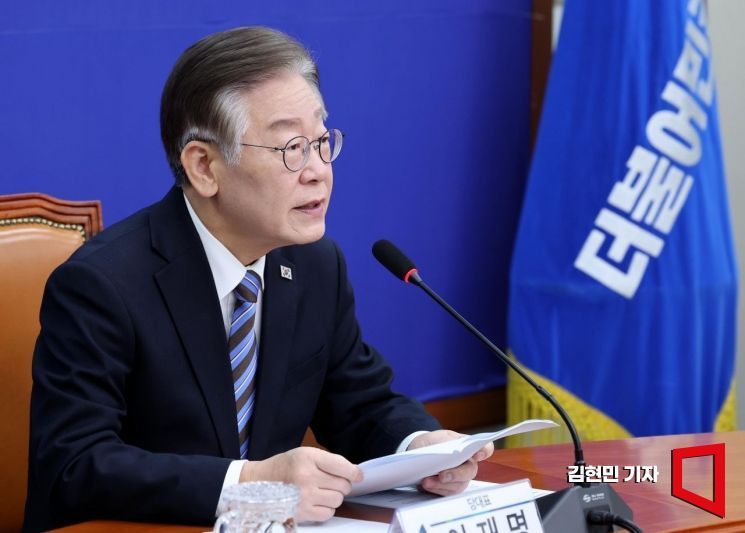
Although the amendment was ranked 71st out of 88 referred bills and thus pushed back in priority, the Democratic Party plans to exert full efforts to ensure the bill passes the National Assembly within the year through the ongoing subcommittee meetings scheduled until the end of the year. The bill has effectively become party policy, with party leaders including Representative Lee Jae-myung and Floor Leader Hong Ik-pyo signing on as co-sponsors.
▲Windfall Tax, a 'Global Standard' Led by Western Countries = According to materials obtained by Asia Economy regarding the Democratic Party's windfall tax legislation, the party has stockpiled various evidence and data to counter the ruling party's opposition arguments. For example, in response to criticisms that the proposal is a populist policy for the general election, such as the ruling party's claim regarding the incorporation of Gimpo City into Seoul, the Democratic Party cited cases of windfall tax implementation in countries like the United States, the United Kingdom, and Spain. They argued, "If banks have made enormous profits in a high-interest-rate era, it is their social responsibility to help ordinary citizens and businesses suffering from interest burdens. The president's expression that 'the people are slaves to banks' is the real populism."
▶How Much Did Banks Contribute After Receiving 170 Trillion Won During the IMF Crisis? = Particularly regarding concerns about whether financial companies would be supported when in difficulty if a burden is imposed on excess profits, the party recalled the 1997 IMF crisis. At that time, 168.6553 trillion won was invested in restructuring financial companies on the brink of bankruptcy. Public funds amounting to 86.8768 trillion won were provided to banks and 81.7785 trillion won to non-bank sectors such as insurance companies through equity investments, contributions, and asset purchases. A Democratic Party official stated, "It is inconsistent for banks, which operate as oligopolies under government approval and regulation, to receive tax support when losses occur due to poor management but claim 'my money' when earning profits from interest business."
▶What If the Windfall Tax Leads to Higher Loan Interest Rates? = The biggest concern about introducing the windfall tax targeting banks is the potential rise in loan interest rates. If banks raise rates to cover losses from the contribution, the burden could ultimately be passed on to the public. The Democratic Party counters this by arguing there would be a 'price stabilization effect.' A party policy committee official explained, "Banks' enormous net interest income stems from excessive interest rate margins in a high-interest-rate environment. If the margin difference is not large, banks may not have to pay the contribution." The logic is that imposing a windfall tax on excess profits would make banks more cautious about raising loan interest rates, thereby curbing interest rate hikes.
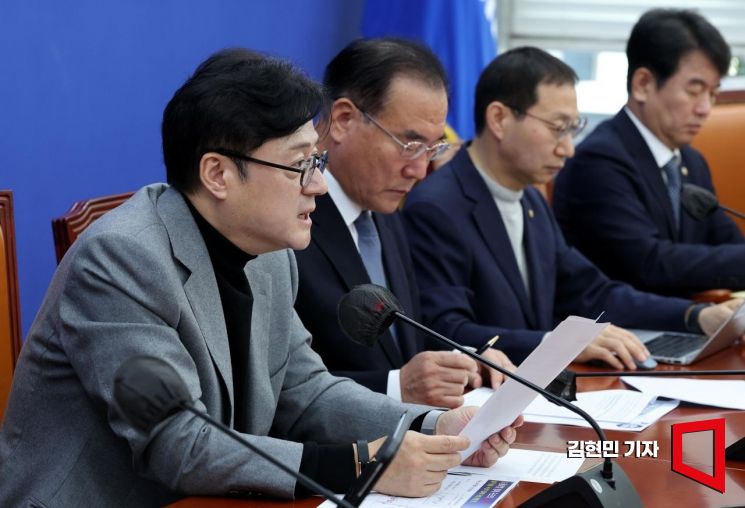 Hong Ik-pyo, the floor leader of the Democratic Party of Korea, is speaking at the party strategy meeting held at the National Assembly on the 21st. Photo by Kim Hyun-min kimhyun81@
Additionally, the Democratic Party highlights 'Article 2 of the Supplementary Provisions' as one of the key points of the bill, which applies the windfall tax from the fiscal year when the law is enacted. It is estimated that domestic banks earned over 44 trillion won in interest income up to the third quarter of this year, due to increased loan interest profits from rate hikes. If the bill passes within the year, the windfall tax applied to banks this year is expected to be 1.9 trillion won. Since this amount is similar to the funds the government plans to allocate under the name of 'shared growth finance,' the Democratic Party argues that handling it legislatively rather than as pressure is more reasonable.
A subtle shift in sentiment is also detected within the ruling party, which has opposed the windfall tax. Financial Services Commission Chairman Kim Ju-hyun pressured the financial sector by mentioning the windfall tax. At a meeting held the previous day, Chairman Kim said, "If the level is not acceptable to the public even at holding companies, it will not be allowed," and added, "There is a bill related to the windfall tax, so we will consider the level the public demands." This is interpreted as indicating a plan to secure up to around 2 trillion won through 'shared growth finance,' keeping in mind the 1.9 trillion won expected from the windfall tax.
The Democratic Party is pressuring the government and ruling party to introduce the windfall tax. At a party strategy meeting held at the National Assembly that morning, Policy Committee Chairman Lee Gae-ho said, "As people's lives become more difficult and small business owners' survival is threatened, practical livelihood measures are urgently needed," urging, "Actively participate in the introduction of a Korean-style windfall tax." He added, "We need sustainable financial policies legislated based on reasonable principles and standards, not policies that twist the arms of commercial banks," and said, "We will watch the Political Affairs Committee's bill review to see if President Yoon Seok-yeol's will is genuine."
Senior Deputy Chairman of the Policy Committee Kim Seong-ju criticized, "Calling bank holding company chairmen and pressuring them to 'do shared growth finance' while telling them to 'pay more money' is typical government-controlled finance." He added, "Recently, banks' excess profits came from raising loan interest rates significantly while only slightly increasing deposit rates when the Bank of Korea raised the base rate, engaging in interest business." He urged, "If the amendment to the Financial Consumer Protection Act discussed in the Political Affairs Committee subcommittee passes, it will lead to institutionalized shared growth with legal grounds, not forced shared growth that twists the arms of financial companies."
© The Asia Business Daily(www.asiae.co.kr). All rights reserved.
![Clutching a Stolen Dior Bag, Saying "I Hate Being Poor but Real"... The Grotesque Con of a "Human Knockoff" [Slate]](https://cwcontent.asiae.co.kr/asiaresize/183/2026021902243444107_1771435474.jpg)

















