Nikkei 225 Hits Highest Level Since Bubble Burst
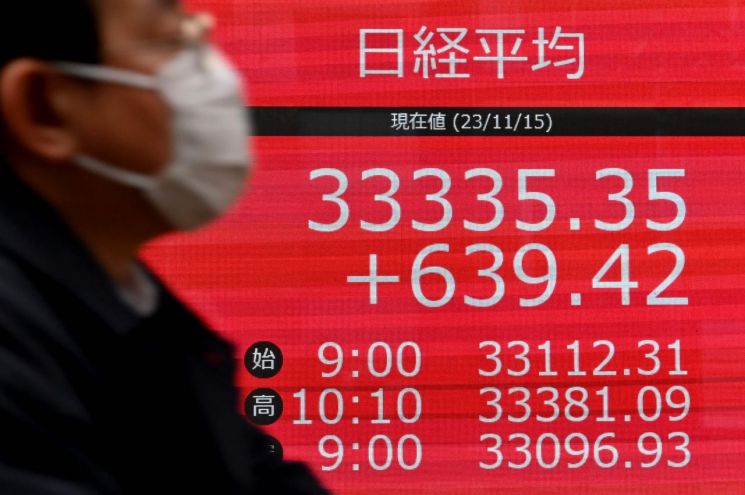
The Japanese stock market showed an unstoppable upward trend, reaching its highest level in 33 years since the bubble burst in 1990. Although the economy appeared to pause briefly, this was interpreted as a result of investor sentiment being boosted by expectations that the US interest rate hikes would come to an end.
On the 20th, the Nikkei 225 index, the representative stock index of the Japanese market, closed at 33,388.03, down 0.59% from the previous session. The TOPIX index closed at 2,372.60, down 0.77%. The Nikkei 225 index soared to as high as 33,853.46 during the day but closed slightly lower due to profit-taking from short-term rapid gains. The intraday high was the highest level in 33 years since the Japanese bubble economy period, surpassing the 36,000 mark.
On this day, the Japanese stock market saw a flood of 'buy' orders as strong performances from key industries such as automobile and semiconductor companies coincided with expectations that the US interest rate hikes would end.
The Japanese stock market has shown remarkable performance this month due to favorable domestic and international factors. The Nikkei 225 index rose 8.8% this month, outperforming the Morgan Stanley Capital International (MSCI) Asia index increase of 6.7%.
Among the top stocks in the Nikkei 225 index, those that showed significant gains on this day included Tokyo Marine Holdings (5.63%), Panasonic (4.98%), Nitori Holdings (4.03%), Sharp (3.64%), JGC Holdings (3.01%), Sumitomo Pharma (2.35%), and Mitsubishi Electric (2.22%).
Unlike the US and Europe, which have shown uncertain growth paths due to high interest rates and high inflation, the Japanese economy has maintained a gradual recovery this year, acting as a positive factor for the Japanese stock market.
Japan's real Gross Domestic Product (GDP) declined by 0.1% in the fourth quarter of last year but showed consecutive increases of 0.9% and 1.1% in the first and second quarters of this year. Although the Japanese economy, which had surprising growth in the first half of the year, contracted by 2.1% (preliminary figure) in the third quarter, the market remained unfazed.
On the 14th, the day before Japan's third-quarter GDP announcement, the US Consumer Price Index (CPI) came in below expectations, increasing hopes that the US Federal Reserve (Fed) would halt interest rate hikes, which led to a surge in buying.
Following the Fed's sharp interest rate hikes, the long-term interest rate gap between the US and Japan widened to 4 percentage points. As a result, the yen's value has fallen more than 20% this year. However, foreign media analysts suggest that even if the US-Japan interest rate gap narrows, it is unlikely that the yen's depreciation will end until the Fed lowers the benchmark interest rate next year.
Experts predict that the upward trend of the Japanese stock market will continue for the time being. The Nikkei 225 index has risen 29% so far this year. The 12-month forward price-to-earnings ratio (PER) of the Nikkei 225 index stands at 14 times, significantly lower than the US S&P 500 index (23 times) and the Nasdaq index (29 times) during the same period.
© The Asia Business Daily(www.asiae.co.kr). All rights reserved.
![Clutching a Stolen Dior Bag, Saying "I Hate Being Poor but Real"... The Grotesque Con of a "Human Knockoff" [Slate]](https://cwcontent.asiae.co.kr/asiaresize/183/2026021902243444107_1771435474.jpg)











