Major Shift in Korean and English Exam Policies
From Memorization to Verification of Thinking and Practical Skills
Starting in 2025, the Korean and English subjects of the Grade 9 civil service exam will undergo a complete shift in their question-setting approach, moving from memorization-based questions to those that assess thinking skills and practical abilities. The government explained that it will not include overly difficult questions that lack discriminatory power and expects this change to encourage job seekers from the private sector to enter public service.
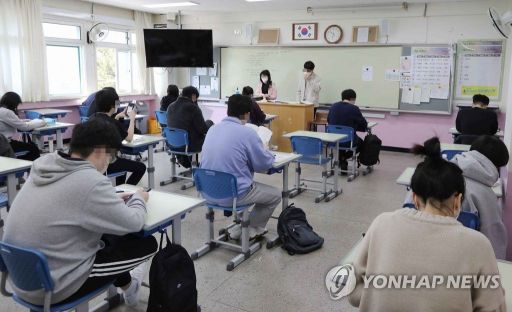 On the 8th, when the written exam for the Grade 9 National Civil Service Open Competitive Recruitment was held, examinees were waiting for the exam to start at a school in Seocho-gu, Seoul.
 [Photo by Yonhap News]
On the 20th, the Ministry of Personnel Management announced that it will actively promote the 'shift in question-setting approach' for the Grade 9 civil service exam administered by the ministry starting in 2025. The core of this shift is to change the current Korean and English subjects, which are mainly knowledge memorization-based, to focus on job competency.
To evaluate job-related skills on site, the Korean subject will verify thinking skills such as ▲basic Korean language ability ▲comprehension ▲reasoning ▲critical thinking, while the English subject will assess practical English skills necessary for actual job performance.
The Ministry of Personnel Management explained the background of this shift by stating, "The Grade 9 civil service exam has been somewhat memorization-oriented, which is not suitable for the Fourth Industrial Revolution era. The exam content has become 'Galapagosized,' isolated from other exams, and the knowledge or skills acquired during preparation are not utilized in actual work."
The ministry released sample questions reflecting the new question-setting approach on the Cyber National Examination Center website. The sample questions consist of 20 Korean and 20 English questions in the same format as the actual exam. In the Korean subject, the questions are designed so that they can be solved by using information within the passages without requiring background knowledge or memorization.
In the English subject, the questions focus on vocabulary and grammar that are highly practical and require less memorization, actively utilizing materials and formats encountered in the workplace, such as emails and notices.
"Questions will be created by analyzing job aptitude tests, NCS, basic vocational competency assessments, TOEIC, etc."
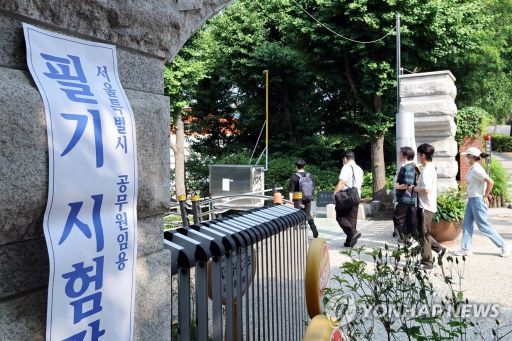 On the morning of the 10th, when the 2023 local government level 9 public official open recruitment written exam was held, applicants for Seoul city government positions were entering the exam site set up at Cheongun Middle School in Jongno-gu.
 [Photo by Yonhap News]
The question types for the Korean and English subjects were developed through research projects analyzing private sector job aptitude tests, NCS basic vocational competency assessments, TEPS, TOEIC, other private language tests, and the College Scholastic Ability Test.
Lee In-ho, Deputy Minister of the Ministry of Personnel Management, stated, "We will not include overly difficult questions that lack discriminatory power. When question setters gather at the examination center for question development, not only the question setters but also last year's successful candidates will participate to adjust the difficulty level."
The new question types based on the revised approach will be applied starting in 2025 to the national and local Grade 9 open competitive exams and the regional talent Grade 9 exams administered by the ministry, considering the preparation period for examinees. In other words, the existing question-setting approach will be maintained next year for examinees studying under the current system.
Meanwhile, to help examinees easily understand and thoroughly prepare for the changes, an explanatory video outlining the purpose of the questions and question types will be posted on June 20 on the YouTube channel 'Insa-cheo TV.'
Deputy Minister Lee emphasized, "Private companies and public institutions use job aptitude tests and NCS basic vocational competency assessments in their recruitment processes. Going forward, the civil service exam will also shift to focus on thinking skills, enhancing compatibility with private and public institutions and facilitating the inflow of talent into public service."
According to the Ministry of the Interior and Safety, the planned number of Grade 9 civil service recruits for 2023 is 14,038, with 150,487 applicants, resulting in an average competition ratio of 10.7, up from 9.1 last year.
© The Asia Business Daily(www.asiae.co.kr). All rights reserved.


















