Five Months Before the General Election, 'Cheongnyeon' Rapidly Formed Again
"The 2030 Generation Still Effective as Casting Voters," Analysis
Desperate for 2030 Votes to Win... "No Understanding" Criticism
With about five months remaining until next year's general election, both ruling and opposition parties are busy trying to capture the votes of the 20s and 30s age groups. The proportion of non-affiliated voters, who are disillusioned with the two major parties, is highest among these age groups. As analyses suggest that the 20s and 30s will play the role of 'casting voters' just like in the last presidential election, both parties are scrambling to 'embrace the youth,' but there are criticisms that they are focusing solely on winning votes without a precise understanding of the younger generation.
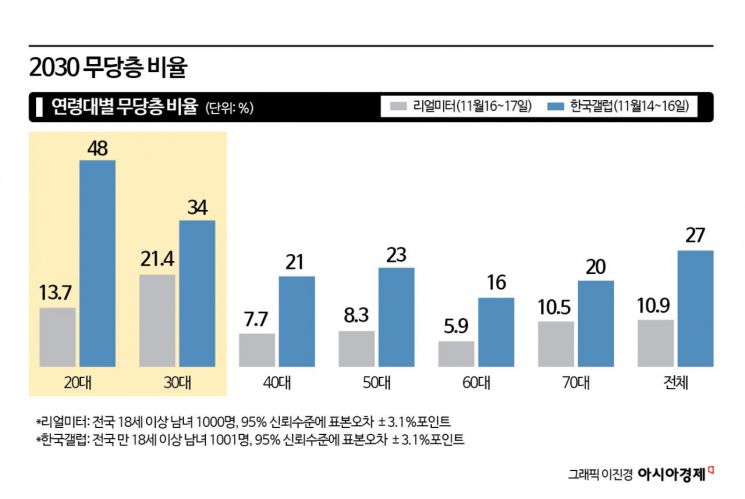
On the 20th, Realmeter, a public opinion research firm, released the results of a survey conducted on November 16-17 (3rd week of November) commissioned by the Korea Energy Economics Institute. The survey showed that 13.7% of respondents in their 20s and 21.4% in their 30s answered that they do not support any political party. This is significantly higher compared to single-digit percentages of non-affiliated voters in other age groups. The figures for other age groups were 7.7% for those in their 40s, 8.3% for those in their 50s, 5.9% for those in their 60s, and 10.5% for those in their 70s. The same trend was observed in the survey conducted on November 9-10 (2nd week of November), where 21.0% of those in their 20s and 15.9% of those in their 30s were non-affiliated voters, the highest among all age groups. The percentages for other age groups were 7.3% for the 40s, 7.8% for the 50s, 8.6% for the 60s, and 5.0% for the 70s, all in single digits.
The overall proportion of non-affiliated voters is in the 10% range (10.8% in the 2nd week of November, 10.9% in the 3rd week), with the 20s and 30s age groups driving this average upward. (Nationwide survey of 1,000 men and women aged 18 and over, with a 95% confidence level and a margin of error of ±3.1 percentage points)
According to a survey by Korea Gallup, the proportion of non-affiliated voters is even more pronounced. Gallup conducted a party support survey from November 14-16 (nationwide, 1,001 men and women aged 18 and over, 95% confidence level, margin of error ±3.1 percentage points), which showed that the People Power Party had 35% support, the Democratic Party 33%, and non-affiliated voters accounted for 27%. Among age groups, the proportion of non-affiliated voters in their 20s was a staggering 48%. (People Power Party 18% - Democratic Party 28%) This means that one out of every two people in their 20s answered that they do not support any party. In their 30s, 34% of respondents said they had no party affiliation. (People Power Party 30% - Democratic Party 33%)
Given this situation, both ruling and opposition parties are putting great effort into capturing the votes of the 20s and 30s. The political landscape is polarized, and the direction of the 20s and 30s vote is seen as decisive for the outcome of the general election. Um Kyung-young, director of the Era Spirit Research Institute, analyzed, "Looking at the voter demographics, those aged 60 and over make up 32%, those in their 40s and 50s make up 37%, and the remaining approximately 31% are in their 20s and 30s. Since those aged 60 and over predominantly support the People Power Party and those in their 40s and 50s favor the Democratic Party, the group holding the casting vote is precisely the 20s and 30s."
The problem is that both major parties are rushing to embrace the youth without a precise understanding of the 20s and 30s, leading to criticism that their policies are inadequate. Um pointed out, "Both parties are rolling out all sorts of populist policies aimed at the 20s and 30s, but both are only looking at the votes, lacking an accurate understanding of the younger generation."
The recent controversy over the Democratic Party's banner slogan, which sparked accusations of 'youth disparagement,' can be seen as an extension of this issue.
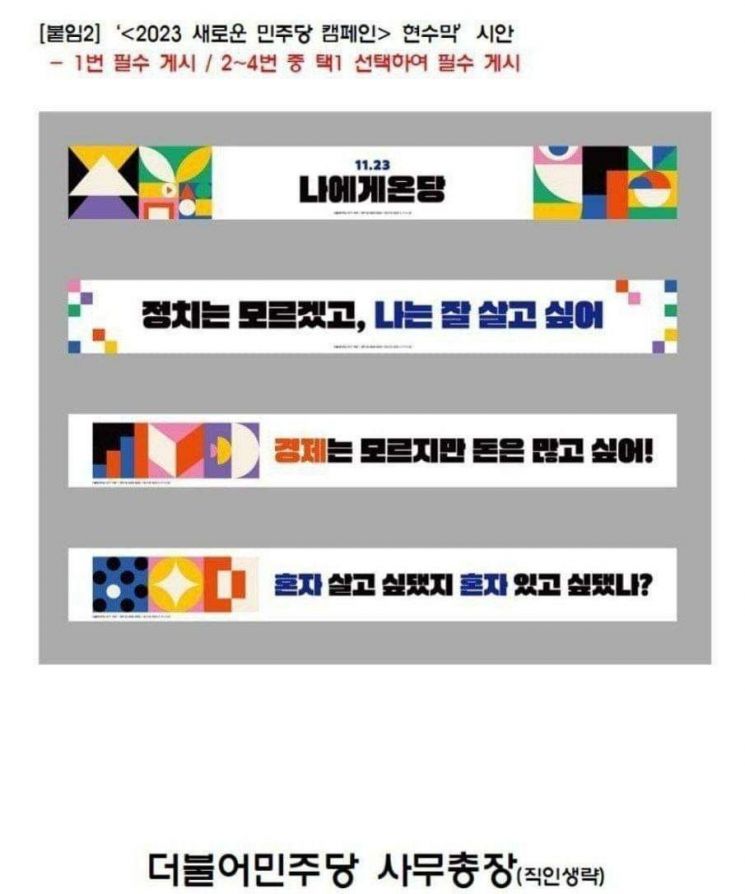
On the 17th, the Democratic Party sent four types of banner drafts targeting the 20s and 30s to each provincial party office nationwide, but the example slogans on the banners became controversial. The slogans included phrases such as "Naegae Ondang" (a pun meaning "I have a party"), "I don't know politics, but I want to live well," "I don't know the economy, but I want to have a lot of money!," and "I said I want to live alone, not be alone." These were criticized for belittling young people as politically ignorant and portraying them as a selfish group.
There were also reactions within the party calling it "shocking." The 'Principles and Common Sense' group, a faction of non-mainstream Democratic Party lawmakers who claim to be reformists, stated on the 18th, "This banner incident is an example that shows the miserable reality of the Democratic Party, which has lost morality, democracy, and vision," and criticized it as "evidence of Lee Jae-myung and the Democratic Party's lack of understanding of the youth generation." The People Power Party also condemned the slogans, saying, "These incomprehensible phrases, which contain the meaning of ignoring the youth, show no intention to empathize with the young generation who live fiercely day by day, nor any policies or alternatives for the youth."
As the controversy grew, the Democratic Party apologized for the banner slogans and announced that the events they intended to promote with the banners would be reconsidered from scratch. Cho Jung-sik, the party's secretary-general, said at a National Assembly press conference, "Regardless of the planning intention, if the public and party members felt uncomfortable, this is clearly a mistake," adding, "It was the party's fault, not something to be blamed on the company, and as the secretary-general overseeing party affairs, I apologize to the public and party members." Cho explained, "The controversial banners were teaser ads for the Democratic Party," and "They were ideas containing a bold promotional concept by external experts, but ultimately the party failed to carefully review and proceeded with the implementation process."
The People Power Party, which desperately needs the support of the 20s and 30s, is expected to actively embrace the youth following this controversy. Earlier, the People Power Party's Innovation Committee announced in its third innovation plan that "50% of the proportional representation list will be mandatorily allocated to youth," thus playing the youth card. However, there are criticisms that setting the youth age limit at under 45 years old to capture the 20s and 30s vote is itself a flawed 'preset value.' It is said that the People Power Party is also rolling out hastily prepared policies.
Moreover, both parties are engaged in a tactical battle over the 'youth budget' with an eye on votes. The People Power Party criticizes that 80% of the youth-related budget of 302.8 billion won included in the government proposal was uniformly cut under the Democratic Party's leadership, while the Democratic Party counters that the government proposal is a 'hollow shell' budget focused on 'experiential projects' far from long-term job creation. Because even the youth budget is viewed as a means to 'show results,' in-depth youth policies or well-structured budget allocations suitable for them remain out of reach in the political arena.
© The Asia Business Daily(www.asiae.co.kr). All rights reserved.


















