The domestic botulinum toxin (BTX) market has entered a new competitive phase. While BTX companies are introducing new formulations ranging from high purity to therapeutic uses, they are also turning their attention to overseas markets such as China and the United States.
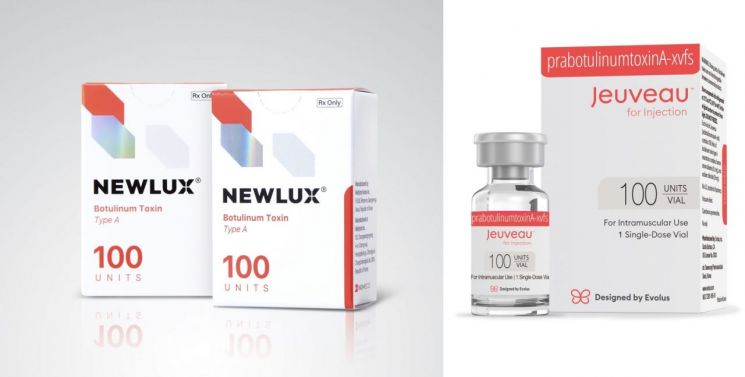 Botulinum toxin product 'Newlux' (left) from Newmeco, a Medytox affiliate, and botulinum toxin product 'Nabota' (US product name Jeuveau) from Daewoong Pharmaceutical.
 [Photo by each company]
Huons Biopharma received approval from the Ministry of Food and Drug Safety (MFDS) on the 16th for the clinical phase 3 trial plan (IND) of its self-developed BTX formulation ‘HU-045’. This clinical trial targets the improvement of moderate to severe glabellar lines and will evaluate safety and efficacy at three domestic institutions.
Medyttox is also planning to launch a new product with enhanced safety. Newmeco, a subsidiary of Medyttox, obtained marketing authorization from the MFDS in August for the next-generation BTX formulation ‘Newlux’. Newlux is a formulation developed by Newmeco through technology transfer of the next-generation BTX candidate substance ‘MBA-P01’ from Medyttox. The lyophilized Newlux excludes animal-derived components during the raw material production process to increase safety. Newlux is expected to be launched domestically within this year.
Some companies are expanding their scope beyond aesthetics to therapeutic uses. Daewoong Pharmaceutical, through its partner Ion Biopharma, has obtained a patent in the United States for the use of the BTX formulation ‘Nabota’ (U.S. product name Jeuveau) in migraine treatment. This patent grants exclusive rights until 2041. BTX formulations are used cosmetically or medically by injecting minute amounts under the skin to induce slight muscle paralysis, which smooths wrinkles. In Korea, over 90% of BTX formulations are used for cosmetic purposes, but overseas, the therapeutic use proportion is known to be higher. Daewoong Pharmaceutical explained that the therapeutic market accounts for 53% of the global BTX market.
Overseas expansion beyond the narrow domestic market is also active. Medyttox, which was attempting to enter the Chinese market with the BTX formulation ‘Medytoxine’ (export name Neuronox), has shifted its focus to the Chinese market with Newlux. Considering the future growth potential of the Chinese market and the fact that a mass production system has been established along with the application of the latest manufacturing processes, they judged that entering with Newlux is more advantageous. Medyttox withdrew its application for imported drug registration of Medytoxine. Along with Medyttox, Daewoong Pharmaceutical and Huons Biopharma are proceeding with procedures to enter the Chinese market. Daewoong Pharmaceutical, which applied for marketing authorization in 2021, is expected to receive approval as early as this year. Currently, the only domestic company with marketing authorization for a BTX formulation in the Chinese market is Hugel’s ‘Botulax’ (local product name Letivo).
More companies are targeting the U.S. market as well. Currently, the only domestic product approved and sold in the U.S. market is Daewoong Pharmaceutical’s Nabota. Hugel, the domestic BTX market leader, resubmitted a Biologics License Application (BLA) for Letivo to the U.S. Food and Drug Administration (FDA) in September. Previously, Hugel applied for marketing authorization to the FDA in March 2021 and October last year, but both times the approval was denied due to requests for additional information (CRL). The approval decision for Hugel is expected in the first quarter of next year. Medyttox also plans to apply for U.S. approval this year for its non-animal-derived liquid toxin formulation ‘MT10109L’.
According to the global market research firm Grand View Research, the global BTX market size was $6.4 billion (approximately 8.3 trillion KRW) last year and is expected to grow at an average annual rate of 5.1%, reaching $15.4 billion (approximately 20 trillion KRW) by 2030.
© The Asia Business Daily(www.asiae.co.kr). All rights reserved.

















