Joint Call for Whole-Government Support Including Enactment of the Moonlight High-Speed Rail Special Act Within the Year
Gwangju Metropolitan City and the Democratic Party of Korea held a budget policy meeting at Gwangju City Hall on the 18th, agreeing to focus all efforts on prioritizing the livelihood of the people amid the ongoing economic crisis.
They agreed to work together on the enactment of the Dalbit High-Speed Railway Special Act within the year, securing national funds for next year's artificial intelligence (AI) development projects, and urging comprehensive government support to resolve the Daewoo Winia Group crisis.
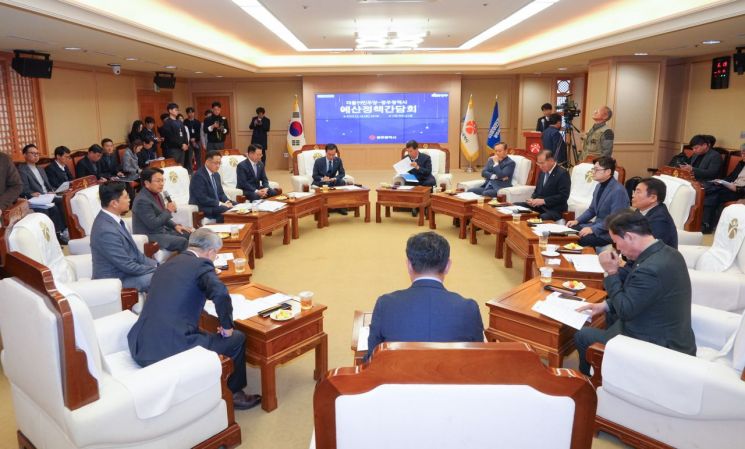
Attending the budget policy meeting were Gwangju Mayor Kang Gi-jung, Deputy Mayor for Culture and Economy Kim Kwang-jin, and Planning and Coordination Office Director Bae Il-kwon from Gwangju City; and Hong Ik-pyo, floor leader, and Lee Gae-ho, chairman of the Policy Committee, from the Democratic Party’s central party. Also present were Lee Byung-hoon, chairman of the Gwangju City Party Committee; Shin Jeong-hoon, chairman of the Jeonnam Provincial Party Committee; and local district lawmakers Yoon Young-duk, Song Gap-seok, Jo Oh-seop, Lee Hyung-seok, Lee Yong-bin, and Min Hyung-bae.
Considering the limited time left for the National Assembly’s budget review period and the absence of Gwangju-origin members in the Budget and Accounts Committee, the meeting was urgently held over the weekend to conduct consultations.
Gwangju City and the Democratic Party discussed major local issues and party-level support measures to secure national budget funds for 2024.
Gwangju City first requested strong support for financial assistance and designation as an employment crisis area to resolve the Daewoo Winia crisis, the region’s biggest issue.
To minimize the impact of the Daewoo Winia Group crisis on the local economy, Gwangju City provided emergency financial and fiscal support, including a 5 billion KRW special guarantee and an emergency management stabilization fund of 5 billion KRW to support up to 100 million KRW per company.
Additionally, the special support area for small and medium enterprises, applied for in October, is expected to be designated around the 20th, contributing to the swift recovery of the local economy.
However, Gwangju City emphasized the need for further strong government-level support. Accordingly, it proposed the injection of 20 billion KRW in emergency production funds from public funds, expansion of special guarantees for partner companies (special contribution of 10 billion KRW), and the relaxation and prompt designation of employment crisis area requirements.
Gwangju City and the Democratic Party also agreed to work toward the enactment of the Dalbit High-Speed Railway Special Act within the year. They aimed to achieve the first outcome symbolizing national balanced development encompassing both Yeongnam and Honam regions through the enactment of the special law within the year. They also agreed to promote a constitutional amendment to include the spirit of the May 18 Democratic Movement and other democratic values in the preamble of the Constitution.
On this day, Gwangju City proposed seven national budget-supported projects to the Democratic Party.
In particular, to ensure the smooth completion of the first phase of the AI project, which is central to Gwangju’s focus on the artificial intelligence industry, by next year, it explained the essential need to increase the national budget by 15.1 billion KRW to cover unavoidable additional construction costs (7.7 billion KRW) due to inflation and ground reinforcement, as well as the remaining project costs (7.4 billion KRW).
Furthermore, with the national AI data center commencing operations in November, Gwangju requested the inclusion of national funds for 14 billion KRW to create a demonstration environment for ultra-large AI customized data preprocessing, 2 billion KRW for building a digital-based future car parts technology commercialization platform, and 6.2 billion KRW for establishing a semiconductor materials, parts, and equipment reliability support center, all related to AI and future car industries.
Other requests included 1.5 billion KRW for detailed design costs to create a Children’s Art and Science Park, 11.3 billion KRW to complete next year’s project for the Mudeungsan Wonhyosa Collective Facility District maintenance project, and 1.94 billion KRW in contributions to ensure the opening and stable operation of the National Violence Trauma Healing Center in May next year.
Mayor Kang Gi-jung of Gwangju said regarding the response to the Daewoo Winia crisis, “Despite difficult financial conditions, we urgently expedited emergency financial and fiscal support with the desperate resolve to protect the livelihood of the people,” and added, “We ask for special attention to ensure the Ministry of Employment and Labor promptly designates the employment crisis area.”
He continued, “I hope the enactment of the Dalbit High-Speed Railway Special Act within the year will promote exchange and mutual development between Yeongnam and Honam. Although both national and local finances are difficult, we will pave the way for future investment that Gwangju must pursue through active national budget acquisition. Especially, since AI and future car industries are key future growth engines, I ask for joint efforts in securing the budget in the National Assembly.”
Floor Leader Hong Ik-pyo said, “To realize Gwangju as a city of shining opportunities tomorrow, we will ensure the budget for AI and local currency is secured. Also, the Dalbit High-Speed Railway, a crucial issue for Gwangju and a representative project for national balanced development, symbolizes not only regional harmony but also national unity,” adding, “With the support of 261 lawmakers from both ruling and opposition parties, and the shared will of Gwangju Mayor Kang Gi-jung and Daegu Mayor Hong Jun-pyo, we will do our best to pass the related law within this regular session of the National Assembly and reflect at least part of the design service budget so that this project can be fully launched next year.”
Policy Committee Chairman Lee Gae-ho stated, “We will ensure the Dalbit High-Speed Railway Special Act passes through in-depth discussions within this regular session of the National Assembly,” emphasizing, “Opposing it solely on economic grounds is a perspective that neglects regional balanced development and leaves the capital-centered one-pole system unchecked. As an important bill symbolizing east-west harmony and regional balanced development, the ruling and opposition parties will join forces to process it within the year.”
© The Asia Business Daily(www.asiae.co.kr). All rights reserved.
![Clutching a Stolen Dior Bag, Saying "I Hate Being Poor but Real"... The Grotesque Con of a "Human Knockoff" [Slate]](https://cwcontent.asiae.co.kr/asiaresize/183/2026021902243444107_1771435474.jpg)











