'Defense and Administration Experts and Local Residents Participate in "Pyeongdong-Donggok Area Policy Forum"
Pyeongdong Hosu Park and Myeonghwa Kimchi Village Established... Regional Development and Job Creation Also Included'
Attorney Park Gyuntaek argued that the issue of relocating the Pyeongdong artillery shooting range in Gwangsan-gu, Gwangju, which has been at a standstill for 10 years since the announcement of the creation of an eco-friendly national industrial complex on the site of the Pyeongdong artillery shooting range (2013), must be resolved.
Attorney Park Gyuntaek, legal special advisor to Lee Jae-myung, leader of the Democratic Party, held a policy proposal and discussion meeting on the afternoon of the 18th at the Pyeongdong Nonghyup meeting room in Gwangsan-gu, Gwangju, together with residents of the Pyeongdong and Donggok areas.
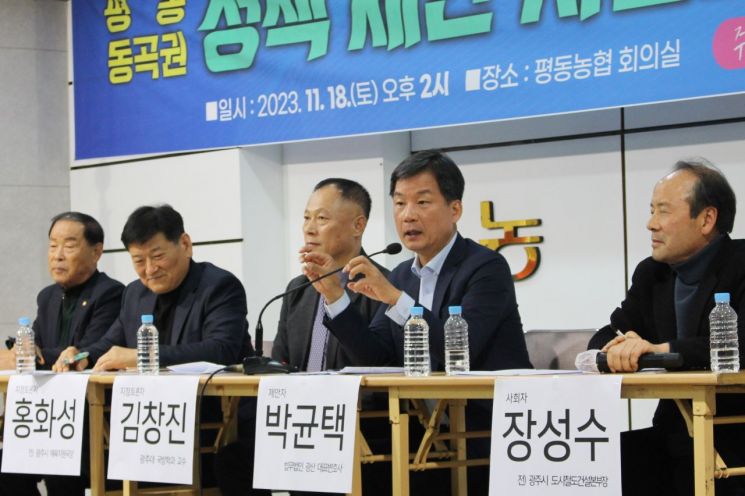
At this meeting, in-depth discussions were held on the relocation and utilization plans of the Pyeongdong artillery shooting range.
Attorney Park presented the topic, with Jang Seongsu, former head of the Gwangju Urban Railroad Construction Headquarters, acting as moderator; designated discussants included Kim Changjin, professor of Defense Studies at Gwangju University, Hong Hwaseong, former director of Gwangju Sports Support Bureau, and Lee Jaecheol, visiting lecturer at Hyoryeong Senior Welfare Town. About 80 residents participated and exchanged opinions.
Attorney Park said, “When the Gwangju Sangmu Base was relocated to Jangseong in 1994, the artillery shooting range was moved to the Jangseong Comprehensive Training Ground, and the tank and attack helicopter shooting ranges were relocated to other areas. Currently, the Pyeongdong artillery shooting range is used only about 45 days a year as a mortar shooting range, making it largely ineffective,” adding, “Since a mortar shooting range has already been established within the Jangseong Comprehensive Training Ground near Sangmu Base, there are no restrictions on relocation.”
He continued, “Despite the urgent need to relocate the artillery shooting range to ensure normal residential life around the city and for balanced urban development, politicians have neglected this issue until now, which I deeply regret,” and emphasized, “Even now, a signature campaign should be launched to spread public opinion for relocation, and the approximately 750,000-pyeong artillery shooting range site should be returned to the residents who have suffered for the past 70 years.”
He also added, “Facilities such as university hospital-level medical institutions like Chonnam National University Hospital, a medical research complex, a senior health welfare town, comprehensive sports facilities, a pet theme park, and an animal empathy personality healing center should be established.”
Kim Changjin, professor of Defense Studies at Gwangju University, said, “The primary foundation for relocating the artillery shooting range is already sufficiently in place, so it is important to create conditions for smooth consultations among the related organizations: Gwangsan-gu, Jangseong-gun, and the Army Infantry School,” and expressed agreement with the plan to utilize the Pyeongdong artillery shooting range site as a public facility for regional development and resident welfare in Gwangsan.
Meanwhile, various opinions were exchanged on plans to develop Pyeongdong Lake Park and Kimchi Village, operate a direct agricultural product market for farmers and retailers, and promote regional development by utilizing the natural environment and agricultural products of the rural Pyeongdong and Donggok areas.
Attorney Park said, “If a ten-ri trail consisting of a yellow soil path, health path, and jogging road is created along the 4 km circumference of Pyeongdong Lake to make it a lake park, it will become a healing space for Gwangju citizens,” and added, “If a farming corporation involving village residents and kimchi experts is established in Myeonghwa Village next to Pyeongdong Lake and designated as a Kimchi Village, it will become a representative tourist attraction of Gwangju by hosting kimchi festivals and regularly serving as a place for kimchi-making demonstrations and sales.”
He also proposed, “To reduce costs and burdens for farmers and retailers in Pyeongdong and Donggok, I suggest operating a market where direct transactions between farmers and retailers are possible by utilizing vacant lots or farmland near Pyeongdong Station.”
Hong Hwaseong, former director of Gwangju Sports Support Bureau, explained, “If a kimchi festival is held in Myeonghwa Village, where kimchi-related crops are cultivated, logistics costs will be reduced, and the promotional effect can be enhanced by the surrounding natural environment related to the festival’s purpose,” adding, “Since Gwangju City is fostering the kimchi industry, if the atmosphere for designating a Kimchi Village is created, it is feasible.”
Lee Jaecheol, visiting lecturer at Hyoryeong Senior Welfare Town, argued, “Pyeongdong and Donggok, located in the western part of Gwangju, are far from the agricultural wholesale market in the east, and due to distribution costs, farmers find it difficult to get fair prices for their hard-grown agricultural products,” and stated, “If a direct transaction market is opened using vacant lots under the overpass near Pyeongdong Station or farmland next to the national road in Donggok, it will greatly help both farmers and retailers.”
© The Asia Business Daily(www.asiae.co.kr). All rights reserved.

















