The prices of representative seafood items frequently found on dining tables, such as squid and myeongtae (pollock), have been soaring day by day, increasing the burden on ordinary citizens' grocery bills.
According to the Korea Agro-Fisheries & Food Trade Corporation (aT) on the 19th, the price of one myeongtae fish rose 17.1% from 3,305 won a month ago to 3,873 won. The price of domestic refrigerated galchi (hairtail) increased 11.0% from 3,436 won to 3,816 won during the same period, and mul ojingeo (webfoot octopus) rose 8.9% to 5,131 won.
The sharp rise in seafood prices is attributed to a decrease in catch volumes continuing since last year. In September, squid catch volume was 3,946 tons, about half of the 7,160 tons caught in the same month last year. As catch volumes declined, seafood prices last month increased by 3% compared to the same month the previous year.
As seafood prices rise, the prices of canned seafood such as tuna, mackerel, and kkongchi (Pacific saury) have also been hitting record highs daily. Last month, the price increase rate for canned seafood was 10.5% compared to the same month last year, marking the highest level in 14 years and 1 month since September 2009 (16.5%).
The government is making all-out efforts to curb soaring prices by forming on-site inspection teams and daily monitoring teams. Seven items closely related to the public's daily life, including popular fish species and sun-dried salt, have been designated as price stabilization management items. The popular fish species include myeongtae, mackerel, squid, galchi, chamjogi (yellow croaker), and dried anchovies.
The government will also expand its stockpile. Additional government reserves of squid and mackerel will be released, and 5,000 tons of sun-dried salt will be preferentially supplied to traditional markets and supermarkets by the 15th of next month. Furthermore, plans include focusing on price and livelihood stabilization through measures such as issuing discounted zero-pay mobile gift certificates exclusively for seafood.
However, the food industry that processes and sells seafood anticipates that some product price increases are inevitable due to rising raw material and logistics costs, making it difficult to ease the burden on ordinary citizens quickly.
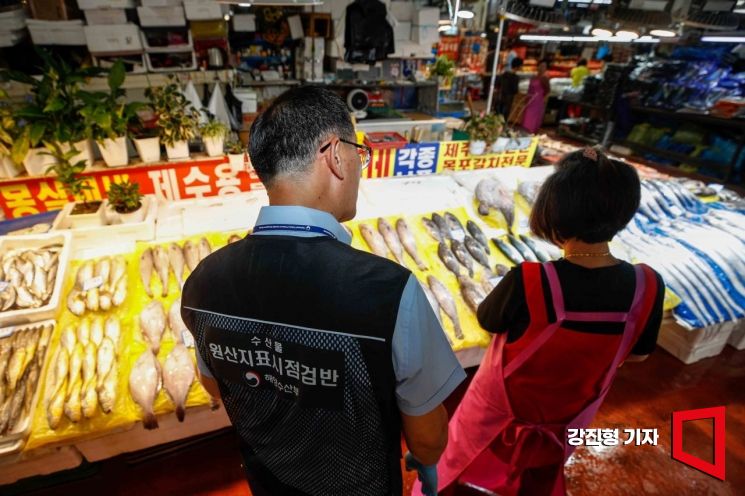 On the 29th, the Ministry of Oceans and Fisheries' seafood origin labeling inspection team visited the Suhyup Gangseo Wholesale Market in Gangseo-gu, Seoul, to check the status of seafood origin labeling. Photo by Jinhyung Kang aymsdream@
© The Asia Business Daily(www.asiae.co.kr). All rights reserved.

















