5 of Top 10 KOSPI Stocks Show Lower Gains Than KOSPI
4 of Top 10 KOSDAQ Stocks Show Lower Gains Than KOSDAQ
"Recent Market Rebound Driven by Eased High Interest Rate Burden"
Two weeks have passed since the complete ban on short selling in the domestic stock market, and it has been found that the stock prices of stocks with a high proportion of short selling have shown no clear direction. Although short selling was blamed as the 'main culprit' for stock price declines among individual investors, the effect of stock price rebound after the ban on short selling was not significant. It is pointed out that this only increased temporary volatility in the domestic stock market and resulted in moving further away from the 'global standard.'
According to the Korea Exchange on the 20th, an analysis of the stock price fluctuations over the past two weeks (November 6-17) for the top 10 stocks with the highest short selling ratio relative to market capitalization in the KOSPI and KOSDAQ markets showed that 9 out of 20 stocks underperformed the KOSPI (4.29%) and KOSDAQ (2.18%) index gains. The short selling ratio was based on November 3, just before the financial authorities suddenly announced the 'complete ban on short selling.'
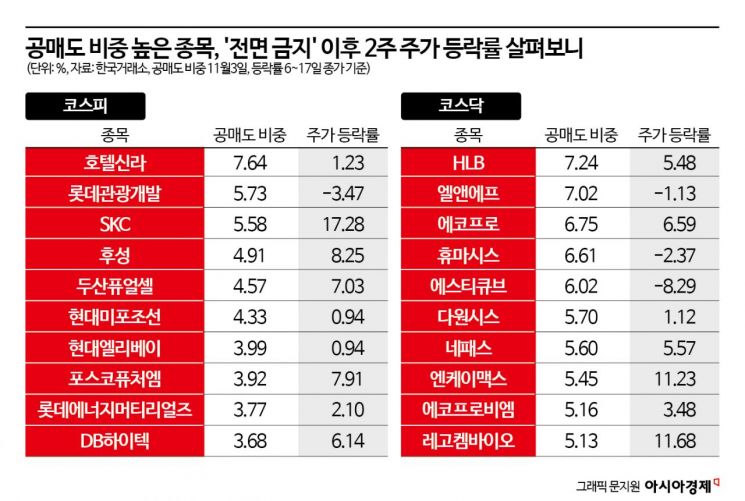
In the KOSPI market, the stock with the highest short selling ratio was Hotel Shilla at 7.64%. However, during the two weeks since the complete ban on short selling, Hotel Shilla's stock price rose only 1.23%, far below the KOSPI's gain. Lotte Tour Development, which had the second highest short selling ratio at 5.73%, saw its stock price fall 3.47% after the policy announcement. Among the top 10 stocks with the highest short selling ratios in the KOSPI market, 5 stocks underperformed the KOSPI returns. SKC was the only stock to show a double-digit increase, rising 17.28%.
Among the 10 stocks with high short selling ratios in the KOSDAQ market, 4 underperformed the KOSDAQ index. L&F, with a short selling ratio of 7.02%, saw its stock price drop 1.13% after the short selling ban. STCube, with a short selling ratio of 6.02%, fell 8.29% over the past two weeks. EcoPro and EcoPro BM, representative secondary battery stocks favored by individual investors, rose 6.59% and 3.48%, respectively, after the short selling ban.
Looking at the trading performance by investor type over the past two weeks since the short selling ban, individual investors, who were expected to improve supply and demand, actually sold nearly 3 trillion won worth of stocks. In particular, they net sold 1.93 trillion won worth of Samsung Electronics shares. During the same period, foreign investors net bought 2.771 trillion won, and institutions also purchased 632 billion won worth of stocks.
Daeseok Kang, a researcher at Yuanta Securities, said, "The short selling ban only caused unnecessary volatility," adding, "Considering that Tesla has shown a monthly return of over 11% in the secondary battery sector, which is the hottest sector among market participants this month, it is difficult to say that the short selling ban and the resulting short covering had a significant impact." He continued, "Ultimately, the short selling ban is likely to be just 'noise,' and the essence of the recent market rebound is the easing of high interest rate burdens, so there is no need to cling to the short selling ban."
Since short selling is introduced and operated in many advanced countries including the United States, there have been continuous criticisms that the financial authorities' recent measures have moved away from the global standard. Jihyun Kim, a researcher at Kiwoom Securities, said, "From a long-term perspective, there are concerns that the short selling ban limits foreign investors' access and makes inclusion in the Morgan Stanley Capital International (MSCI) developed market index uncertain," adding, "This measure has increased the uncertainty of being listed on the watchlist in June next year."
© The Asia Business Daily(www.asiae.co.kr). All rights reserved.


















