Im Seong-ho, CEO of Jongno Academy, YTN Radio Interview
"Even if anxious about Suneung, must attend interview and essay test first"
As the 2024 College Scholastic Ability Test (CSAT) was conducted, Lim Seong-ho, CEO of Jongro Academy, analyzed that the number of repeat test-takers and working adults taking this year's CSAT has significantly increased, and their academic levels could become a variable in the admissions process.
Lim appeared on YTN Radio's 'Issue & People' on the 17th and said, "Currently, repeat test-takers make up about 35% of the total, which is the largest scale ever," adding, "Also, there are about 90,000 students retaking the test after a gap year this year. Compared to about 81,000 last year, this is an increase of nearly 10,000."
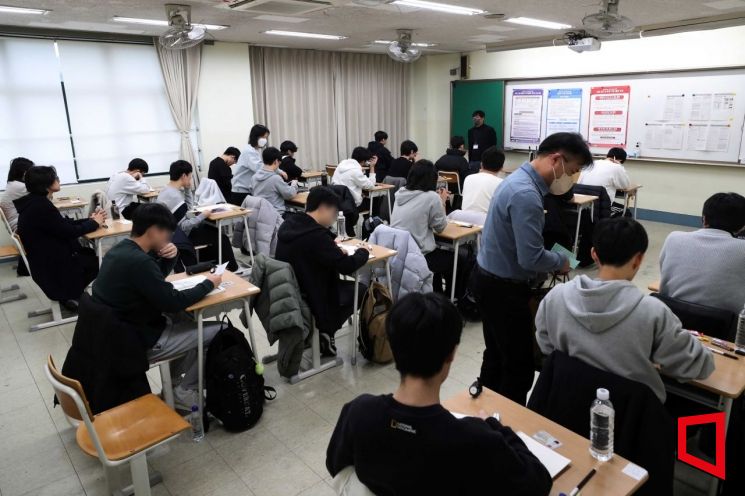 On the 16th, when the 2024 College Scholastic Ability Test was held, examinees were preparing for the exam at Yongsan High School in Seoul. Photo by Joint Press Corps
He continued, "During the June evaluation mock exam, many of the students retaking after a gap year did not take the test," and noted, "The academic level of those students could also be a significant variable."
Regarding the sharp increase in so-called N-suseng (repeat test-takers) and working adults taking the CSAT, he explained, "Overall, employment is difficult, and there is a trend of concentration toward medical schools. Also, rather than continuing as is, there is a widespread atmosphere among young students to transfer universities or move to higher-ranking departments or professional fields. Even professionals who have worked in specialized jobs are showing a tendency to take the CSAT again to enter medical schools or other professional departments."
He said, "In the past, major academies had about 20% of students retaking the test three times, but now, in major academies, depending on the situation, more than 50% to 60% of students are those retaking the test three times or more," adding, "This is a situation that has never been experienced before."
Regarding the difficulty level of this year's CSAT, he said, "High-difficulty killer questions were removed, and instead, the test was designed to be discriminative rather than an easy test, which seems to have been accurately planned," but added, "There was certainly an expectation that the test would be somewhat easier without difficult questions, but the reality was completely different from that expectation."
Lim said, "Especially in the first session, students usually start by solving easier questions and then approach harder ones, but this time, the test was difficult from the start," and added, "Due to the initial pace, there were phenomena where students' mental states collapsed."
Furthermore, Lim said, "Although admission institutions predict that some students will fail to meet the minimum CSAT grade requirements, those predictions could be significantly off," and explained, "One of the most important variables causing this discrepancy is the 90,000 students who did not take the June evaluation mock exam. No one currently knows their academic levels."
He advised, "Even if students fail to meet the minimum CSAT standards in interviews or essays, it is necessary to at least have the basic attitude to participate," and added, "It is worth considering that gaining practical experience in the exam room could be helpful."
© The Asia Business Daily(www.asiae.co.kr). All rights reserved.

















