Decline in Public Exports Leads to 5.6 Trillion Deficit
Economic Uncertainty Grows Amid Yen Weakness
BOJ May Delay Normalizing Monetary Policy
Japan's trade balance turned to a deficit for the first time in two months due to decreased demand from the US and China amid a global economic slowdown. Concerns are rising that uncertainty in the Japanese economy is increasing as the trade deficit appears amid a situation where the burden on private consumption has grown due to the depreciation of the yen.
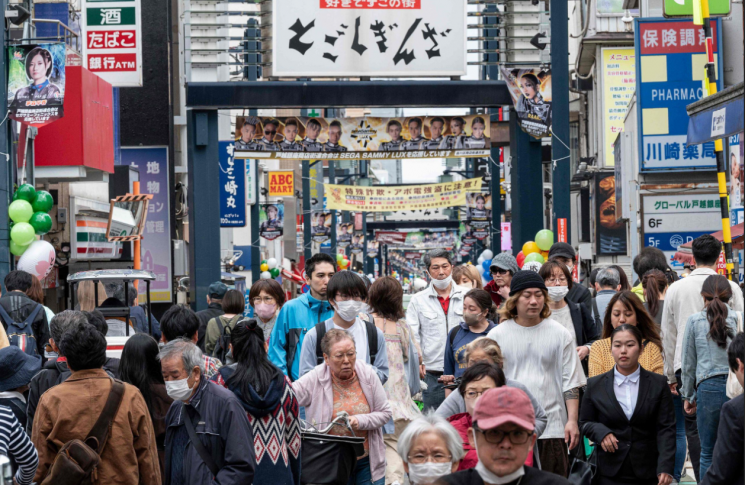
According to trade statistics released by the Ministry of Finance on the 16th, last month's export value was 9.1471 trillion yen (approximately 78.9 trillion won), a 1.6% increase compared to the same month last year. This is the largest scale ever recorded for October. However, the trade balance, calculated by subtracting imports from exports, recorded a deficit of 662.5 billion yen (5.691 trillion won). Previously, Japan had recorded deficits in July and August but turned to a surplus of 72.1 billion yen in September.
The trade deficit was caused by a decrease in exports to China due to the Chinese economic slowdown and US export sanctions against China. Last month's exports to China amounted to 2.3255 trillion yen, down 2.9% from the same month last year. In particular, the decline in imports of electronic components such as computers and semiconductors was notable.
The sharp rise in international energy prices also contributed to the trade deficit. Last month, with international oil prices exceeding $90 per barrel and the yen's value falling to the 149 yen range per dollar, energy import costs increased significantly. Although the cost burden was not greater than last year when oil prices exceeded $100 due to the Russia-Ukraine war, it recorded the second-highest import amount for October since 1979.
Following a -0.5% GDP growth rate in the third quarter, indicating economic contraction, and the trade balance turning to a deficit, concerns about uncertainty in the Japanese economy are emerging. Bloomberg explained, "With domestic consumption shrinking due to low wages and rising prices, and exports also slowing down, uncertainty in the Japanese economy has increased."
There are also forecasts that Japan may fall into a "vicious cycle of yen depreciation." Yen depreciation increases the cost of importing international raw materials, expanding the trade deficit, and the growing deficit further encourages selling of the yen, causing additional depreciation?a vicious cycle that may continue. Last year, the surge in international raw material prices combined with an unprecedented yen depreciation led to a record-high trade deficit of 19.9713 trillion yen. Shunhei Goto, a researcher at the Japan Research Institute, a Japanese think tank, pointed out, "Yen depreciation worsens trade conditions, resulting in capital outflows from companies overseas," adding, "This hinders companies' wage increases."
In the fourth quarter of this year, the yen-dollar exchange rate surpassed the 150 yen level, raising concerns about further weakening of private consumption. In the third quarter, the yen's value against the dollar started in the low 140 yen range and fell to the high 140 yen range around September. Amid this situation, with inflation exceeding the Bank of Japan's (BOJ) target rate of 2% and maintaining a growth rate in the 3% range, private consumption decreased by 0.04% compared to the previous quarter. Researcher Goto explained, "If yen depreciation continues, it will be difficult for the virtuous cycle of companies raising wages to increase private consumption to continue."
Some expect that the BOJ may delay ending its large-scale monetary easing due to the economic slowdown. Bloomberg stated, "Personal consumption, which accounts for more than 50% of GDP, shows no signs of increasing, making the path to economic recovery heavy," adding, "Moreover, with a global economic recession expected to worsen export conditions, the timing for the BOJ to normalize monetary policy may be delayed."
© The Asia Business Daily(www.asiae.co.kr). All rights reserved.
![Clutching a Stolen Dior Bag, Saying "I Hate Being Poor but Real"... The Grotesque Con of a "Human Knockoff" [Slate]](https://cwcontent.asiae.co.kr/asiaresize/183/2026021902243444107_1771435474.jpg)
















