Up to $155 Billion New Investment in Clean Energy and Carbon Neutral Technologies
Improving Trade and Investment Environment through Anti-Corruption and Tax Transparency
Trade Agreement Negotiations to Continue Next Year
At the Indo-Pacific Economic Framework (IPEF) ministerial meeting held in San Francisco, USA, agreements on the Clean Economy (Pillar 3) and Fair Economy (Pillar 4) were reached.
The Ministry of Trade, Industry and Energy announced on the 16th that 14 IPEF participating countries, including the United States, Japan, Australia, Thailand, and India, attended the ministerial meeting on the 13th and 14th (local time), signed the supply chain (Pillar 2) agreement already concluded in May, and finalized the Pillar 3 and 4 agreements.
IPEF is a cooperative body launched through a summit meeting last May to jointly respond to new global challenges emerging after the pandemic, such as supply chains and climate change. In September last year, it was agreed to pursue negotiations in four major areas: trade, supply chains, clean economy, and fair economy. Since December last year, the Korean government has conducted intensive negotiations through seven official negotiation rounds, several ministerial meetings, and intersessional meetings in coordination with related ministries including the Ministry of Trade, Industry and Energy, Ministry of Foreign Affairs, and Ministry of Economy and Finance.
An official from the Ministry of Trade, Industry and Energy explained, "With the conclusion of the three agreements on supply chains, clean economy, and fair economy at this IPEF ministerial meeting, a massive economic bloc accounting for 40% of the world's gross domestic product (GDP) and 28% of goods and services trade has been completed," adding, "The participating countries share the recognition that a joint response and cooperation system within the Indo-Pacific region is urgently needed to achieve the goals of enhancing supply chain resilience and stability, early transition to a clean economy, and building a fair economy."
First, the supply chain agreement was concluded earliest in May and signed at this ministerial meeting. This agreement includes cooperation measures such as activating the 'Crisis Response Network,' a high-level intergovernmental consultative body within 15 days upon request from a country experiencing a supply chain crisis in the region, to prepare alternative supply sources and procurement plans; identifying supply chain bottlenecks; discovering opportunities for technological cooperation and joint investment; matching interested companies; and improving logistics infrastructure to diversify supply chains. The Ministry of Trade, Industry and Energy expects this will enable a more rapid response to supply chain disruption crises. Additionally, cooperation between resource-rich countries like Australia and Indonesia and technologically advanced countries such as the United States and Japan within IPEF is expected to enhance the resilience and stability of regional supply chains.
The newly concluded Clean Economy agreement will serve as an institutional foundation to strengthen cooperation among participating countries in the transition to a clean economy, including energy transition, emission reductions in industry and transportation sectors, and carbon markets. In particular, it covers cooperation on technologies, norms, and standards across all stages of energy?from production involving all clean energy sources such as nuclear power, hydrogen, and clean energy?to carbon reduction technologies and carbon trading markets. Furthermore, it will expand cooperation in research and development related to clean economy technologies, policy exchanges, pilot projects, and certification. For key areas such as clean energy storage, renewable energy, and carbon removal, the agreement promises efforts to generate approximately $155 billion in new regional investments by 2030, including private investments. The Ministry of Trade, Industry and Energy expects the Clean Economy agreement to become a central axis in establishing global norms and standards related to the clean economy and to act as a catalyst for deriving practical business opportunities and promoting investments in the clean energy sector.
The Fair Economy agreement includes provisions to strengthen protection for whistleblowers reporting corruption, revise disciplinary procedures for corrupt public officials, and establish punishment regulations for illegal acts in government procurement processes. Additionally, it aims to enhance transparency and efficiency in tax administration through active exchange of tax information among tax authorities and utilization of tax initiatives by international organizations such as the Organisation for Economic Co-operation and Development (OECD). Through this, the overall integrity of IPEF countries is expected to improve, creating a more favorable business environment for Korean companies and reducing uncertainties such as concerns over double taxation when entering overseas markets.
The participating countries confirmed progress in negotiations on the Trade (Pillar 1) agreement and agreed to continue negotiations next year. Based on the concrete cooperation framework established by the signed supply chain agreement and the concluded Clean and Fair Economy agreements, IPEF countries plan to respond quickly and flexibly to newly emerging global issues. To this end, they plan to establish and operate an 'IPEF Ministerial Consultative Body' overseeing the entire IPEF.
An official from the Ministry of Trade, Industry and Energy stated, "Our government will actively participate to ensure that our interests are reflected in the ongoing IPEF trade agreement negotiations next year," and added, "We plan to continue cooperating with other IPEF countries to ensure the rapid enactment and effective implementation of the supply chain, clean economy, and fair economy agreements."
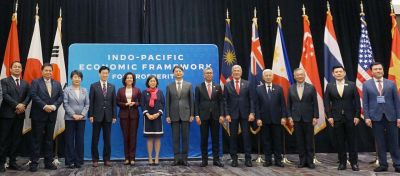 Anduk Geun, Director General for Trade Negotiations at the Ministry of Trade, Industry and Energy (center), attended the "Indo-Pacific Economic Framework (IPEF) Pillar 2 Supply Chain Agreement Signing Ceremony" held on the 14th (local time) at the San Francisco Marriott Marquis Hotel in the United States, signing the Pillar 2 Supply Chain Agreement that was already concluded in May this year and taking a commemorative photo.
© The Asia Business Daily(www.asiae.co.kr). All rights reserved.

















