ETF Net Buying Sectors Diverge by Buyer Type
Foreigners and Institutions Bet on Index Rise, Individuals on Index Fall
Each type of buyer showed different preferences when shopping for exchange-traded funds (ETFs). Foreign investors focused on semiconductors, institutions mainly net bought ETFs related to robots, bio, and entertainment, while individual investors still concentrated on secondary batteries.
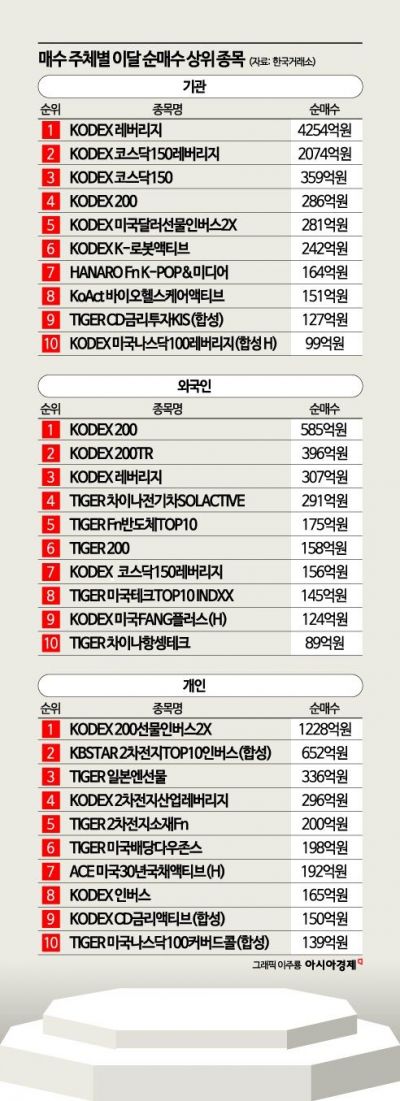
According to the Korea Exchange on the 17th, among the top net bought ETFs by foreigners this month, many were technology stocks such as semiconductors and big tech. Foreigners heavily purchased thematic ETFs investing in specific industries, including TIGER China Electric Vehicle SOLACTIVE, TIGER Fn Semiconductor TOP10, TIGER US Tech TOP10 INDXX, KODEX US FANG Plus (H), and TIGER China Hang Seng Tech.
Institutions ranked thematic ETFs such as KODEX K-Robot Active, HANARO Fn K-POP & Media, and KoAct Bio Healthcare Active among their top net buys. These ETFs invest in the robot, entertainment, and bio sectors, which attracted attention aside from the semiconductor and secondary battery sectors that led the market this year.
Individual investors still appeared to focus on secondary batteries. They heavily purchased KBSTAR Secondary Battery TOP10 Inverse (Synthetic), KODEX Secondary Battery Industry Leverage, and TIGER Secondary Battery Materials Fn. Since August, the volatility of secondary battery stocks increased, especially after the recent short-selling ban, volatility expanded further. Notably, individuals simultaneously bought inverse ETFs betting on declines and leveraged ETFs betting on rises.
In index ETFs, foreigners and institutions bet on index rises, while individuals bet on declines. Foreigners bought KODEX 200 the most, followed by KODEX 200TR, KODEX Leverage, and KODEX KOSDAQ150 Leverage. Institutions net bought KODEX Leverage the most, followed by KODEX KOSDAQ150 Leverage, KODEX KOSDAQ150, and KODEX 200.
Individuals most heavily purchased KODEX 200 Futures Inverse 2X, betting on stock price declines. This ETF, known as "Gopbus," inversely tracks twice the daily return of the KOSPI 200 futures index. Along with this, KODEX Inverse was also net bought. This contrasting stock price outlook is reflected in trading. From the beginning of this month to the 16th, individuals net sold 4.4117 trillion KRW in the KOSPI market and sold 548 billion KRW in the KOSDAQ market. In contrast, foreigners and institutions bought 2.3585 trillion KRW and 2.4856 trillion KRW respectively in the KOSPI market.
Additionally, individuals purchased many bond-type ETFs amid prolonged high interest rates and, reflecting the yen depreciation trend, TIGER Japan Yen Futures also ranked among the top net bought ETFs.
The average return of the top net bought ETFs was highest for foreigners at 1.92%, followed by institutions at 0.88%, and individuals at -1.28%. The overall return for individuals declined as secondary battery ETFs recorded relatively large drops.
© The Asia Business Daily(www.asiae.co.kr). All rights reserved.

















