On the 16th, Ruling Party Walks Out at the Full Sanjawi Meeting
Ruling Party: "Hope for Cooperative Governance"
The Democratic Party of Korea, holding a large majority, is causing disruptions as it consecutively passes next year's budget bills unilaterally in each standing committee of the National Assembly.
On the 16th, the National Assembly's Industry, Trade, Energy, Small and Medium Enterprises Committee held a plenary session and approved the budget bill to forward it to the Special Committee on Budget and Accounts, but the processing of the budget bill failed as opposition party members demanded an extension of the schedule. The ruling and opposition parties agreed to continue discussions on the 20th.
If the budget bill does not pass from the standing committee to the Budget and Accounts Committee within the deadline, the government’s original proposal is usually discussed in the Budget and Accounts Committee. However, the opposition party insists on extending the schedule to continue negotiations.
In response, the ruling party protested and walked out, accusing the opposition of using such a loophole because they could not pass the bill unilaterally due to a lack of quorum. Kim Seong-won, a member of the People Power Party (secretary), criticized, "Currently, there is no compromise in budget review between the two parties, so postponing it only means that the quorum for unilateral approval is lacking and it is just a stalling tactic." He also stated that if Lee Jae-jung, chair of the Industry Committee, publicly promises not to unilaterally pass the budget in the future, they could agree to change the schedule.
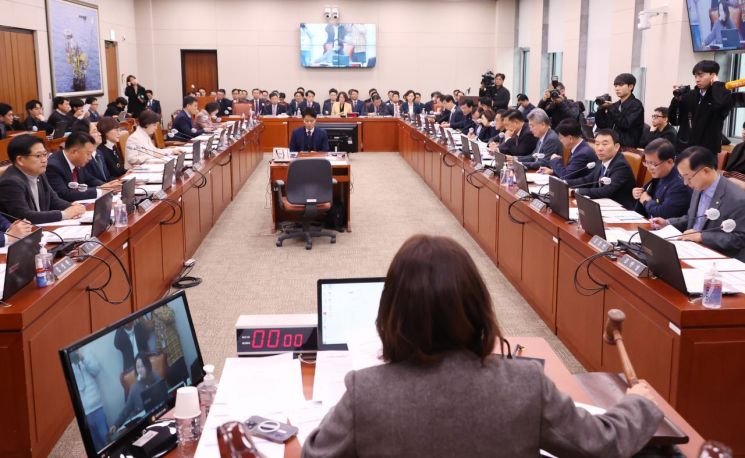
Earlier, in the Industry Committee’s budget subcommittee the previous day, the ruling and opposition parties failed to narrow their differences over budgets related to renewable energy and nuclear power. Although the opposition had more members than the ruling party, allowing unilateral approval, the ruling party claimed that the absence of one member, Kim Han-jung of the Democratic Party, who was on a business trip, resulted in a lack of quorum and prevented forced approval.
The Democratic Party did not relent on the need for additional consultations based on the budget review authority granted to the National Assembly. Chair Lee said, "Just because each position is running parallel and we cannot reach a decision, submitting the government’s original proposal as is means the National Assembly is hiding its own existence," emphasizing, "I think that (submitting the government’s proposal) is something that cannot be allowed from a principled and parliamentary perspective."
Since the start of this year’s budget review, the Democratic Party has unilaterally approved budget bills in several standing committees. On the 9th, the Administrative Safety Committee unilaterally approved about 700 billion won for local love gift certificates, which were not included in the government’s budget proposal. The day before, the Land, Infrastructure and Transport Committee unilaterally increased the budget by 147.1 billion won related to the Saemangeum project. Two days earlier, on the 14th, the Science, Technology, Information and Broadcasting Committee’s budget subcommittee unilaterally cut about 1.16 trillion won from the government’s 'global' project budget and increased about 2 trillion won for R&D-related personnel support.
The People Power Party expressed concern over the Democratic Party’s budget processing. Park Jeong-ha, chief spokesperson, said in a statement, "The reckless use of the majority seat count without proper consultation between the ruling and opposition parties continues unabated even in the budget National Assembly," adding, "The reckless exercise of absolute power in impeachment, legislation, state audits, and budget continues endlessly. At least for the budget bill, we urge to show cooperation and coexistence."
Meanwhile, although the Democratic Party can use its majority to unilaterally pass the budget in standing committees and the Budget and Accounts Committee, it is unlikely to lead to actual budget allocation. Article 57 of the Constitution states, "The National Assembly shall not increase the amount of any item of expenditure budget submitted by the government or establish new budget items without the government's consent." Therefore, if the government does not agree to the National Assembly’s increased budget demands, the final decision is bound to fail.
© The Asia Business Daily(www.asiae.co.kr). All rights reserved.
![Clutching a Stolen Dior Bag, Saying "I Hate Being Poor but Real"... The Grotesque Con of a "Human Knockoff" [Slate]](https://cwcontent.asiae.co.kr/asiaresize/183/2026021902243444107_1771435474.jpg)
















