Seoul Asan Hospital Professors Song Woo-jung and Lee Ji-hyang Research
Comparison of Second-Generation Antihistamines and Placebo
"No Difference in Improvement Degree"
A study has revealed that second-generation antihistamines, which are used to treat rhinitis, are ineffective for cough treatment. Second-generation antihistamines are commonly used when cough persists alongside allergic rhinitis.

Seoul Asan Medical Center announced on the 16th that a research team led by Professors Song Woo-jung and Lee Ji-hyang from the Department of Allergy analyzed the effects of treatment after dividing 49 patients with chronic cough accompanied by allergic rhinitis into two groups: one taking second-generation antihistamines and the other taking a placebo for two weeks. Both groups showed alleviation of cough symptoms, but there was no significant difference in the degree of improvement.
In clinical practice, antihistamines and other rhinitis treatments have been used for chronic cough accompanied by allergic rhinitis. However, the exact mechanism by which allergic rhinitis causes chronic cough has not been clearly identified. It is commonly believed that allergic rhinitis can cause chronic cough, and empirically, many cases have shown improvement in both rhinitis and cough symptoms.
Among rhinitis treatments, second-generation antihistamines, which eliminate the central nervous system side effects of traditional antihistamines, are representative drugs for treating allergic rhinitis. Due to their relatively fewer side effects and excellent tolerability, they have been frequently prescribed to patients with chronic cough accompanied by allergic rhinitis.
However, according to the hospital, there had been disagreements among experts regarding the cough-relieving effects of second-generation antihistamines due to the lack of appropriate placebo-controlled clinical trials. This placebo-controlled clinical trial by the research team is the first to reveal that second-generation antihistamines are ineffective in treating chronic cough accompanied by allergic rhinitis.
The research team randomly assigned 49 patients who visited the hospital with cough lasting more than three weeks due to allergic rhinitis from October 2021 to September 2022. Twenty-five patients took antihistamines for two weeks, and 24 patients took a placebo.
Using the Leicester Cough Questionnaire (LCQ), which assesses cough-related quality of life through patient responses before and after treatment, the antihistamine group’s average score increased from 12.49 to 15.94 after two weeks, a rise of 3.45 points. The placebo group’s average score rose from 12.77 to 15.81, an increase of 3.04 points. Both groups reported similar improvements in cough-related quality of life. The proportion of patients whose LCQ scores increased by more than 5 points was 36% in the antihistamine group and 32% in the placebo group.
Additionally, the severity of cough and throat discomfort was measured using a visual analog scale (VAS), where patients mark their symptoms on a 100 mm horizontal line. Both groups showed improvement, but there was no statistically significant difference in the degree of improvement. The antihistamine group’s average VAS score for cough severity decreased by 31 points, while the placebo group’s decreased by 25 points. For throat discomfort, the antihistamine group’s average VAS score decreased by 28 points, and the placebo group’s decreased by 27 points.
Professor Song Woo-jung, corresponding author of the study and an allergy specialist at Seoul Asan Medical Center, said, "Allergic rhinitis is a common issue in patients with chronic cough, and second-generation antihistamines have been widely prescribed worldwide due to their minimal side effects. While second-generation antihistamines remain the standard treatment for allergic rhinitis, this study has revealed that they do not help control chronic cough."
Professor Song added, "We hope these findings will reduce unnecessary medication use in chronic cough patients and be reflected in future revisions of cough treatment guidelines."
Meanwhile, the study was recently published in the online journal of the European Respiratory Society, ERJ Open Research (IF=4.6). The research was supported by funding from the Asan Institute for Life Sciences at Seoul Asan Medical Center.
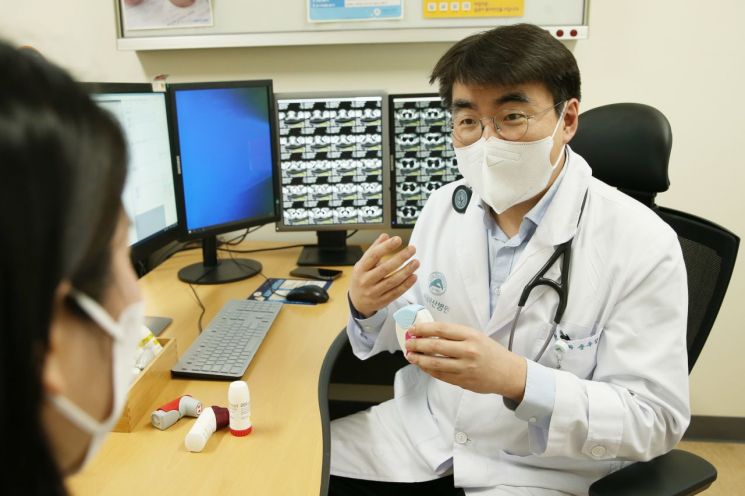 Professor Song Woo-jung of the Allergy Department at Seoul Asan Medical Center is examining a patient.
 [Photo by Seoul Asan Medical Center]
© The Asia Business Daily(www.asiae.co.kr). All rights reserved.
![Clutching a Stolen Dior Bag, Saying "I Hate Being Poor but Real"... The Grotesque Con of a "Human Knockoff" [Slate]](https://cwcontent.asiae.co.kr/asiaresize/183/2026021902243444107_1771435474.jpg)

















