Recently, domestic medical staff successfully treated an angina patient with a cardiac stent procedure using a robot for the first time in Korea.
Seoul Asan Medical Center announced that the cardiology team led by Professors Lee Seung-hwan and Kim Tae-oh safely treated Mr. Ji (50, male), who was suffering from angina, with robot-assisted percutaneous coronary intervention (PCI). Mr. Ji was discharged in good health just one day after the procedure without any complications. This procedure is significant as it utilized the first domestically developed coronary intervention robot, marking a milestone in a market previously dependent on foreign-made robots from the United States, Germany, France, and others.
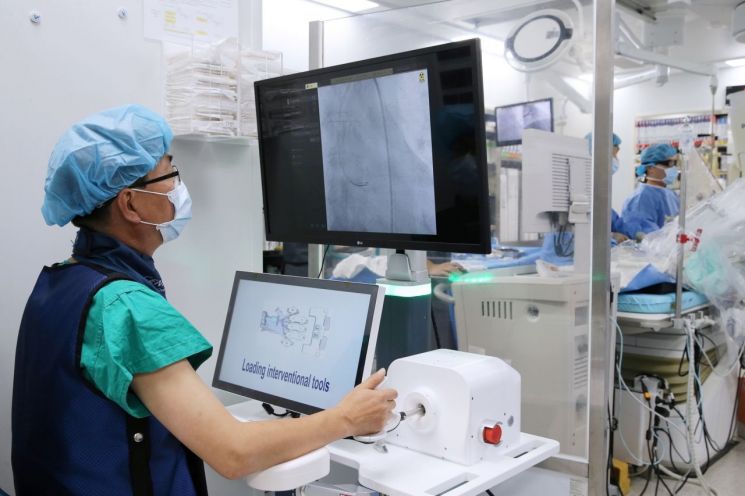 Professor Lee Seunghwan (left) and Professor Kim Taeo (right) from the Department of Cardiology at Seoul Asan Medical Center are performing the first coronary artery intervention in Korea using a domestically produced robot. (Photo by Seoul Asan Medical Center)
The coronary intervention assistive robot 'AVIAR,' developed by the Medical Engineering Research Institute at Seoul Asan Medical Center and the cardiology team led by Professors Choi Jae-soon and Kim Young-hak, received approval from the Ministry of Food and Drug Safety in February. Currently, it is being used in actual procedures for clinical validation studies at Seoul Asan Medical Center and Eunpyeong St. Mary's Hospital. Expansion into overseas markets such as the United States and Europe is also underway.
Percutaneous coronary intervention is a procedure in which a thin catheter is inserted through the femoral artery in the patient's groin or the blood vessels in the wrist and guided to the coronary arteries of the heart. A balloon is then advanced to the narrowed coronary artery to widen the vessel, and a stent is deployed. This procedure is performed on patients with angina or myocardial infarction caused by atherosclerosis or thrombosis that narrows or blocks the coronary arteries.
The procedure involves inserting hair-thin equipment into microvessels, and since the lesions in the coronary arteries vary and are complex for each patient, the skill of experienced medical staff is crucial. Additionally, because the procedure is performed on blood vessels inside the body that cannot be seen with the naked eye, the position of the stent is confirmed through X-ray fluoroscopy during the procedure. Medical staff treating multiple patients face a high risk of continuous radiation exposure due to repeated X-ray imaging.
The coronary intervention assistive robot consists of a handle, which corresponds to the doctor's hand, and a computer. The robot is controlled by a joystick-like handle to guide a guidewire to the target lesion within the patient's coronary artery, followed by the insertion of a balloon and stent for vessel dilation. The handle moves precisely by 1mm increments with each movement. Additionally, the handle is equipped with haptic feedback, allowing the operator to feel the subtle sensations experienced during the procedure as if using their own hand.
The computer component of the coronary intervention assistive robot displays various data necessary for the procedure based on artificial intelligence, helping medical staff accurately assess the procedural situation. It analyzes the curvature of the patient's blood vessels during the procedure and indicates any abnormal signs.
Previously, the procedure relied heavily on the expertise of skilled medical staff, but using the coronary intervention assistive robot allows for fine adjustments via the robot, enabling more precise and delicate surgery.
Moreover, by using the coronary intervention assistive robot, medical staff can perform the procedure from a location separate from the X-ray machine, reducing radiation exposure for both medical staff and patients due to shorter procedure times.
Professor Lee Seung-hwan of the Cardiology Department at Seoul Asan Medical Center said, “Through robot-assisted fine adjustments, we accurately inserted the stent into the patient's lesion without error, and the patient was discharged in good health without complications. Using the coronary intervention assistive robot allows for more precise procedures, so we expect that even high-risk patients with complex or difficult coronary lesions can be treated more safely.”
Meanwhile, the coronary intervention assistive robot 'AVIAR,' developed based on Seoul Asan Medical Center's medical robot technology capabilities and expertise, is being commercialized through L& Robotics. The coronary intervention assistive robot successfully passed clinical trials up to the exploration phase with an initial prototype in October 2019. After three years of functional improvements and refinements, it obtained product approval from the Ministry of Food and Drug Safety last February.
© The Asia Business Daily(www.asiae.co.kr). All rights reserved.
![Clutching a Stolen Dior Bag, Saying "I Hate Being Poor but Real"... The Grotesque Con of a "Human Knockoff" [Slate]](https://cwcontent.asiae.co.kr/asiaresize/183/2026021902243444107_1771435474.jpg)
















