There is an analysis that the large-scale cabinet reshuffle and tax cut policies promoted by Japanese Prime Minister Fumio Kishida have backfired, causing the cabinet's approval rating to plummet to the brink of resignation.
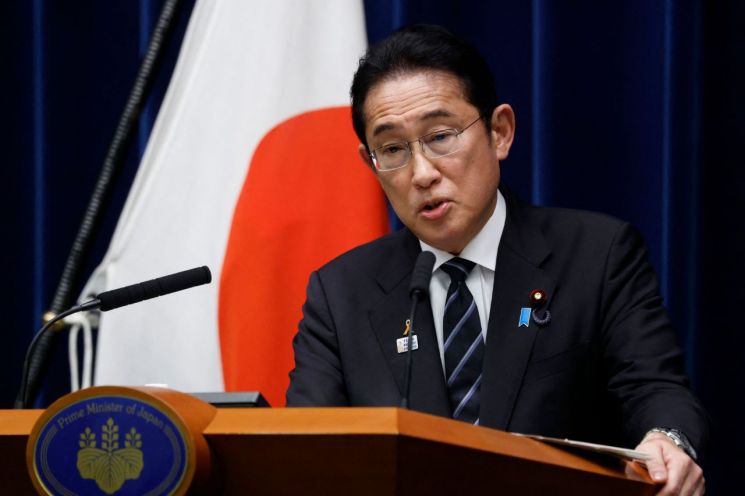
On the 14th, the Mainichi Shimbun reported that within the ruling Liberal Democratic Party (LDP), there is a growing view that, as it becomes difficult for Prime Minister Kishida to maintain his administration, he should aim to rally the conservative base and boost approval ratings through constitutional revision efforts.
Prime Minister Kishida carried out a major cabinet reshuffle in September, replacing many ministers and vice-ministerial officials, but since the end of last month, three vice-ministerial officials, including deputy ministers and political affairs secretaries, have been embroiled in scandalous allegations and resigned. Additionally, the policy to cut taxes by 40,000 yen (approximately 350 USD) per person starting next June has been negatively evaluated due to unclear reasons for implementation and its contradiction with the future plan to raise taxes to fund defense spending.
Mainichi reported that while Prime Minister Kishida has failed to show results in economic policy, the constitutional revision is the task that the LDP is focusing on. Since the LDP was founded in 1955, constitutional revision has been set as the party’s mission, and advancing discussions on this issue could strengthen the party’s cohesion and garner support from the conservative base.
Recently, the LDP has been pushing constitutional revision focusing on four key points: explicitly stating the Self-Defense Forces in the constitution, emergency response measures, resolving the electoral district issues of the House of Councillors (upper house), and enhancing education. However, some opposition parties oppose this, and since a national referendum is also required, significant challenges are expected before realization. Furthermore, Mainichi analyzed that since Prime Minister Kishida repeatedly emphasized "economy" in his policy speech at the extraordinary Diet session on the 23rd of last month, attempting to shift the political situation through constitutional revision may invite criticism from opposition parties.
In the diplomatic field, it is also considered one of the factors for Prime Minister Kishida’s approval rating recovery. Despite facing the resignation of four ministers he appointed since October last year, Kishida managed to boost his approval ratings through the G7 summit held in Hiroshima last May. The Sankei Shimbun reported that attention is focused on what results will come from the summit meeting with Chinese President Xi Jinping, which Kishida is coordinating to hold during the Asia-Pacific Economic Cooperation (APEC) summit in the United States from the 15th to the 17th.
Meanwhile, according to Sankei, with public opinion polls showing the cabinet’s approval rating falling below 30%, there are forecasts within the LDP that Prime Minister Kishida may not run in the party presidential election next September or may resign in the spring of next year when the 2024 fiscal year budget bill is passed.
© The Asia Business Daily(www.asiae.co.kr). All rights reserved.
![Clutching a Stolen Dior Bag, Saying "I Hate Being Poor but Real"... The Grotesque Con of a "Human Knockoff" [Slate]](https://cwcontent.asiae.co.kr/asiaresize/183/2026021902243444107_1771435474.jpg)











