Survey Results on Expert Opinions Regarding Regulatory Innovation Policies
Two out of three domestic experts believe that legislative activities in the National Assembly do not help ease regulations on businesses, according to a survey. More respondents also evaluated the government's regulatory easing efforts negatively.
On the 14th, the Korea Employers Federation (KEF) conducted a survey of 200 professors from four-year domestic universities majoring in economics, business administration, and public administration, and released a report containing these findings. According to the results, 64.5% answered that legislative activities in the National Assembly do not help ease business regulations.
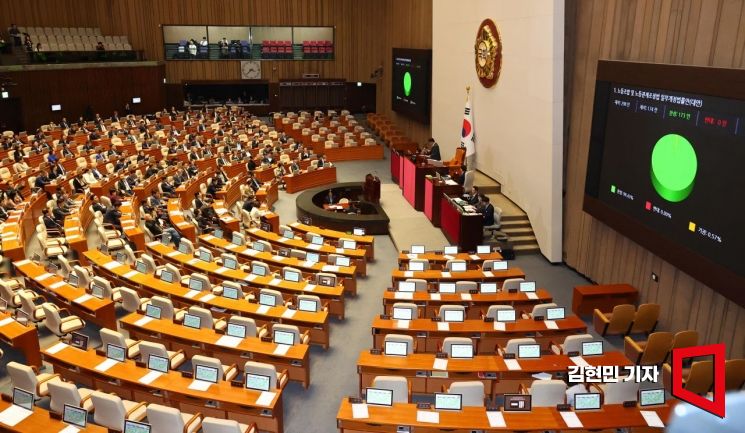 On the 9th, the partial amendment bill of the Labor Union and Labor Relations Adjustment Act was passed at the plenary session held at the National Assembly. Photo by Kim Hyun-min kimhyun81@
Those who said it helps accounted for 18.0%, and about 17.5% responded that they were unsure. KEF explained that the reason for judging that it does not help is because various regulatory innovation bills are not passing in the National Assembly and their processing is delayed.
Regarding the government's regulatory innovation policies, 54.5% viewed them negatively, exceeding half. Those with a positive view accounted for 45.5%. The reasons for negative views included a lack of mid- to long-term plans and concrete details, as well as criticisms that the policies are pursued sporadically and lack organic coordination among ministries.
Nearly half of the respondents, 49.5%, believed that the level of regulation on domestic companies is higher compared to competing countries such as the United States, Japan, and China. Those who thought it was similar to competing countries accounted for 38.5%, while only 12.0% thought it was lower.
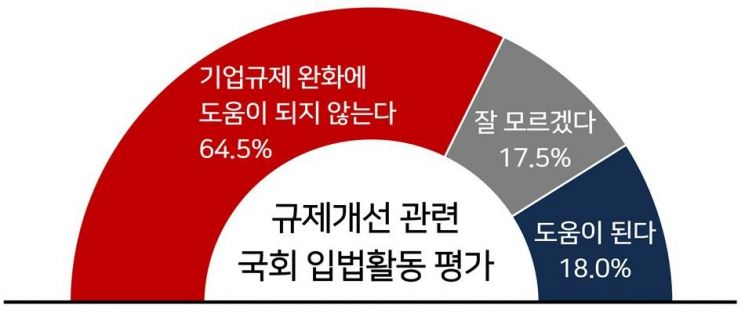 Recent Evaluation of Legislative Activities in the National Assembly [Source: Korea Employers Federation]
The labor and employment sector, including working hours, was most frequently cited as the regulation that is out of step with international standards and needs to be corrected quickly. About half of the respondents chose this sector. Many also pointed to industrial safety regulations such as the Serious Accident Punishment Act, tax regulations such as inheritance tax, and location regulations such as those related to the metropolitan area development.
As for the background of why past governments failed to properly innovate regulations, 42.5% answered that it was due to opposition from vested interest groups, the highest proportion. Those who believed it was because regulatory innovation was misunderstood as corporate favoritism and anti-business sentiment spread accounted for 39.5%, also a significant portion.
To enhance the perception of regulatory innovation by companies, 58.0% believed that regulatory impact analysis reports should also be introduced for lawmakers' bills, exceeding half. KEF had similar results in a similar survey last year. Unlike government bills, lawmakers' bills do not have to consider the impact of regulations in advance, which has been consistently criticized for being imprecise. A revision bill to the National Assembly Act to assess regulatory impacts on lawmakers' bills has been proposed but is still pending.
Kim Jae-hyun, head of KEF's Regulatory Reform Team, said, "Nearly half of the experts pointed out that the level of corporate regulation in Korea is higher than in competing countries, lowering investment advantages," adding, "To escape the trap of low growth in the 1% range, various regulations must be boldly reformed to support companies to invest easily and quickly."
© The Asia Business Daily(www.asiae.co.kr). All rights reserved.
![Clutching a Stolen Dior Bag, Saying "I Hate Being Poor but Real"... The Grotesque Con of a "Human Knockoff" [Slate]](https://cwcontent.asiae.co.kr/asiaresize/183/2026021902243444107_1771435474.jpg)












