SK Telecom announced on the 14th that it has successfully verified the ‘immersion cooling’ technology, a next-generation thermal management method that cools various servers by immersing them in a special dielectric cooling fluid that does not conduct electricity.
With the surge in generative artificial intelligence (AI) competition, the construction of high-power GPU servers has rapidly increased, highlighting the critical issue of cooling GPU servers, which consume tens of times more power than general servers (x86). Currently, nearly 40% of the electricity used in data centers is consumed solely for cooling GPU servers.
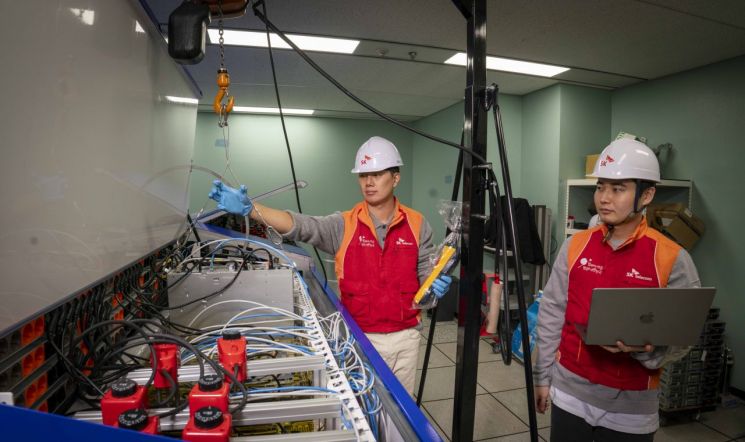
SKT established an immersion cooling system at its Incheon headquarters using equipment from the U.S.-based immersion cooling specialist GRC, test servers from various manufacturers, and SK Enmove’s special cooling fluid (Thermal Fluids, ZIC-GC2), conducting tests over four months starting in June. As a result, it confirmed a 93% reduction in cooling power and over 10% reduction in server power compared to conventional air cooling, achieving a total power saving of 37%.
The immersion cooling system verified by SKT differs from traditional air-cooling systems that circulate cold air or use fans by directly immersing servers in a special cooling fluid that does not conduct electricity but has high thermal conductivity. This fluid, which has much higher thermal conductivity than air, directly absorbs heat from the server equipment, and by eliminating the server fans required for air cooling, it not only cools but also reduces server power consumption. It is also free from humidity, dust, and noise?major causes of server failure?thus extending server lifespan. Moreover, it can stably maintain the temperature of the entire system, including heat-generating components inside the server such as CPUs, GPUs, memory, and storage devices, reducing equipment failures caused by high temperatures.
Performance tests conducted on servers using both air cooling and immersion cooling methods showed no difference in performance. Compared to the same performance test results, immersion cooling demonstrated reduced server power consumption, confirming an improved power efficiency ratio (performance per watt).
In August last year, SKT visited a reference site in the U.S. that has been successfully operating GRC’s immersion cooling system for over 10 years to verify the system’s performance and sustainability. In April this year, SKT installed immersion cooling test facilities and performance and efficiency analysis systems at its Incheon headquarters, and from June, it verified the performance, stability, operational monitoring methods, and cost efficiency of the immersion cooling system, confirming satisfactory results.
SKT plans to build a dedicated data center for its AI services at its Incheon headquarters in November, with full-scale application of the immersion cooling system scheduled for next year at the same location.
Although immersion cooling has been proposed for a long time, it has not been widely used. Since 2020, it has been partially used in overseas data centers for AI and cryptocurrency mining purposes. However, as the heat generation of GPU server systems continues to increase, leading to rapid growth in data center energy consumption, major tech companies such as Google, Microsoft, and Intel are also considering the adoption of immersion cooling. Co-location service providers like the U.S.-based Equinix and Hungary’s Digital Reality have reportedly completed reviews and demonstrations of immersion cooling systems.
Recently, CPU designs have shifted to connecting multiple chiplets to form a large chip, increasing power consumption. Intel, facing challenges in managing this with air-cooled coolers, is promoting the adoption of immersion cooling systems. In August 2021, Intel announced a collaboration with Spain’s Submer, a leading company in this field, to develop immersion cooling technology, and in January 2022, it partnered with the specialist company GRC to introduce immersion cooling systems for high-performance computing (HPC) for AI.
GRC, the solution provider adopted by SKT, was established in 2009 and is headquartered in Austin, USA, with a research center. It holds over 25 global patents and has secured global clients such as NVIDIA, Intel, Dell, HPE, and SGI, engaging in various technological collaborations. It is regarded as the most suitable immersion cooling system company for domestic companies that emphasize demonstration results.
Additionally, SK Enmove invested $25 million in GRC last year and signed a business agreement with GRC and Dell Technologies to develop technology and establish an after-sales service (AS) market to expand demand for data center immersion cooling systems. SK Enmove also participated in SKT’s immersion cooling demonstration and review, contributing to the successful outcome.
Energy savings in data centers depend largely on how efficiently cooling facilities, which consume the most power after servers, are configured. This is quantified by the Power Usage Effectiveness (PUE), which is the total power consumption of a data center divided by the power consumption of IT equipment; the closer the value is to 1, the more energy-efficient the data center is considered.
The latest data centers using air cooling have a PUE of about 1.5. To lower PUE, various attempts are made, such as drawing in cold external air during winter or building low-power, high-efficiency facilities. However, despite technological advances in air cooling, issues remain regarding installation space and significant energy consumption and costs. To reduce the increasing power usage, improving the efficiency of data center cooling systems is urgently needed.
According to the International Energy Agency (IEA), the estimated global data center power consumption in 2022 was between 240 and 340 TWh, an enormous amount equivalent to 42-60% of South Korea’s annual power consumption.
Through the first domestic establishment and successful verification of an immersion cooling system, SKT plans to combine the proven data center monitoring solution with SK Enmove’s thermal management business to actively pursue the immersion cooling business. It is expected to lead the dissemination of immersion cooling technology and contribute to achieving net-zero through data center power savings.
Cho Dong-hwan, SKT CIO (Vice President), stated, “As we accelerate our transformation into an AI company, the adoption of high-power GPU servers is increasing, and through the introduction of immersion cooling, we expect significant energy cost savings. We will also contribute to achieving carbon neutrality goals by promoting the widespread adoption of this technology in the future.”
© The Asia Business Daily(www.asiae.co.kr). All rights reserved.

















