Reducing Interest Expenses, Securing Liquidity
Korean Air Provides Funding on Condition of Cargo Division Sale
With the success of the Korean Air-Asiana Airlines merger uncertain, Asiana Airlines has issued 300 billion KRW worth of perpetual convertible bonds (perpetual CBs). The Asiana Airlines board approved a corrective action plan that includes the separation and sale of its cargo division, fulfilling Korean Air's promise to provide additional funding to Asiana Airlines through the acquisition of the perpetual CBs.
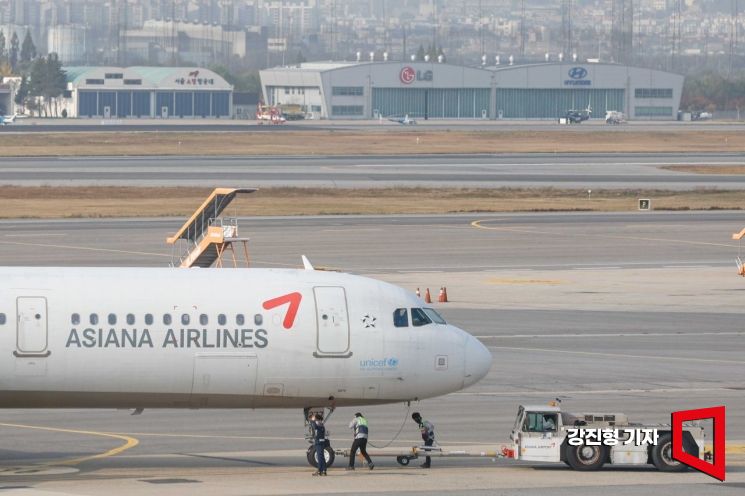
According to the investment banking (IB) industry on the 14th, Asiana Airlines issued 300 billion KRW worth of 30-year maturity perpetual CBs the previous day. The interest rate is 4.7%, and from one year after issuance, the company can exercise an early redemption right (call option) on every business day to repay principal and interest. Asiana Airlines can freely decide whether to redeem early, but if it does not redeem early before maturity, the interest rate increases significantly. If the call option is not exercised, the interest rate will be about 3% after two years, and from the fifth year onward, the interest rate increases by about 50 basis points (1bp = 0.01 percentage points) annually.
This move is interpreted as an effort by Asiana Airlines to secure liquidity for refinancing existing perpetual CBs and improve its financial structure. The Korean Air-Asiana merger discussions have been going back and forth, and cash liquidity has nearly run dry, while debt maturities and operating fund requirements continue.
Perpetual convertible bonds are a type of bond with maturity and interest payments. However, theoretically, the issuing company can decide whether to repay principal and interest, so they can be recognized as equity in accounting terms. For this reason, Asiana Airlines has continuously issued perpetual CBs to secure urgent liquidity while preventing deterioration of its financial structure.

Asiana Airlines began issuing perpetual CBs in March 2019 with 85 billion KRW worth amid severely deteriorated financial conditions. As the debt ratio surged and the financial structure rapidly worsened, making self-funding difficult, creditors stepped in with emergency capital injections. Accordingly, in April and June of the same year and again in June 2020, Asiana Airlines issued 800 billion KRW worth of perpetual CBs to the Korea Development Bank and the Export-Import Bank of Korea in three tranches.
Later, as Korean Air moved toward acquiring Asiana Airlines, the support responsibility shifted from creditors to Korean Air. In December 2020, Asiana Airlines issued 300 billion KRW worth of perpetual CBs with Korean Air's support. In June last year, it issued 175 billion KRW worth of perpetual CBs with Eugene Investment & Securities and others as underwriters.
With consecutive perpetual CB issuances, the amount of hybrid capital in Asiana Airlines' total equity has exceeded 1 trillion KRW. Additionally, failure to early redeem some previously issued perpetual CBs caused interest expenses to surge, creating a financial burden.

Accordingly, Korean Air recently proposed large-scale financial support to Asiana Airlines' board on the condition of approving a corrective action plan that includes the separation and sale of Asiana Airlines' cargo division. Through a third-party allotment rights offering, 700 billion KRW paid as contract and interim payments can be withdrawn and used as operating funds until the merger approval. Upon merger approval, 150 billion KRW of the contract payment will be converted into a performance bond, and 300 billion KRW worth of existing perpetual CBs will be refinanced with lower-interest perpetual CBs.
Thanks to Korean Air's support, Asiana Airlines secured urgent liquidity and was able to switch to new perpetual CBs with relatively lower interest rates. Some of the previously issued perpetual CBs had interest rates in double digits due to the non-exercise of call options.
Although the immediate crisis has been averted, if Korean Air's acquisition of Asiana Airlines does not proceed smoothly, Asiana Airlines will have to repay a large amount of debt. If the European Union (EU) competition authority, the European Commission (EC), does not grant conditional approval based on the sale of Asiana Airlines' cargo division by January next year, Asiana Airlines must repay all borrowed funds. Even if final approval is not obtained by December next year, the company must repay all funds except for 150 billion KRW.
An IB industry official said, "With the cargo division sale underway, the EC is increasingly likely to grant conditional approval for the merger," adding, "If the merger fails, the recovery of 3.6 trillion KRW in public funds will be practically impossible, and Asiana Airlines could face severe management and financial difficulties."
© The Asia Business Daily(www.asiae.co.kr). All rights reserved.



















