Subway Union Discusses Strike Schedule on 13th
Korail Union May Strike as Early as 20th
The Seoul Metro Workers' Union, operated by Seoul Transportation Corporation, has announced a second strike, and the Korea Railroad Corporation (KORAIL) union is also preparing for a strike. Although the situation in the National Assembly remains fluid, there is speculation that both unions might strike simultaneously on the 20th. While the unions claim that the strike schedules were not coordinated in advance, if a simultaneous strike occurs, a major transportation crisis in the metropolitan area seems inevitable.
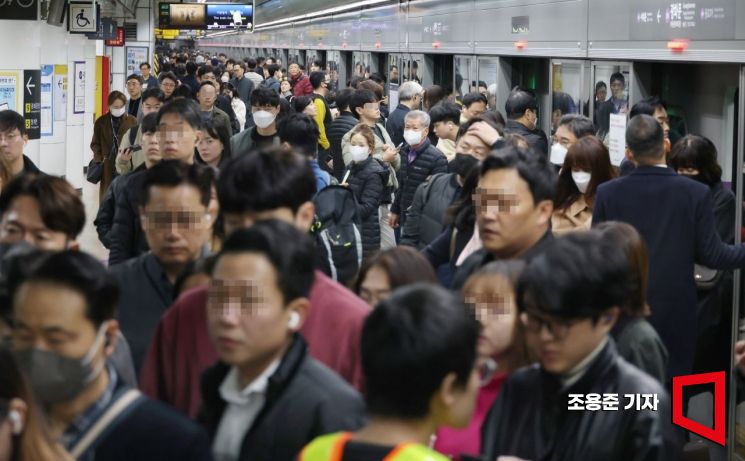 On the 9th, when the Seoul Metro Union operating lines 1 to 8 of the Seoul Subway began a two-day warning strike, the platform of Line 5 at Gwanghwamun Station in Seoul was crowded with commuters during the morning rush hour. Photo by Jo Yongjun jun21@
According to the Transportation Corporation Union affiliated with the Korean Confederation of Trade Unions, the union will hold a Central Dispute Countermeasure Committee meeting at 2 p.m. on the 14th to discuss the schedule for the second strike. A union official stated, "The strike schedule will be decided at the Dispute Countermeasure Committee meeting, but we are considering a period between the 20th and 24th."
The union staged a temporary strike on the 9th and 10th in protest against the corporation's workforce reduction plan. Despite the strike, the labor and management sides have yet to find common ground. Since the strike, they have not scheduled any main negotiations. On the last day of the temporary strike, the 10th, the Transportation Corporation Union issued a statement saying, "If there is no change in the positions of Seoul City and the corporation and they give up a sincere attitude, we plan to launch a second full strike after the college entrance exam period."
The KORAIL union held an expanded Dispute Countermeasure Committee meeting the previous day to discuss the strike schedule. A KORAIL union official said, "The strike schedule will be decided depending on how the National Assembly’s Land, Infrastructure and Transport Committee’s Transportation Subcommittee handles the bill submission. If the Basic Act on Railroad Industry Development is submitted and discussed, the Dispute Countermeasure Committee will finalize the strike schedule." Following the committee’s decision, the KORAIL union canceled a planned press conference on the strike scheduled for the 15th.
The KORAIL union opposes the amendment to Article 38 of the Railroad Act, which deletes the clause that "facility maintenance work is entrusted to the railroad corporation." The amendment, proposed by Rep. Cho Eung-cheon of the Democratic Party, allows companies other than KORAIL to perform railroad maintenance work. The union argues that such changes could lead to railroad privatization. Regarding this, the KORAIL union achieved 50,000 signatures on an online petition requesting a halt to discussions on the 6th of this month and submitted it to the National Assembly.
The KORAIL union has stated that if the amendment is submitted to one of the two remaining Transportation Subcommittee meetings this year, they will strike the day before the discussion. The Transportation Subcommittee meetings are scheduled for the 21st of this month and the 5th of next month. Considering this, a strike could begin as early as the 20th of this month.
If the two major unions strike simultaneously, commuting chaos in the metropolitan area is unavoidable. During the union strike on the 9th and 10th, KORAIL deployed a total of 20 temporary electric trains?12 in the morning and 8 in the afternoon?on Lines 1, 3, and 4, which are jointly operated with the Transportation Corporation. However, there was significant disruption, including about a 15-minute delay during rush hour. If the unions strike simultaneously, subway operation rates during morning commute hours will be maintained at 100%, but service disruptions are unavoidable at other times.
However, both unions maintain that this strike is not a sympathetic strike. A Transportation Corporation union official said, "The timing of the issues just happened to coincide," and added, "There was no prior discussion about coordinating the strike schedules."
© The Asia Business Daily(www.asiae.co.kr). All rights reserved.

















