Bank of Korea Announces 'Export and Import Price Index'
Minimal Impact of Israel-Hamas War on Oil Prices
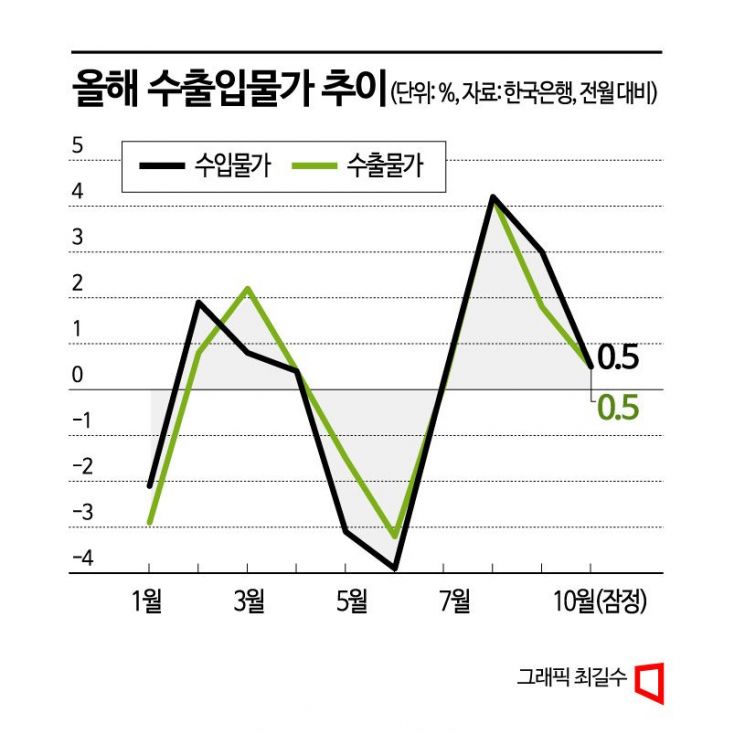
Last month, import prices rose by 0.5% compared to the previous month despite the decline in international oil prices, due to the increase in the won-dollar exchange rate. Export prices also increased by 0.5%, influenced by the rise in the exchange rate and partial recovery in semiconductor prices.
According to the 'October Export-Import Price Index' released by the Bank of Korea on the 14th, the import price index (based on the Korean won) rose 0.5% from the previous month, marking four consecutive months of increase. Although international oil prices fell, causing a decline in mineral products, the rise in the won-dollar exchange rate led to increases in computers, electronics and optical equipment, and chemical products. The average won-dollar exchange rate last month was 1,350.69 won, up 1.6% from the previous month (1,329.47 won).
Yoo Sung-wook, head of the Price Statistics Team at the Bank of Korea's Economic Statistics Bureau, explained, "Import prices rose due to the impact of the exchange rate increase," adding, "Despite the war between Israel and the Palestinian armed group Hamas, international oil prices fell compared to the previous month's average, so the war's impact was not significant."
However, compared to the same month last year, import prices fell by 10.2%, widening the decline. This was due to price drops in natural gas and chemical products, which led to decreases in raw materials and intermediate goods import prices.
Raw materials fell 0.4% from the previous month, mainly in mineral products, as international oil prices stabilized. The monthly average price of Dubai crude oil dropped 3.8% from $93.25 per barrel in September to $89.75 last month. Compared to the same month last year, it decreased by 1.5%.
On the other hand, intermediate goods rose 0.9% from the previous month, with increases in computers, electronics and optical equipment (3.0%) and chemical products (1.1%). Capital goods and consumer goods rose 0.8% and 1.0%, respectively, compared to the previous month.
Import prices based on contract currency, which limits the effect of exchange rates, fell 0.9% from the previous month.
Export Prices Rise 0.5% Due to Exchange Rate Increase and Semiconductor Price Recovery
The export price index (based on the Korean won) rose 0.5% from the previous month, marking four consecutive months of increase. Although the export price index declined in May and June, it rose in July after three months of decline and continued to increase this month. Compared to the same month last year, it fell 9.5%, maintaining a downward trend.
By item, agricultural, forestry, and fishery products fell 0.7% from the previous month. Manufactured goods declined due to decreases in coal and petroleum products (-4.9%) and primary metal products (-0.8%), but computers, electronics and optical equipment (3.6%), centered on semiconductors, and transportation equipment (1.7%) maintained an upward trend, resulting in a 0.5% increase from the previous month.
Export prices based on contract currency, which limits the effect of exchange rates, fell 1.0% from the previous month.
Team leader Yoo explained, "Export prices in October rose 0.5% based on the Korean won but fell 1.0% based on contract currency. Import prices also rose 0.5% based on the Korean won but fell 0.9% based on contract currency, which is due to the impact of the exchange rate." Regarding the outlook for November, he said, "The exchange rate has dropped slightly, but since November is still ongoing, we need to observe the situation further," adding, "Export-import prices are influenced by international oil prices, exchange rates, and item-specific factors such as semiconductor prices, so these aspects need to be considered to understand the situation."
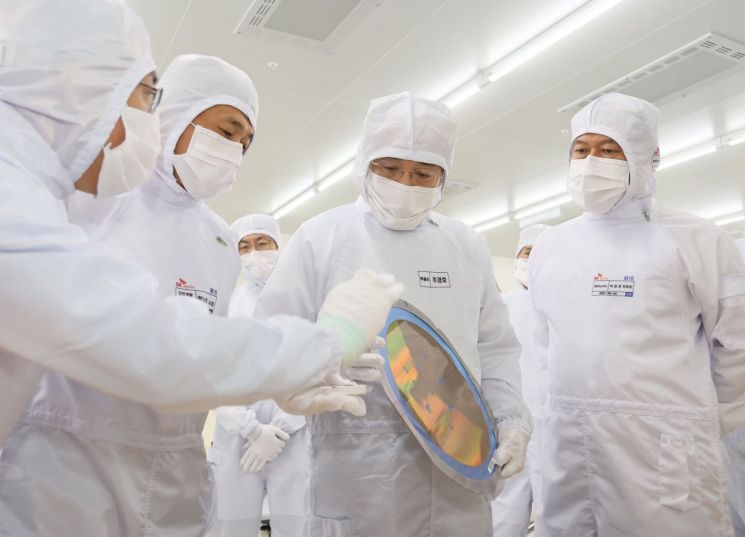
He added, "Semiconductor export prices are gradually rising due to increases in DRAM prices, growing demand for high-performance and high-spec products, and inventory adjustments caused by production cuts from suppliers."
© The Asia Business Daily(www.asiae.co.kr). All rights reserved.



















