Huawei Latest Smartphone Mate60 Pro
47% Price Ratio of Chinese Components in Product
Display Replaced from LG to Chinese-Made
Huawei has significantly increased the proportion of Chinese-made components used in its smartphones over the past three years. As overseas component suppliers from South Korea, the United States, and other countries cut ties with Huawei due to U.S. sanctions, Chinese companies have filled the gap.
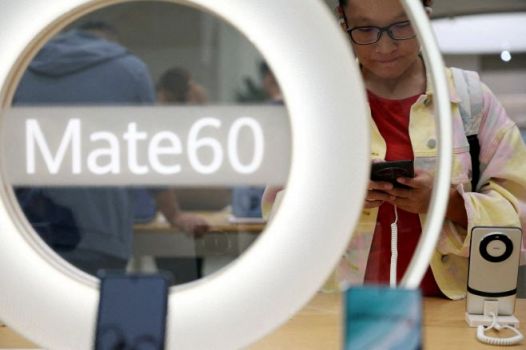 The latest smartphone Mate60 Pro Plus from China's Huawei (華爲) is displayed on September 25 at Huawei's flagship product showroom in Beijing (北京), China.
 [Photo by Yonhap News]
On the 13th, major foreign media reported, "According to a teardown investigation conducted with electronic device teardown company Formalhaut Technosolutions on Huawei's Mate 60 Pro, released last August, the proportion of Chinese-made components reached 47%."
The proportion of Chinese-made components in the Mate 40 Pro, released in 2020, was 29%, marking an 18 percentage point increase in Chinese components over three years.
Meanwhile, the price ratio of South Korean components rose by 5 percentage points to 36%, while U.S.-made components decreased from 3% to 2%, and Japanese-made components dropped from 19% to 1%.
Huawei had primarily equipped its smartphones with LG Display's OLED (organic light-emitting diode) displays. However, the recently released Mate 60 Pro was found to use Chinese BOE panels. OLED displays are known to be the most expensive components in smartphones. The touch panel components from U.S. company Synaptics were also replaced with Chinese-made parts.
This is interpreted as a result of the U.S. placing Huawei on the blacklist (trade restriction list) in 2019, leading LG Display and Samsung Electronics to halt panel supply in September of the following year. This was because the display driver chips included technology supported by the U.S.
Foreign media reported, "The teardown investigation confirmed that the main semiconductors in the Mate 60 Pro were designed by Huawei's semiconductor design subsidiary HiSilicon and manufactured by SMIC."
In 2020, the processor was designed by Huawei HiSilicon and produced by Taiwanese semiconductor foundry TSMC, but this year it was produced by China's Semiconductor Manufacturing International Corporation (SMIC). The U.S. Center for Strategic and International Studies (CSIS) pointed out that SMIC may have produced 7-nanometer semiconductors using equipment imported by circumventing sanctions, although it claimed to produce 28-nanometer process semiconductors.
Experts analyzed that Huawei's smartphone business, which had been stagnant due to U.S. export regulations, is showing signs of recovery, and that this business could regain momentum domestically in China as advanced semiconductor procurement becomes possible.
Meanwhile, according to U.S. market research firm IDC, China's smartphone market share based on shipments in the second quarter (April to June) of this year rose by 6 percentage points year-on-year to 13% globally.
© The Asia Business Daily(www.asiae.co.kr). All rights reserved.

















