The water quality improvement project for Seunggi Stream in Incheon, which had been plagued by frequent odor complaints, is set to begin in earnest. On the 13th, Yeonsu-gu, Incheon announced that it will start restoring the waterway, reinforcing the embankments, and removing sediment, beginning around Seunggi 2-gyo Bridge upstream?where the most odor complaints were reported?after taking over management of the 6.2 km-long Seunggi Stream from Namdong-gu in February this year, aiming to develop it into Incheon's representative ecological stream.
The area around Seunggi 2-gyo Bridge is the most vulnerable section of Seunggi Stream, facing difficulties in water quality and odor management due to non-point source pollution flowing in from Yeonsu-gu, Michuhol-gu, and Namdong-gu during initial rainfall. The district plans to treat about 20 tons of sediment, which had been difficult to handle near Seunggi 2-gyo Bridge, using special techniques. Along with this, five locations within Seunggi Stream where odors frequently occur have been selected for improvement works such as upgrading the catchment channels (facilities that collect sewage and send it to treatment plants), with plans to complete maintenance within this year and resolve odor complaints in the surrounding areas.
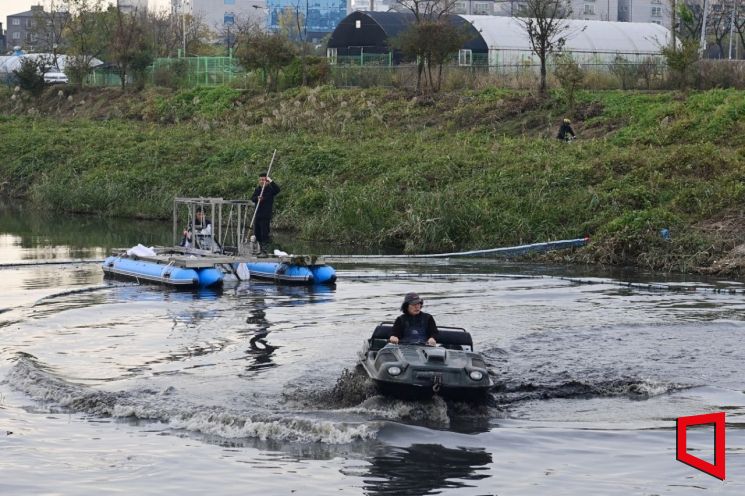 Incheon Yeonsu-gu is promoting a water quality improvement project to develop Seunggi Stream as a representative ecological stream of Incheon.
 [Photo by Incheon Yeonsu-gu]
To manage water quality through the accumulation of water quality data for Seunggi Stream, monitoring of water environment quality measurement networks is underway at investigation points including the wall fountain, Namchon confluence point, Namdong Bridge, Dongchun Bridge, and Dongmak Bridge, measuring parameters such as BOD, TOC, SS, T-N, and T-P. The district also plans to monitor pollution activities in the stream using advanced equipment such as drones and operate ecological programs to foster Seunggi Stream as Incheon's representative ecological stream.
Currently, Seunggi Stream's water quality is rated as Grade 3, but the district expects that if these improvement projects proceed smoothly, the water quality grade can be raised to Grade 1 or 2. Since the transfer of management rights, Yeonsu-gu has been restoring the collapsed embankments and recreating natural riffles within Seunggi Stream to recover the waterway, and residents have reportedly been experiencing significant changes.
In a survey conducted by the district last month, 76% of the 375 respondents answered that the management level of Seunggi Stream has improved compared to the past. Among the responses, water quality and odor improvement (33%) was cited most frequently, followed by flower path scenery (32%), improvement of aging facilities (19%), and prompt handling of complaints (15%). As for desired future cultural events, the water love music concert (29%), Seunggi Stream busking performances (27%), nights of Seunggi Stream with flowing movies (25%), moonlit Seunggi Stream night walks (11%), and Seunggi Stream scenic photo contests (8%) were surveyed in that order.
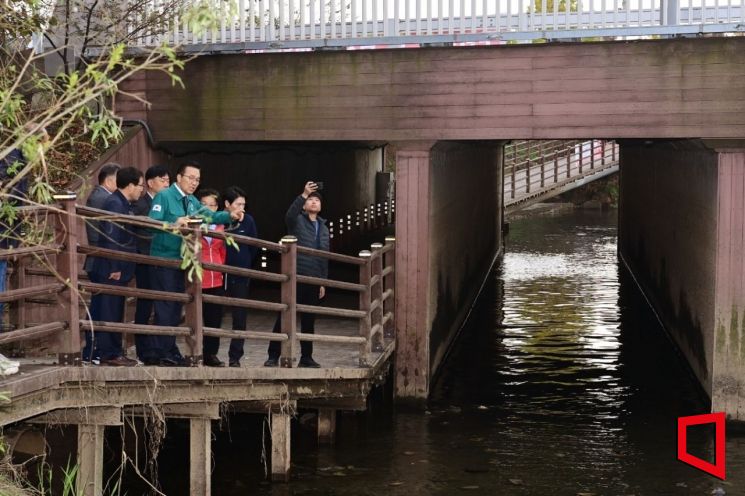 On the 9th, Lee Jae-ho, head of Yeonsu District Office, visited Seunggi 2 Bridge, where sediment removal work for water quality improvement is underway, to inspect the site conditions. 2023.11.9 [Photo by Yeonsu District Office, Incheon]
Lee Jae-ho, head of Yeonsu-gu Office, said, "Through the water quality improvement project, we will make Seunggi Stream a representative Incheon attraction that families enjoy visiting together," adding, "We will present the most comfortable and wonderful space to residents who have endured damage such as odors caused by Seunggi Stream."
Seunggi Stream, which had suffered severe water pollution due to the inflow of domestic sewage and industrial water in the past, continued to receive odor complaints regardless of the season even after the completion of Incheon City's natural ecological stream creation project in 2009, as water flow was not smooth.
© The Asia Business Daily(www.asiae.co.kr). All rights reserved.
![Clutching a Stolen Dior Bag, Saying "I Hate Being Poor but Real"... The Grotesque Con of a "Human Knockoff" [Slate]](https://cwcontent.asiae.co.kr/asiaresize/183/2026021902243444107_1771435474.jpg)












