LIG Nex1 (CEO Kim Ji-chan) has completed the "Curved Array Sonar Technology Development Program for Submarines," which was approved in 2018 as a leading core technology project led by the Agency for Defense Development.
The first task of this program involved the design of curved array sonar and verification of signal processing technology prototypes, while the second task focused on the development of curved array sensors and sensor signal network manufacturing technology. LIG Nex1 explained that the integrated technology performance test was successfully completed in September 2023, marking the successful conclusion of the technology project.
The submarine curved array sonar project began with the system development kickoff meeting in 2018, followed by the SRR (System Requirements Review) in 2019, PDR (Preliminary Design Review) and CDR (Critical Design Review) in 2020, unit task technology performance tests in 2022, and successfully conducted the integrated program technology performance test in 2023.
This means that core technologies for the independent domestic development of curved array sonar applicable to submarine sonar systems have been secured.
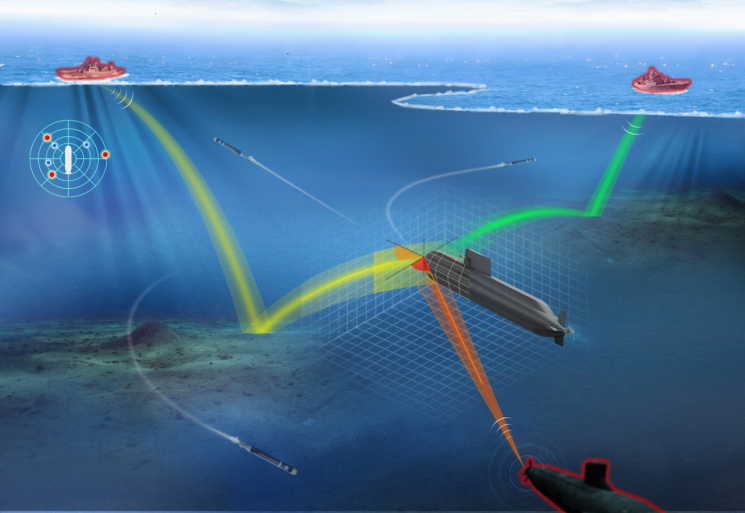
The submarine curved array sonar project developed the first task prototype for signal processing technology verification and the second task prototype for curved array sensors and sensor signal network verification, and verified the curved array sonar technology by linking and integrating the prototypes of tasks 1 and 2.
As a result, the amount of acoustic sensor signal linkage between tasks during sensor signal network integration significantly increased compared to existing sonar. Various tests were conducted during the technology development process to meet target performance, such as confirming real-time integration performance at the level of actual equipment by applying redundancy and system distribution.
Existing cylindrical array sonar requires additional maneuvering to accurately locate targets and has the disadvantage of long processing times. Due to the sensor placement structure, rear constraints occur, necessitating sonar technology to minimize rear shadow zones.
By overcoming the limitations of existing cylindrical array sonar, the development of curved array sonar capable of wider and faster detection was successful. Considering the optimal design for the entire sonar system and ship installation in the future, it became possible to develop various shapes beyond the curved array sonar shape, taking system applicability into account.
LIG Nex1, which participated in the leading core technology program led by the Agency for Defense Development in 2018, through the completion of this project, secured technology and capabilities for developing low-frequency broadband large-aperture curved array sonar for next-generation submarine system development. This will not only secure tactical superiority through early detection of enemy warships and submarines but also improve the survivability of friendly warships.
Kim Ji-chan, CEO of LIG Nex1, said, “Thanks to the full support of the Defense Acquisition Program Administration and the Agency for Defense Development, we were able to successfully complete the curved array sonar technology project for submarines.”
CEO Kim added, “If curved array sensors are installed on unmanned underwater vehicles and next-generation submarines, it is expected to greatly contribute to detection capabilities against enemy anti-submarine warfare forces, survivability of friendly forces, and enhancement of anti-submarine combat power.”
© The Asia Business Daily(www.asiae.co.kr). All rights reserved.

















