Meeting at the White House on the 13th to Discuss the Critical Minerals Agreement
The United States is entering negotiations with the Indonesian government to secure the supply chain of nickel, a key mineral for electric vehicle batteries. Indonesia holds the world's largest nickel reserves, but China dominates the nickel mineral sector by acquiring or securing stakes in major local mining companies.
U.S. President Joe Biden and Indonesian President Joko Widodo met at the White House on the 13th (local time) to discuss ways to enable nickel, a key mineral for electric vehicle batteries, to benefit from the Inflation Reduction Act (IRA), according to major foreign media. Sources said President Joko Widodo plans to visit Washington ahead of his attendance at the Asia-Pacific Economic Cooperation (APEC) summit in San Francisco starting on the 15th.
One source said, "The main agenda of this meeting is to discuss the conclusion of a critical minerals agreement for Indonesian nickel, and it appears that the two countries will enter formal negotiations to finalize the agreement."
The IRA aims to encourage increased production and assembly within North America in the electric vehicle sector while reducing dependence on Chinese minerals in batteries. To qualify for these benefits, a certain percentage of key minerals (nickel, manganese, graphite, cobalt, lithium, etc.) and components in the battery must be sourced from North America or countries with which the U.S. has a Free Trade Agreement (FTA).
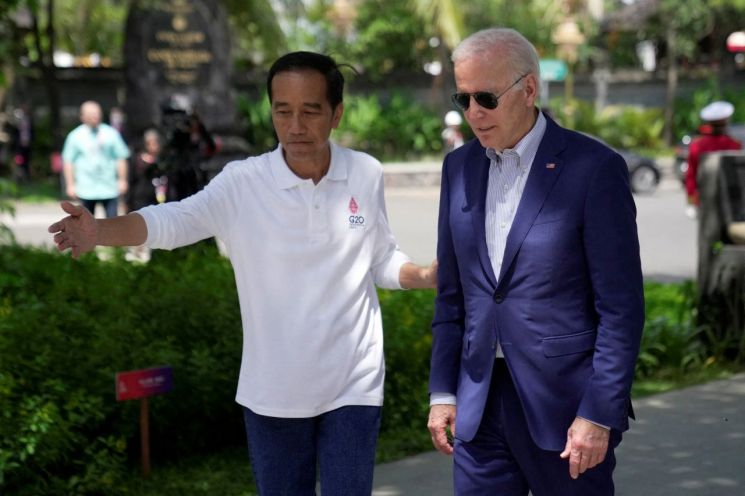 U.S. President Joe Biden (right) and Indonesian President Joko Widodo.
 [Image source=Reuters Yonhap News]
Indonesia has the largest nickel reserves and production in the world but does not have an FTA with the U.S., so it cannot benefit from the IRA. For this reason, Indonesia is pursuing a separate critical minerals agreement that would grant it a status equivalent to an FTA partner.
The U.S. government is also positive about cooperation with Indonesia. President Biden, who has strongly pushed for the electric vehicle transition, has initiated a restructuring of the global battery supply chain centered on the U.S. through the IRA, and securing a stable supply chain of critical minerals is essential for this effort.
The biggest challenge in the negotiations is China. China has already entered the nickel refining and processing sector in Indonesia through its Belt and Road Initiative (육상 및 해상 실크로드), effectively controlling Indonesia's supply chain.
Within U.S. political circles, there is significant concern that concluding a critical minerals agreement with Indonesia could ultimately allow Chinese companies to benefit from the IRA. Earlier, nine bipartisan senators sent a letter on the 24th of last month to Katherine Tai, U.S. Trade Representative (USTR), Janet Yellen, Secretary of the Treasury, and Jennifer Granholm, Secretary of Energy, expressing concerns about cooperating with Indonesia under the IRA due to Indonesia's low environmental, human rights, and labor standards.
In response, the U.S. administration is discussing ways to ensure that nickel products processed by Chinese companies using Indonesian nickel minerals do not qualify for IRA benefits.
The Diplomat, a U.S. foreign affairs magazine, noted, "China's massive dominance and poor governance in Indonesia's nickel refining and processing sector could be a major obstacle in the summit negotiations between the two countries' leaders," but also suggested, "It might be possible to consider supplying nickel produced under relatively high environmental, human rights, and labor standards in Indonesia to Western markets such as the U.S., while providing the remainder to China."
© The Asia Business Daily(www.asiae.co.kr). All rights reserved.

















