The Newborn Son of a Diplomat Assigned Locally in 1964
"Evidence Representing the Turbulent History of South Korean Diplomacy"
Embassy of Turkey Decides to Commemorate the Deceased Annually
A large Taegeukgi flag, two crosses, and an old tombstone engraved with the Turkish word 'Corelli' (Korean) above the name were discovered. This tombstone had not been known to the Korean community in T?rkiye until now.
Following this discovery, the Embassy of the Republic of Korea in T?rkiye decided to visit this grave, presumed to be the first Korean cemetery in T?rkiye, every year with flowers to pay respects to the deceased.
On the 31st of last month (local time), Ambassador Lee Won-ik of the Korean Embassy in T?rkiye received a brief text message from the Polish Ambassador to T?rkiye saying, "I just found this now." The Polish Ambassador also sent a photo along with the message. The photo was taken by the Polish Ambassador while taking a walk in a park cemetery in the heart of Ankara.
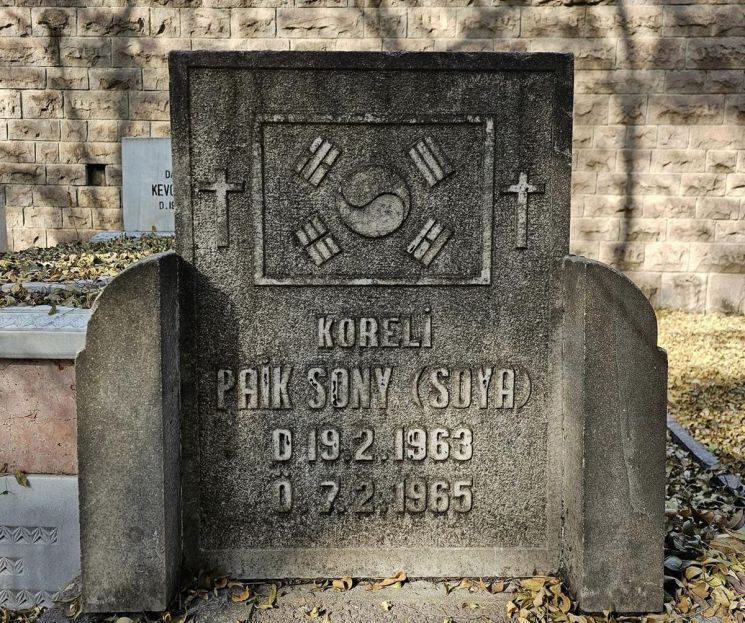 The tombstone was engraved with two Taegeukgi flags and crosses, along with the inscription "Corelli" (Korean). [Photo by the Embassy of the Republic of Korea in Turkey]
The tombstone was engraved with the Taegeukgi flag, two crosses, and the word 'Corelli' (Korean). According to the inscription, the deceased was born in 1963 and passed away in 1965. The person died just ten days before their second birthday.
The embassy requested additional simple records such as the burial date through the cemetery management office to accurately identify who the deceased was. However, there was not enough information left, making it difficult to trace any connections. It seemed the mystery would remain forever, but by chance, visitors who came to see Ambassador Lee recalled and shared pieces of stories. Based on these, the embassy was able to identify who the deceased was.
Presumed to be the infant son of a defense attach? assigned to T?rkiye in 1964
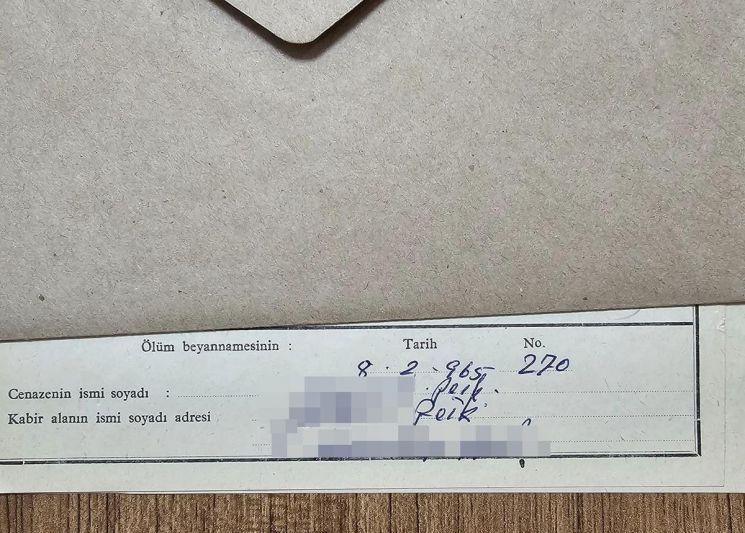 Records related to the Corelli tombstone left at the management office.
 [Photo by Embassy of the Republic of Korea in Turkey]
The deceased is presumed to be the son of Mr. Baek, a defense attach? (a military officer serving as a resident officer at a diplomatic mission) who was assigned to the Korean Embassy in T?rkiye in 1964.
Mr. Baek came to a foreign land far away with his newborn child and faithfully performed his diplomatic duties in a harsh environment where there were no fellow Koreans. However, within just one year, he lost his son in an unfortunate accident, and a few years later, after completing his term, Mr. Baek had no choice but to return to Korea, leaving his child buried here.
The exact circumstances under which the deceased was buried here are unknown. At that time, there was no direct flight from Seoul to Ankara, T?rkiye, and one had to change planes three to four times via Taiwan, Singapore, and the United Arab Emirates (UAE).
Moreover, Islamic culture does not permit cremation, believing that the soul’s resting place would be destroyed. Therefore, transporting a coffin with a body was physically and procedurally difficult, so it is believed that the deceased was inevitably buried here.
T?rkiye, which established diplomatic relations with South Korea in 1957 shortly after the Korean War, is South Korea’s 10th diplomatic partner. The grave of the deceased, dating back to a period earlier than the 1970s when the Korean immigrant history in T?rkiye began, is evidence of the challenging early days of South Korea’s diplomatic history.
The Embassy of the Republic of Korea in T?rkiye decided to visit this grave, presumed to be the first Korean cemetery in T?rkiye, every year with flowers to pay respects to the deceased.
On the 12th, Ambassador Lee said, "I found out that the deceased’s father also passed away last year," adding, "Now, the two of them must have happily met in heaven as a two-year-old child and a young father."
© The Asia Business Daily(www.asiae.co.kr). All rights reserved.


















