Candidate Lee "Just college classmates, no private meetings with the President"
Cultural and arts sector 'blacklist creation' ruled unconstitutional... Samsung industrial accident workers win lawsuit ruling
The confirmation hearing for Lee Jong-seok, the nominee for Chief Justice of the Constitutional Court, will be held on the 13th. During the hearing, the focus is expected to be on Lee's personal relationship with President Yoon Seok-yeol and his conservative tendencies demonstrated in past rulings and decisions.
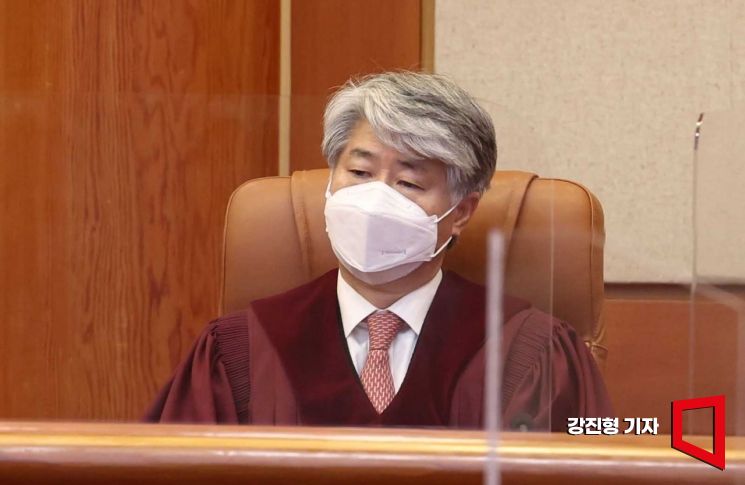 Lee Jong-seok, nominee for Chief Justice of the Constitutional Court. Photo by Kang Jin-hyung aymsdream@
In particular, the opposition party is expected to launch a concentrated offensive, emphasizing that Lee, who has only one year left in his term, was nominated as Chief Justice of the Constitutional Court due to his personal connection with President Yoon.
In his written response submitted to the National Assembly, Lee described his relationship with President Yoon as "classmates from Seoul National University College of Law, class of '79," and stated, "I do not have regular private meetings with President Yoon," adding, "I did not receive direct contact from President Yoon before my nomination."
During the hearing, Lee's past rulings and decisions are also expected to come under scrutiny. In particular, the opposition is likely to raise issues regarding a 2011 case when Lee was the presiding judge of the 16th Civil Division at the Seoul High Court. In that case, a heavy equipment export company suffered losses from a currency option product called ‘KIKO’ used for foreign exchange hedging and sued the seller, Woori Bank, among others, but Lee ruled that the contract was not unfair.
Small and medium-sized enterprises that subscribed to KIKO suffered huge losses when exchange rates surged due to the 2008 US financial crisis and other factors. According to a 2010 survey by the Financial Supervisory Service, 738 SMEs suffered damages exceeding 3 trillion won.
Regarding this, Lee stated, "I cannot help but feel sorry for the parties who suffered economic losses related to the KIKO contracts," but added, "Civil lawsuits must be judged and concluded based on laws and precedents. I made a judgment by comprehensively considering all specific circumstances that could be confirmed through the trial process and evidence, such as the plaintiff's economic status, the circumstances under which the KIKO contract was concluded, and the scale of the losses, based on the basic principles of civil law concerning contracts."
The KIKO-related ruling became problematic as it was listed in a document created by former Chief Justice Yang Sung-tae in 2015 before his meeting with former President Park Geun-hye, as one of the rulings made in efforts to fulfill the Park administration's national agenda. During his 2018 confirmation hearing for Constitutional Court Justice, Lee responded "It is inappropriate" to a lawmaker's question asking whether he thought it was the role of the Chief Justice to meet the president and make maximum efforts for national governance.
The opposition is expected to highlight Lee's conservative tendencies by presenting his rulings and decisions. However, Lee also ruled in favor of plaintiffs in a widely known case involving Samsung Electronics workers who claimed to have developed leukemia and other diseases due to exposure to harmful substances such as benzene and radiation during work.
Additionally, in a constitutional complaint case concerning the Park Geun-hye administration's blacklist of cultural and artistic circles and the directive to exclude them from support projects, Lee ruled that the government's act of collecting, holding, and using information about individuals' political views to block government support violated the right to informational self-determination and was unconstitutional, indicating that he did not make one-sided rulings or decisions.
Regarding the evaluation of his conservative tendencies, Lee stated, "I can boldly say that I have approached trials solely based on the Constitution, laws, and the objective conscience of a judge, and I will continue to approach trials with the same attitude."
Furthermore, the opposition is expected to bring up again the issue of Lee's ‘false address registration’ that was pointed out during the confirmation hearing after his nomination as Constitutional Court Justice. Lee registered false addresses in 1982, 1988, and 1993, and his spouse did so in 1993 and 1996. Regarding this, Lee said, "There was no false address registration for the purpose of real estate speculation," but added, "Regardless of the reason, I recognize it as an inappropriate act and offer my apologies."
Regarding allegations of preparing a down payment contract during apartment transactions, Lee said, "It is unclear whether a down payment contract was actually prepared," but added, "If it was prepared, I think it was a failure on my part for not checking carefully."
© The Asia Business Daily(www.asiae.co.kr). All rights reserved.

















