The KOSPI index closed lower on the 10th due to the hawkish stance of Jerome Powell, Chairman of the U.S. Federal Reserve (Fed), who left open the possibility of further tightening, and the weak demand in the U.S. 30-year Treasury bond auction. The KOSDAQ index fell below the 800 mark again.
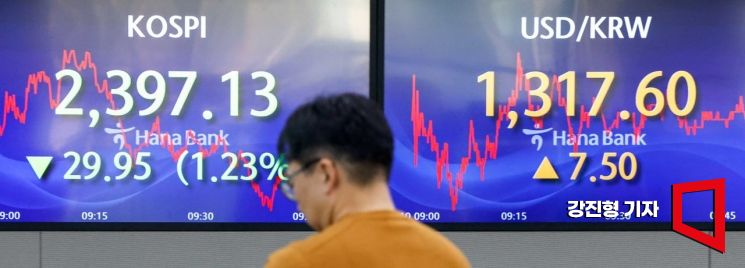 On the 10th, the KOSPI index opened at 2406.40, down 20.68 points (0.85%) from the previous trading day, as dealers were working in the dealing room at the Hana Bank headquarters in Jung-gu, Seoul. After the opening, the KOSPI index continued its downward trend and fell below the 2400 mark during the session. Photo by Jinhyung Kang aymsdream@
On that day, the KOSPI index closed at 2409.66, down 17.42 points (-0.72%) from the previous session. The index opened at 2406.40, down 20.68 points (0.85%). Although it briefly dipped below the 2400 level during the session for the first time in four trading days since the full ban on short selling on the 6th, it reduced losses by the close. Foreigners and individuals were net buyers of 55.3 billion KRW and 31.7 billion KRW respectively, while institutions sold off 112.9 billion KRW worth of shares.
Joon-ki Cho and Jae-hyun Kang, researchers at SK Securities, noted, "The KOSPI index, which surged on the day the short selling ban was implemented, fell on three out of the following four trading days. The KOSDAQ declined by over 1% on all four days. Given the high volatility during the week, the fatigue experienced by market participants was considerable beyond just the numbers."
Among the top market capitalization stocks, SK Hynix (1.95%), Shinhan Financial Group (1.44%), Samsung Life Insurance (0.58%), Samsung Biologics (0.41%), and Samsung Electronics (0.28%) rose. Conversely, POSCO Future M (-4.97%), Samsung SDI (-4.44%), LG Energy Solution (-4.20%), and POSCO Holdings (-2.82%) declined.
Seok-hwan Kim and Su-jin Park, researchers at Mirae Asset Securities, said, "Both KOSPI and KOSDAQ fell. The U.S. 30-year Treasury bond auction was weak, and Powell's hawkish remarks caused bond yields to rise. Additionally, the continued strength of the dollar dampened investor sentiment." On the 9th (local time), Chairman Powell stated, "If it is appropriate to shift monetary policy to a more restrictive stance, we will not hesitate to do so."
Researcher Kim added, "While most sectors declined, semiconductor stocks rose. This was influenced by expectations of increased demand for high-bandwidth memory (HBM) and SK Hynix's plan to execute a 10 trillion KRW scale capital investment next year. Additionally, some thematic stocks related to the Chinese pneumonia outbreak and bedbug pest control rose." He also assessed, "Due to Tesla's weakness in the U.S. stock market, domestic secondary battery stocks faced downward pressure again today."
By sector, most sectors declined except for insurance (0.81%) and telecommunications (59.29%). Chemicals (-2.53%), steel and metals (-1.75%), textiles and apparel (-1.70%), distribution (-1.65%), securities (-1.33%), and electricity and gas (-1.13%) followed in decline.
The KOSDAQ index closed at 789.31, down 13.56 points (-1.69%) from the previous trading day. It opened at 792.86, down 10.01 points (-1.25%), and continued its downward trend. Foreigners and institutions sold 31.4 billion KRW and 57.2 billion KRW respectively, while individuals were the sole net buyers with 94.8 billion KRW.
Among the top market capitalization stocks, ISC (4.05%), Alteogen (4.02%), EO Technics (2.65%), and HPSP (2.41%) rose. Meanwhile, Pearl Abyss (-8.41%), Rainbow Robotics (-8.06%), EcoPro BM (-6.24%), EcoPro (-6.04%), and L&F (-4.95%) declined.
In the Seoul foreign exchange market on the day, the won-dollar exchange rate closed at 1316.8 won, up 6.7 won from the previous trading day.
© The Asia Business Daily(www.asiae.co.kr). All rights reserved.
![Clutching a Stolen Dior Bag, Saying "I Hate Being Poor but Real"... The Grotesque Con of a "Human Knockoff" [Slate]](https://cwcontent.asiae.co.kr/asiaresize/183/2026021902243444107_1771435474.jpg)
















