Yeo "Will the R&D Mid- to Long-Term Plan Change in 6 Months?"
Ruling Party Emphasizes Need to Increase Budget for Diplomatic Sector
The ruling and opposition parties clashed over the review of next year's budget bill at the National Assembly's Special Committee on Budget and Accounts held on the 9th, debating issues such as cuts to the research and development (R&D) budget and reductions in the local currency budget.
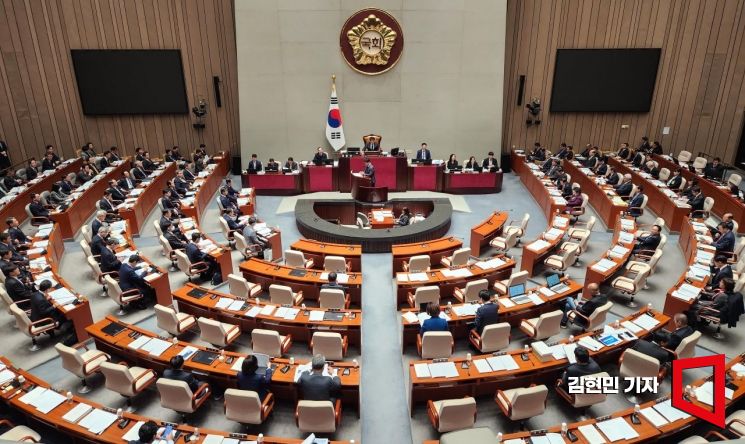 On the 9th, a full meeting of the Special Committee on Budget and Accounts was held at the National Assembly. Photo by Hyunmin Kim kimhyun81@
During the comprehensive policy questioning session of the Special Committee on Budget and Accounts held on the 9th, the Democratic Party pointed out the issue of the R&D budget, which was cut by more than 5 trillion won compared to the previous year. The government and ruling party maintain that budget restructuring is necessary, but the Democratic Party is demanding a full review.
Democratic Party lawmaker Cho Seung-rae criticized, "The R&D budget cut in the government's budget proposal is very serious," adding, "They made large-scale cuts claiming it was excessive, but they have not even presented the criteria for the cuts." He particularly criticized the government's R&D mid- to long-term plan for being reversed in just six months, calling it 'hasty.' According to the '1st National Research and Development Mid- to Long-term Investment Strategy' announced in March this year, the R&D budget was to maintain 5% of total government expenditure and invest 170 trillion won from 2023 to 2027. However, the 'National Fiscal Management Plan' announced in September shows the R&D budget at 3.9% of total government expenditure, with the investment amount reduced from 170 trillion won to 145.7 trillion won. Lawmaker Cho questioned, "How can they make such plans without looking even half a year ahead?" and added, "They say the cuts are due to hasty management, but isn't the government itself hasty?"
Prime Minister Han Duck-soo responded, "(Strengthening national competitiveness through R&D) ultimately comes down to how resources are allocated," adding, "Every country is grappling with this. Many countries reflect that although they invested in R&D, efficiency was not great due to improper resource allocation." He continued, "This year's R&D budget formulation was made with the thought that such concerns should be reconsidered from the beginning."
On the other hand, the People Power Party emphasized the importance of hosting the 2030 Busan World Expo and the need to increase the budget for diplomatic affairs, highlighting overseas diplomatic achievements.
People Power Party lawmaker Lee Yong said, "The decision on whether to host the 2030 Busan World Expo, a regional development and diplomatic policy pursued by the Yoon Seok-yeol administration since taking office in May last year, will be made at the International Bureau of Expositions (BIE) General Assembly on the 28th of this month," adding, "As the public is supporting this, the government, including the president, has actively engaged in diplomatic efforts." He emphasized, "While the Democratic Party is raising issues about the diplomatic budget and pushing for cuts, I believe we should proceed with the government's proposal." Prime Minister Han also said, "Honestly, our diplomatic organization, personnel, and budget are very insufficient to meet the expectations of the international community in line with our national stature," adding, "Although there are unavoidable aspects due to fiscal tightening, diplomacy is key to maintaining the security system in emergencies. I hope the members of the Budget Committee will make a sound judgment and decide accordingly," urging the committee to approve next year's budget as proposed by the government.
The comprehensive policy questioning of the Budget Committee will continue until the 10th, followed by subcommittee reviews starting on the 13th, and will be approved at the plenary session on the 30th. However, it is expected that the review process will not be easy starting from the subcommittee stage.
Next year's budget is being prepared with austerity measures due to worsening tax revenue conditions, leading to significant disagreements between the ruling and opposition parties over the allocation of limited fiscal resources. The opposition has decided to push for cuts amounting to about 5 trillion won. In particular, they plan to cut large amounts from the government's contingency funds and reallocate them to increase funding for research and development (R&D). In addition, major pending issues such as securing budgets for local love gift certificates and Saemangeum are piling up. Moreover, with the general election next year, a fierce competition for securing budgets for local projects within limited resources is inevitable.
Furthermore, this year's Budget Committee review breaks the National Assembly's tradition of only reviewing budget cuts in the subcommittee and increases in the sub-subcommittee, as the ruling and opposition party floor leaders agreed to review some increase projects in the subcommittee, which is also a new point of interest.
Political circles expect that this year's budget review will also extend beyond the legal deadline.
Democratic Party Budget Committee floor leader Kang Ki-sik stated on the 6th when presenting the direction for budget review, "We will not set a deadline or time limit for negotiations." He did not even make the customary remark about trying to meet the legal deadline. In response, People Power Party Budget Committee floor leader Song Eon-seok said, "I cannot help but wonder what their intention is in pressuring the government and ruling party without even starting the full review," and added, "It is worrisome that they are focusing solely on extracting budgets for their political interests by pressuring the government and ruling party while ignoring people's livelihoods."
Last year, the ruling and opposition parties also clashed over issues such as corporate tax cuts and local love gift certificates, and after mediation by National Assembly Speaker Kim Jin-pyo, the budget was approved on December 24, well past the legal deadline.
© The Asia Business Daily(www.asiae.co.kr). All rights reserved.

















