Greenpeace 'Reuse is the Future' Report
"Ministry of Environment Must Expand Reuse Systems"
A study has found that switching from disposable cups to reusable cups can reduce carbon emissions by 250 million kg annually. In response, environmental organizations are raising their voices to strengthen policies that can reduce the use of disposable products.

According to the report titled "Reuse is the Future: Life Cycle Assessment (LCA) Comparison of Environmental Performance of Reusable and Disposable Cup Systems in East Asia," released by the environmental group Greenpeace on the 8th, switching the disposable cups used domestically to a reusable rental system can save more than 250 million kg of carbon annually within the country.
This amount is equivalent to the carbon emissions produced by more than 92,000 internal combustion engine vehicles and can save over 1.8 million cubic meters of water and more than 1 million barrels of oil annually.
Furthermore, Greenpeace set the usage period per cup in the reusable cup rental system at 3 years and compared the effects by dividing annual usage into low frequency (20 times), medium frequency (40 times), and high frequency (60 times). They also analyzed 16 categories including climate change impact linked to the Sustainable Development Goals (SDGs), human toxicity, and water impact.
Analyzing domestic data, based on high usage frequency, improvements were observed in ▲fossil fuel depletion (57.3%) ▲particulate matter formation (56.4%) ▲climate change (44.3%) ▲human toxicity (37.4%) ▲water depletion (36.8%) ▲marine ecological toxicity (28.4%) ▲freshwater ecological toxicity (28.3%), among others.
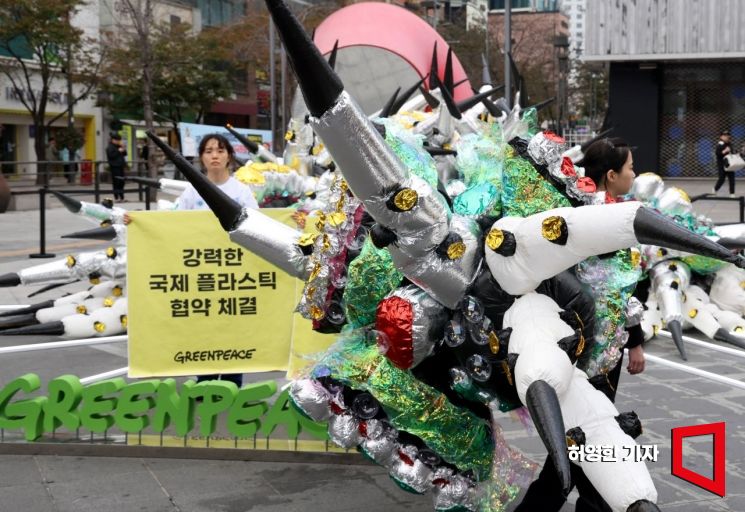 On the 1st, Greenpeace installed a giant plastic monster sculpture measuring 8 meters in diameter in Sinchon, Seoul, and held a performance urging a strong international plastic treaty. They stated that this was to urge the government for a strong international plastic treaty ahead of the 3rd Intergovernmental Negotiating Committee on the International Plastic Treaty, which will be held in Kenya starting on the 13th. Photo by Younghan Heo younghan@
Even based on low usage frequency, effects were seen in ▲particulate matter formation (50.3%) ▲fossil fuel depletion (47.3%) ▲climate change (36.6%) ▲water depletion (33.3%) ▲human toxicity (32.2%), among others.
Additionally, Greenpeace claimed that the use of paper cups alone emits 160 million kg of carbon annually, which is equivalent to the carbon emissions from 62,201 cars.
However, the report pointed out that even when using reusable cups, environmental pollutants can be emitted during processes such as washing and transportation. To minimize negative environmental impacts in the reusable cup rental system, eco-friendly detergents should be used as substitutes, and the use of internal combustion engine vehicles for transportation should be reduced. The more the reusable cup rental system spreads, the more the negative impacts from transportation can be reduced.
Ministry of Environment Announces Disposable Product Management Plan... Greenpeace Calls it "Abandonment of Regulation"
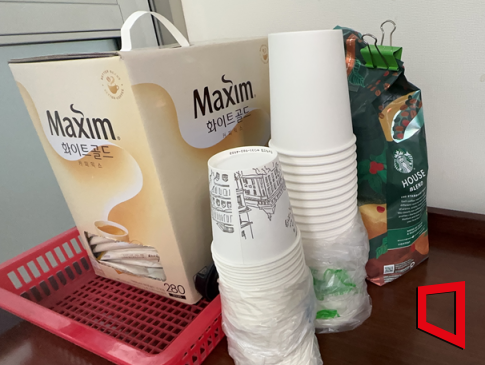
Earlier on the 7th, the Ministry of Environment announced a disposable product management plan that effectively extends the guidance period for banning plastic straw use indefinitely and excludes paper cups from the list of restricted items.
In response, Greenpeace criticized, "Instead of supporting small business owners to stabilize the system during the one-year guidance period, the Ministry of Environment chose the easy way out by effectively abandoning disposable product regulations. This announcement is essentially a surrender of regulations on plastics."
They added, "To escape the increasingly severe climate crisis and plastic pollution crisis, it is necessary to expand reusable systems including paper cups in plastic production and use. The government should agree to and take the lead in concluding a strong international plastic treaty that includes fundamental solutions capable of reducing plastic production at the source, rather than focusing on waste treatment stages such as recycling and energy recovery."
© The Asia Business Daily(www.asiae.co.kr). All rights reserved.



















