Warnings Against Optimistic Views on Interest Rate Cuts
"Central Bank Does Not Want to Reduce Tightening Effects"
The 30-year mortgage rates in the U.S., which had been soaring, fell the most in over a year. This was largely due to the Federal Reserve's (Fed) decision to hold the benchmark interest rate steady for the second consecutive time, easing concerns about further rate hikes. With reduced market uncertainty, the stock market volatility index has continued to decline for eight consecutive days, increasing expectations of a 'pivot'?a change in policy direction.
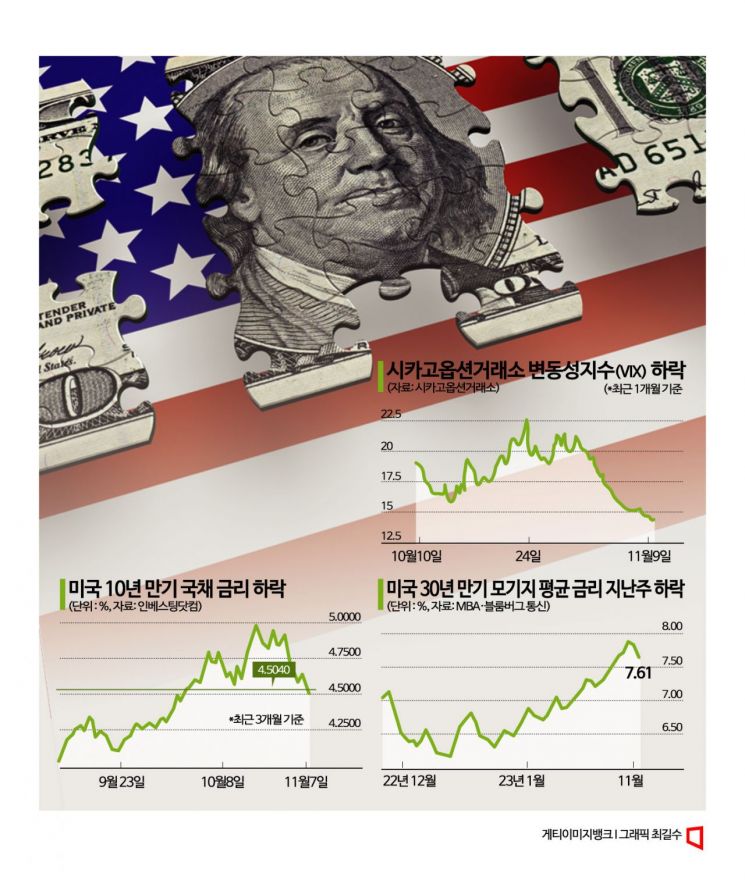
According to the Mortgage Bankers Association (MBA) on the 8th (local time), the average 30-year mortgage rate last week dropped 25 basis points (1bp = 0.01 percentage points) from the previous week to 7.61%. This is the lowest level since the end of September this year. It is the first time since mid-June that mortgage rates have fallen for two consecutive weeks. The weekly decline of 25bp last week was also the largest in 16 months.
The decline is attributed to the U.S. Treasury planning to issue fewer government bonds in the fourth quarter than in the third quarter, easing concerns about a bond supply glut, along with growing expectations that the Fed's two consecutive rate holds at 5.25?5.5% signal the end of the tightening cycle. The benchmark 10-year Treasury yield, which influences mortgage rates, fell to around 4.5% following the Fed's rate hold. The overheated labor market, which had been fueling inflation, is also showing signs of cooling. Joel Kan, MBA Vice President and Economist, analyzed, "The U.S. Treasury's bond issuance plan, the Fed's dovish stance, and slowing labor market data drove last week's mortgage rate decline." Just two weeks ago, the 30-year mortgage rate had surged to 7.9%, the highest in 23 years, as the 10-year Treasury yield hovered around 5%, pushing mortgage rates upward.
The Chicago Board Options Exchange Volatility Index (VIX), known as Wall Street's fear gauge, is currently around 14.4, marking eight consecutive days of decline?the longest downward streak since October 2015. Although Fed officials have recently issued warnings about inflation, the market has shown little reaction.
The market is closely watching the timing of a potential U.S. rate cut. The stock market appears relieved as it gauges the pivot point. Since the Fed held rates steady on the 1st, all three major New York stock indices have risen this month. The S&P 500 has jumped 4.5%, while the Nasdaq and Dow Jones Industrial Average have increased by 6.2% and 3.2%, respectively. Matthew Teem, Head of Equity Derivatives Trading at U.S. investment bank Canter Fitzgerald, commented, "The market seems to be expecting a soft landing for the U.S. economy and a year-end Santa rally." Anthony Sagrimbene, Senior Market Strategist at Ameriprise, diagnosed, "The stock market had been oversold for several months."
However, some caution that investors may be overly optimistic, driven by pivot expectations. If market interest rates fall too quickly in anticipation of a rate cut, the Fed's ability to control inflation through tightening could be limited. Barclays noted in an investor memo, "The VIX has plunged from its October peak, the highest in seven months," suggesting "the market appears too optimistic about the stock market." Michael Mathews, Co-Head of Fixed Income at investment bank Invesco, said, "The bond market tends to bet on rate cuts as soon as rates peak," adding, "We are beginning to be confident that we have reached that point." He emphasized, "Central banks will not want the effects of tightening to diminish."
© The Asia Business Daily(www.asiae.co.kr). All rights reserved.

















