Democratic Party Lawmaker, SBS Radio Interview
"Parallel Regression, Solidification of Two-Party Structure"
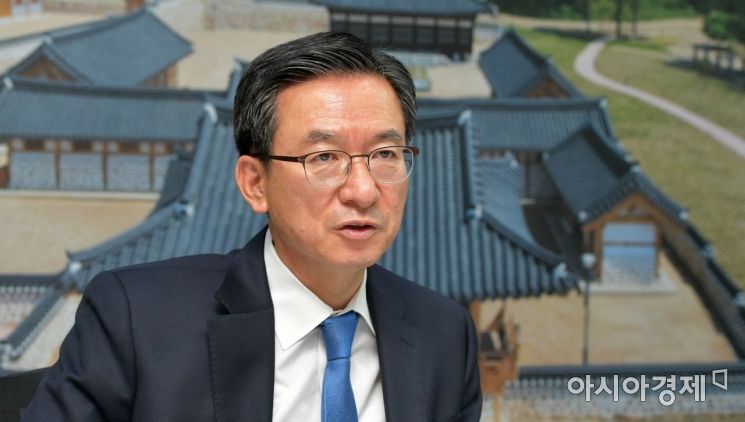
Amid reports that the leadership of the two major parties, currently discussing electoral system reform, is considering a return to the parallel proportional representation system, Jeong Seong-ho, a member of the Democratic Party of Korea, said on the 9th, "A gentleman's agreement not to create satellite parties under the current semi-linked proportional representation system would suffice, but that is not easy," adding, "It is problematic to pass the election law unilaterally as before, so the ruling and opposition parties need to negotiate."
Jeong appeared on SBS Radio's 'Kim Tae-hyun's Political Show' that day and stated, "Returning to the parallel system is a regression to the past and would solidify the two-party structure, so it is not desirable," while making these remarks.
With the general election next year approaching, there are speculations that the People Power Party and the Democratic Party of Korea might revert the proportional representation system back to the parallel type. The semi-linked proportional representation system adopted in the 2020 general election supplements 50% of the proportional seats when the number of constituency seats is less than the party's vote share. It was introduced to help smaller parties enter the National Assembly and secure political pluralism, but its purpose has been criticized as undermined due to the two major parties creating satellite parties.
Jeong expressed concern, saying, "The negotiation proposal is to adopt a parallel system by electoral region. That raises the issue that candidates from those regions would be favored. If that agreement is not reached, we have to go back to the current (semi-linked proportional representation) system, but then satellite parties will be created again. There is no way to prevent the creation of satellite parties."
He added, "In that regard, it would be good if the ruling and opposition parties could agree to jointly nominate all proportional representatives or impose some penalties, but it seems difficult."
The regional parallel proportional representation system is an alternative proposed by Kim Jin-pyo, the Speaker of the National Assembly, who has strongly advocated for electoral reform. This system divides the country into 3 to 6 regions, allocating 47 proportional seats within those regions based on party vote shares, which may reduce the number of seats for smaller parties compared to the current semi-linked proportional representation system. In response, there are also calls to maintain the current proportional representation system while enacting laws to prevent satellite parties.
© The Asia Business Daily(www.asiae.co.kr). All rights reserved.
![Clutching a Stolen Dior Bag, Saying "I Hate Being Poor but Real"... The Grotesque Con of a "Human Knockoff" [Slate]](https://cwcontent.asiae.co.kr/asiaresize/183/2026021902243444107_1771435474.jpg)
















