"Up to 20% Reduction in Risk When Starting Exercise"
A study has found that differences in physical activity levels before and after cancer diagnosis among cancer survivors may affect the risk of cardiovascular disease.

On the 9th, Yonsei University College of Medicine announced that a research team led by Professors Kim Hyun-chang and Lee Ho-gyu, and Lecturer Lee Hyuk-hee from the Department of Preventive Medicine, revealed that if cancer survivors who were physically active before diagnosis stop physical activity after diagnosis, their risk of cardiovascular disease increases by up to 43%.
According to the 2020 National Cancer Registry Statistics, the 5-year relative survival rate for cancer patients in Korea is 71.5%. The relative survival rate compares the survival rate of cancer patients to the expected survival rate of the general population, indicating the probability that cancer patients survive for five years compared to the general population. A relative survival rate of about 70% means that 7 out of 10 cancer patients survive more than five years.
As the number of cancer survivors increases, strategies to prevent cardiovascular disease, a major cause of death among cancer survivors, are becoming increasingly important. The research team conducted a follow-up study over approximately 13.6 years on 11,093 participants in the Atherosclerosis Risk in Communities (ARIC) study and found that cancer survivors had 37%, 52%, and 22% higher risks of cardiovascular disease, heart failure, and stroke, respectively, compared to the control group.
The American Cancer Society's 2022 guidelines recommend that cancer survivors engage in at least 150 minutes of moderate-intensity physical activity or 75 minutes of vigorous-intensity physical activity per week. This corresponds to about 600 MET (Metabolic Equivalent of Task). MET is a measure of energy expenditure during physical activity, calculated by dividing the oxygen consumption per kilogram of body weight per minute by 3.5.
The research team investigated the risk of cardiovascular disease according to changes in physical activity levels before and after cancer diagnosis among cancer survivors. The study subjects were 150,433 cancer survivors aged 20 or older who were diagnosed with cancer between 2011 and 2013 and had undergone national health screenings within 2 years before and 3 years after diagnosis. Participants were classified into inactive (0), insufficient activity (1?599), and sufficient activity (600 or more) groups based on MET levels to assess cardiovascular disease risk.
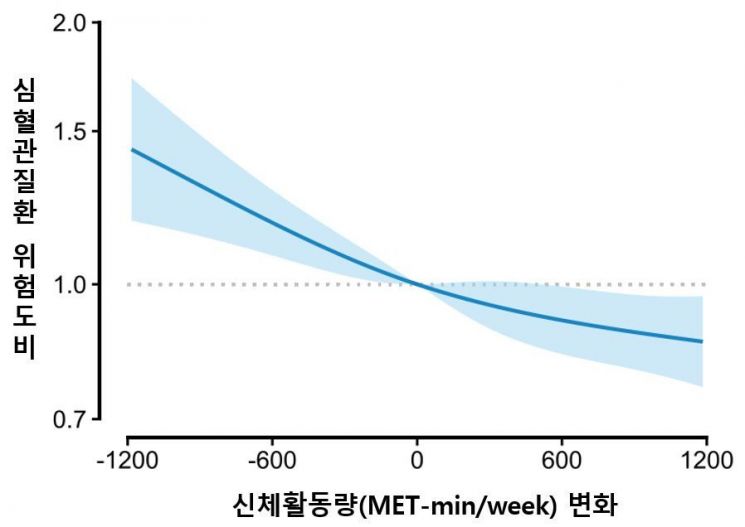
The study results showed that regardless of physical activity levels before diagnosis, higher physical activity levels after diagnosis were associated with lower cardiovascular risk. Even those who were inactive before diagnosis had a 19% and 20% reduction in risk when engaging in insufficient and sufficient activity levels after diagnosis, respectively. Conversely, those who maintained physical activity before diagnosis but stopped after diagnosis experienced increased cardiovascular risk. Specifically, those who engaged in insufficient and sufficient activity levels before diagnosis but stopped after diagnosis had risk increases of 24% and 43%, respectively.
When examining cardiovascular risk continuously according to changes in physical activity, the greater the increase in physical activity after cancer diagnosis compared to before, the greater the reduction in risk; conversely, the greater the decrease in activity, the higher the risk.
Professor Kim Hyun-chang of Yonsei University College of Medicine's Department of Preventive Medicine stated, "This study is significant as the first domestic research investigating cardiovascular disease risk according to changes in physical activity levels among cancer survivors, which had not been previously known," and advised, "Cancer survivors should strive to maintain or, if possible, increase their physical activity levels."
Meanwhile, the study results were published in the international journal European Heart Journal.
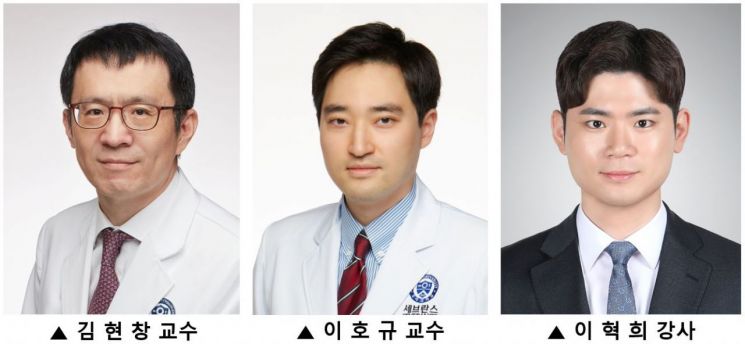 Research team of Professor Kim Hyun-chang, Professor Lee Ho-gyu, and Lecturer Lee Hyuk-hee from the Department of Preventive Medicine, Yonsei University College of Medicine.
 [Photo by Yonsei Medical Center]
© The Asia Business Daily(www.asiae.co.kr). All rights reserved.
![Clutching a Stolen Dior Bag, Saying "I Hate Being Poor but Real"... The Grotesque Con of a "Human Knockoff" [Slate]](https://cwcontent.asiae.co.kr/asiaresize/183/2026021902243444107_1771435474.jpg)


















