No 'Chaos' During Morning Commute as Service Runs Normally,
But Citizens Worry About Evening Rush Hour
"The company is located in Seocho-dong, so I use the subway every day. I left 30 minutes earlier than usual, but I guess I worried for nothing. It seems about the same as usual, so I'm relieved." (Office worker Kim)
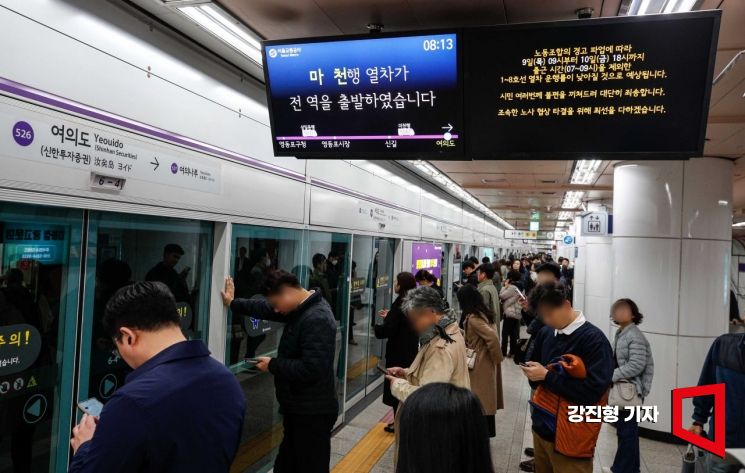 On the 9th, when the labor union affiliated with the Korean Confederation of Trade Unions at Seoul Metro began a two-day warning strike starting at 9 a.m., an electronic display board on the platform of Yeouido Station on Seoul Subway Line 5 showed an announcement regarding subway operations affected by the strike. Photo by Kang Jin-hyeong aymsdream@
As the Seoul Metro Union, which operates lines 1 to 8 of the Seoul subway, launched a warning strike on the 9th, trains during the morning rush hour operated normally, so the feared 'commuting chaos' did not occur. However, citizens came out earlier than usual or moved busily in preparation for any possible situation. Concerns about the expected reduction in service during the evening commute also continued.
At around 7:30 a.m. on the 9th at Sadang Station on Seoul Subway Line 2, posters with phrases such as "Why are you shifting the burden to citizens and workers?", "Bad government ignoring the 'good deficit'", and "Cutting 2,200 safety personnel" were posted in various places, but no separate strike announcement was made. Sadang Station is a transfer station between lines 2 and 4 and is a place with heavy commuter traffic. More than 20 people lined up densely at each entrance, and some passengers could not board the train at once, having to wait for the next train. An on-site safety officer said, "This area is usually very crowded during rush hours," and added, "It is not a situation where people are more crowded than usual."
Citizens expressed concerns about the subway strike. Jang, a worker in his 30s commuting to Gangnam Station, said, "I don't feel much difference from usual," but added, "I hope the labor and management negotiate well so that subway users are not inconvenienced." Another office worker, Lee, said, "Knowing about the strike, I left a little earlier than usual," and added, "I hope there will be minimal delays during rush hours." Concerns about the evening commute also continued. Cho, who commutes from Anyang City, Gyeonggi Province to Seoul, said, "A friend shared the news about the strike last night, so I found out," and added, "The morning commute seems similar to usual, but I hope there won't be major inconveniences during the evening commute."
The situation at City Hall Station, a transfer station between lines 1 and 2, was similar at the same time. Throughout the station, notices were posted stating, "Due to the union strike, operation of some trains on lines 1, 3, and 4 will be adjusted," and "Busy customers are advised to use other transportation methods." Shin (32), who commutes to Gwanghwamun, said, "I left about 20 minutes earlier just in case, but there were no delays or inconveniences," and added, "If a strike must happen, I hope it is done in a way that minimizes inconvenience to citizens, like today." Kim (28, male) said, "I didn't know about the strike when I left home, but fortunately there were no problems on the way to work," but criticized, "There have been many protests by disabled people and continuous problems in the subway, so I think demanding something by holding public transportation hostage is very selfish."
On this day, some subway lines experienced train malfunctions, causing inconvenience to citizens. At around 6:45 a.m., a train operated by Korail broke down at Mia Station on Line 4, forcing all passengers to disembark. This caused a delay of about 15 minutes. At around 7:50 a.m., a train malfunction at Bokjeong Station on Line 8 caused the doors not to close, and the train stopped for several minutes.
The Seoul Metro Union (1st Union) went on strike for the second consecutive year following last year. This warning strike will last for two days, from the 9th to the 10th. However, the integrated union and the proper union, which are the 2nd and 3rd unions, decided not to participate in the strike. Seoul City and the Metro Corporation expect that during the morning rush hour, trains will operate at 100% of normal levels, but overall subway operation rates will drop to 82% compared to normal, and to 87% during the evening rush hour. To minimize inconvenience to citizens, Seoul City and the Metro Corporation secured 13,500 personnel and assigned 125 city employees as station support staff.
© The Asia Business Daily(www.asiae.co.kr). All rights reserved.

















