Due to the impact of high interest rates, a downturn in the real estate market is expected, resulting in a "cloudy" outlook for nationwide apartment move-ins in November.
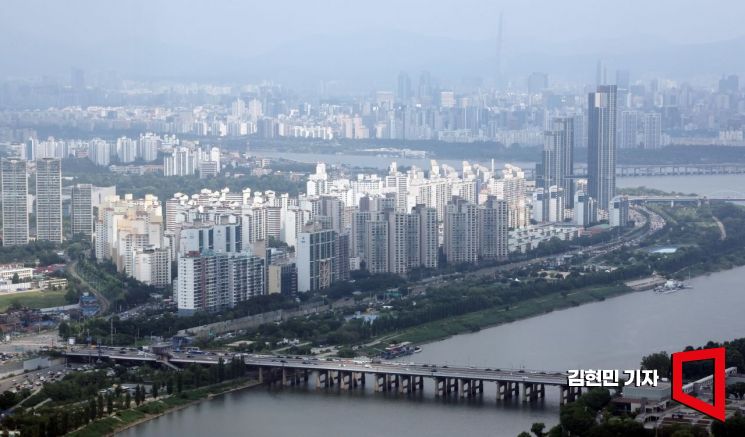 View of apartments in Ichon-dong, eastern Seoul, from the 63 Building observatory. Photo by Hyunmin Kim kimhyun81@
According to the Korea Housing Industry Research Institute on the 9th, the nationwide apartment move-in outlook index was surveyed at 72.9, down 19.5 points from last month (92.4). An index above 100 indicates that housing developers generally expect an increase in actual move-ins.
The metropolitan area dropped from 103.7 to 80.1, falling below the baseline, while metropolitan cities (97.2→76.5) and provincial areas (84.6→67.5) also declined simultaneously. In particular, Daejeon (106.6→75.0) and Sejong (108.3→72.7) plummeted by more than 30 points each.
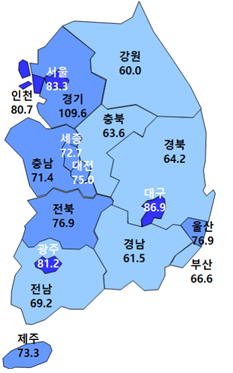
A representative from the Korea Housing Industry Research Institute explained, "The apartment move-in outlook index for November has fallen consecutively following the previous month, returning to the average level of the first half of this year (77.9). Due to the high interest rate trend, the gap between the desired prices of sellers and buyers for apartments has widened, leading the apartment market to shift into a wait-and-see stance." They added, "As apartment transaction volumes decrease, this atmosphere is expected to persist for some time. Given the anticipated real estate market downturn, we need to continuously monitor how much impact the recently announced government housing market stabilization measures will have."
Meanwhile, the nationwide apartment occupancy rate in October was 70.9%, up 5.8 percentage points from September. The nationwide occupancy rate had peaked at 71.5% in August, then dipped below 70% in September before showing a recovery last month.
The metropolitan area's apartment occupancy rate fell by 0.8 percentage points from 81.5% in September to 80.7% last month. In contrast, the five major metropolitan cities rose by 5.1 percentage points from 63.3% to 68.4%, and other regions increased by 8.9 percentage points from 60.3% to 69.2%, driving the nationwide occupancy rate increase.
Looking at detailed regions, Seoul slightly declined from 85.4% to 82.2%. The Gwangju and Jeolla regions recorded the highest occupancy rate this year, rising 11.4 percentage points from 62.9% to 74.3%. Incheon and Gyeonggi (79.6%→79.9%), Gangwon (46.6%→57.5%), Daejeon and Chungcheong (60.9%→65.1%), Daegu, Busan, and Gyeongsang (64.1%→70.9%), and Jeju (62.5%→68.5%) also showed upward trends.
A representative from the Korea Housing Industry Research Institute explained, "In Seoul, apartment occupancy rates declined due to decreased sales and increased listings caused by high loan interest rates at commercial banks and a reduction in the scope of special home mortgage loans." They added, "In provincial cities excluding the metropolitan area and metropolitan cities, apartment transaction volumes increased, leading to a rise in occupancy rates in the Gwangju and Jeolla regions, mainly centered on large construction companies' apartments."
The main cause of non-occupancy was "delayed sales of existing homes," which increased from 36.2% in September to 41.7% last month. "Delayed sales of pre-sale rights" also rose from 10.6% to 14.6%. Conversely, the proportions of "failure to secure balance loans" (21.3%→20.8%) and "failure to secure tenants" (25.5%→16.7%) decreased.
The Korea Housing Industry Research Institute representative stated, "As the apartment sales market turns to a wait-and-see stance, the share of delayed sales of existing homes and pre-sale rights among the causes of non-occupancy has increased. In particular, the backlog of apartment listings in the metropolitan area reaches about 250,000 units, so this trend is expected to continue for the time being."
© The Asia Business Daily(www.asiae.co.kr). All rights reserved.
![Clutching a Stolen Dior Bag, Saying "I Hate Being Poor but Real"... The Grotesque Con of a "Human Knockoff" [Slate]](https://cwcontent.asiae.co.kr/asiaresize/183/2026021902243444107_1771435474.jpg)
















