NH Investment & Securities 100-Year Life Research Institute 'Real Estate Trend 2024'
Professor Kim Kyung-min, Seoul National University Graduate School of Environmental Studies: "Interest Rates Have Major Impact Until Mid-Year"
"Focus on 10-Year Treasury Yield... Supply Volume Will Determine Prices in Second Half"
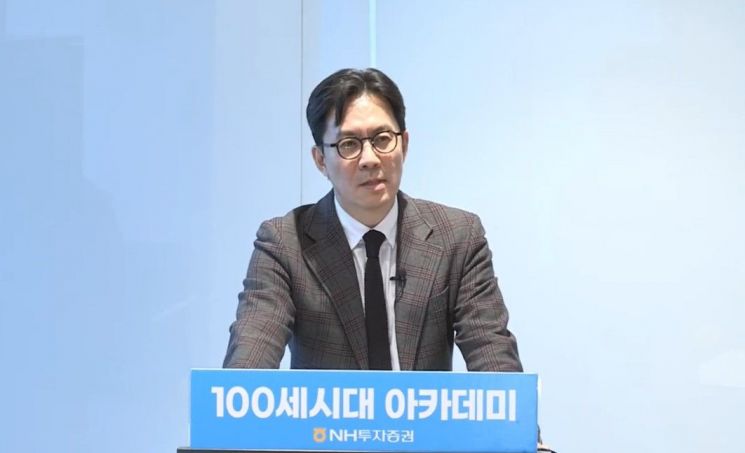 Professor Kim Kyung-min of Seoul National University Graduate School of Environmental Studies said on the 8th at NH Investment & Securities 100-Year Life Research Institute during the lecture "Real Estate Trends 2024" that "If the 10-year government bond yield rises to the level of October last year, real estate prices will fall by about 6%." Photo by NH Investment & Securities YouTube capture
If market interest rates remain high in the first half of 2024, Seoul real estate prices are expected to decline slightly. However, from the second half of the year, apartment move-in volumes and 'replacement demand' are anticipated to have a greater impact than interest rates.
Professor Kim Kyung-min of Seoul National University’s Graduate School of Environmental Studies stated on the 8th during a lecture titled 'Real Estate Trends 2024' at NH Investment & Securities' 100-Year Life Research Institute, "If the 10-year government bond yield rises to the level seen in October last year, real estate prices will fall by about 6%."
Professor Kim predicted, "Financial market factors such as interest rates will strongly influence the market through this year and next," adding, "Mortgage loan interest rates will also be significantly affected depending on the trend of the 10-year government bond yield." He continued, "If interest rates rise to the level of last October, Seoul apartment prices are expected to drop by about 6%. However, this would be a slight decline or stagnation, not a crash."
He forecasted that supply and demand factors will have a greater influence in the second half of 2024, as both apartment and villa supply volumes are currently insufficient.
Regarding apartments, the average annual supply in the 2010s was about 35,000 units. Last year and this year, the move-in volume is short by approximately 10,000 units. Professor Kim pointed out, "Since early this year, jeonse (long-term lease) prices have been gradually rising in apartment complexes," adding, "When move-in volumes are insufficient, the first phenomenon to appear is an increase in jeonse prices." He further explained, "Jeonse is a market for actual residence, so demand does not shrink even if bond yields surge due to project financing (PF) crises or wars. The problem is that supply volumes in 2024 and 2025 are below average."
According to Zigbang, the scheduled apartment move-in volume in Seoul for 2024 is 13,841 households. This represents a 54.4% (16,505 households) decrease compared to this year's move-in volume (30,346 households), marking the lowest volume since 2020.
However, the situation is expected to differ outside Seoul. Professor Kim analyzed, "In Incheon, there is a high possibility of prices being suppressed due to overwhelming oversupply compared to 2023, and jeonse prices may also fall. Price increases are expected to be difficult in Incheon, Daegu, and Gwangju." He also noted that Sejong City, along with Seoul, has potential for price increases.
He also diagnosed that villa supply will be a factor driving up apartment jeonse prices. Professor Kim pointed out, "The average annual authorized villa supply in Seoul is about 230,000 units, but the completion volume is only about one-fifth to one-quarter of that. As of June this year, villa authorization volume was only about 6,000 units." He explained, "Land prices are too high to build villas. Unlike apartments, villas generate returns by leasing jeonse, so if supply is insufficient at a certain point, jeonse prices rise." This means that if villa prices increase, residents may move to apartment jeonse with better living environments.
He emphasized the importance of focusing on 'replacement demand' from the demand side as well. Professor Kim estimated, "The average period between apartment purchase and replacement in Seoul is seven years. Approximately 360,000 apartments were traded between 2015 and 2017, and these could appear in the market for replacement purposes." Buyers from that period have made sufficient profits despite price declines or high loan interest rates, so they should be considered potential demand in the real estate market.
Professor Kim stressed, "The reason real estate prices rose in the early days of the previous government was due to a lack of new supply," and added, "Policy authorities should pay attention to apartment supply shortages to prevent price surges caused by supply deficits."
© The Asia Business Daily(www.asiae.co.kr). All rights reserved.
![Clutching a Stolen Dior Bag, Saying "I Hate Being Poor but Real"... The Grotesque Con of a "Human Knockoff" [Slate]](https://cwcontent.asiae.co.kr/asiaresize/183/2026021902243444107_1771435474.jpg)
















