KDI Current Issue Analysis: "Impact of Contraction in China's Construction Industry and Implications for Medium- to Long-Term Trade Structure Changes"
A diagnosis has emerged that if construction output in Chinese construction companies declines by 10% due to deteriorating financial soundness, South Korea's GDP could decrease by 0.4%.
On the 8th, Jeong Gyu-cheol, a senior research fellow at KDI, stated in the report titled "Impacts of the Contraction of China's Construction Industry and Implications of Medium- to Long-term Trade Structure Changes" that "the short-term instability of China's construction industry could lead to a decrease in South Korea's GDP." In particular, by industry, the impact of the contraction in China's construction industry was found to be significant in the chemical industry, mining, shipping, non-metallic minerals, and metal product manufacturing, which are closely related to the production of construction materials and transportation.
This is due to the decrease in South Korea's intermediate goods exports to China when China's construction output declines. Considering the macroeconomic ripple effects, the impact on South Korea is diagnosed to lead to a 0.4 percentage point decrease in South Korea's GDP if China's construction output decreases by 10%. However, Research Fellow Jeong noted, "If the decrease in China's construction output occurs over several years rather than a single year, the decline in South Korea's economic growth rate could be proportionally reduced."
At the same time, as China's competitiveness in intermediate goods increases, South Korea's competitiveness is relatively weakening. According to Jeong's analysis, the portion of South Korea's exports to China that are processed and then re-exported to third countries is shrinking, while the portion dependent on China's domestic market is gradually expanding. In the Vietnamese intermediate goods market, where domestic companies are actively entering to substitute the Chinese market, China's market share is also rising.
Jeong suggested, "We must continuously pursue a risk diversification strategy through export and investment market diversification," adding, "Although it is difficult to find clear short-term measures, the government should actively utilize networks such as the Korea Trade-Investment Promotion Agency to support corporate expansion into rapidly growing emerging markets like Southeast Asia and India, as well as the Middle East and Eastern Europe."
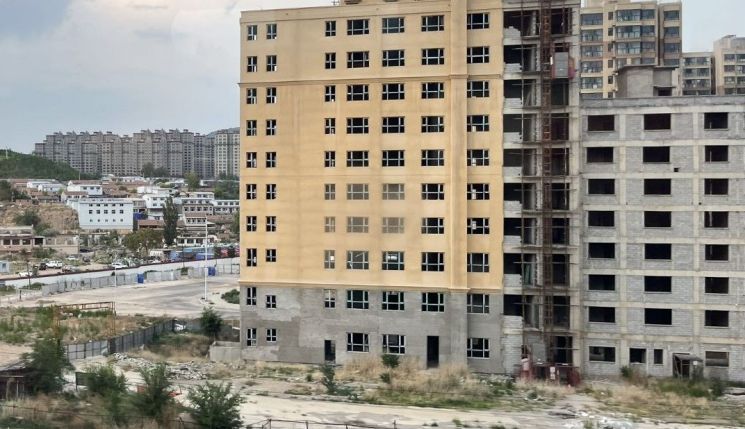 The capital of Hebei Province, Shijiazhuang, China, with a population of 11 million. Located adjacent to Beijing with excellent accessibility, an apartment complex that was left unfinished several years ago remains abandoned and unsightly. (Photo by Kim Hyunjung)
© The Asia Business Daily(www.asiae.co.kr). All rights reserved.
![Clutching a Stolen Dior Bag, Saying "I Hate Being Poor but Real"... The Grotesque Con of a "Human Knockoff" [Slate]](https://cwcontent.asiae.co.kr/asiaresize/183/2026021902243444107_1771435474.jpg)
















