Improvement Measures for Interbank Market Practices and Infrastructure
Exchange Rate Stability During Capital Market Closing Hours
Reform of Lead Bank System for Market Making
Starting from July next year, the opening hours for electronic transactions between domestic foreign exchange banks and foreign financial institutions (RFIs) will be extended until 2 a.m. the following day, and foreign exchange transactions will be recognized as same-day trades. Additionally, to minimize the impact on the spot foreign exchange market, domestic banks will be allowed to conduct non-deliverable forward (NDF) electronic transactions only during the extended hours after the Seoul session (3:30 p.m. to 2 a.m. the next day).
The Ministry of Economy and Finance and the Bank of Korea announced these measures on the 8th as part of the "Interbank Market Practices and Infrastructure Improvement Plan." This is a follow-up to the "Foreign Exchange Market Structure Improvement Plan" announced last February, and opinions from related agencies and the market were gathered through the Foreign Exchange Soundness Council and the Seoul Foreign Exchange Market Operation Council the day before.
The foreign exchange authorities have been accepting registrations from RFIs wishing to trade in the domestic foreign exchange market since the 18th of last month, and from January next year, authorized foreign financial institutions will pilot trading won-dollar spot foreign exchange and other transactions in the domestic foreign exchange market. From July of the same year, the foreign exchange market opening hours will be extended until 2 a.m. the following day.
Specifically, to establish order in the foreign exchange market, a "Code of Conduct Self-Compliance Committee" composed of market participants will be newly established, and the authorities plan to monitor abnormal transactions and quotes through the spot foreign exchange brokerage platform. This is because, after market opening, there is a coexistence of risks where RFIs may raise issues regarding the reliability of the transaction reference rate or become agents of market disruption.
The plan to recognize foreign exchange transactions during the opening hours (9 a.m. to 2 a.m. the next day) as same-day trades will be finalized after consultations among related agencies including the Ministry of Economy and Finance, the Financial Services Commission, the Bank of Korea, and the Financial Supervisory Service. This is based on the judgment that extending the opening hours to 2 a.m. the next day could cause confusion due to changes in the transaction date.
Efforts will also be made to stabilize the exchange rate during the capital market closing hours. There has been concern that the demand from foreign investors to trade at the closing exchange rate around the stock and bond market closing time (3:30 p.m. to 3:45 p.m.) could increase exchange rate volatility at 3:30 p.m. To prevent this, the government recommends completing customer order acceptance 10 minutes before market close and dispersing orders thereafter to reduce demand concentration and suppress speculative trading inflows.
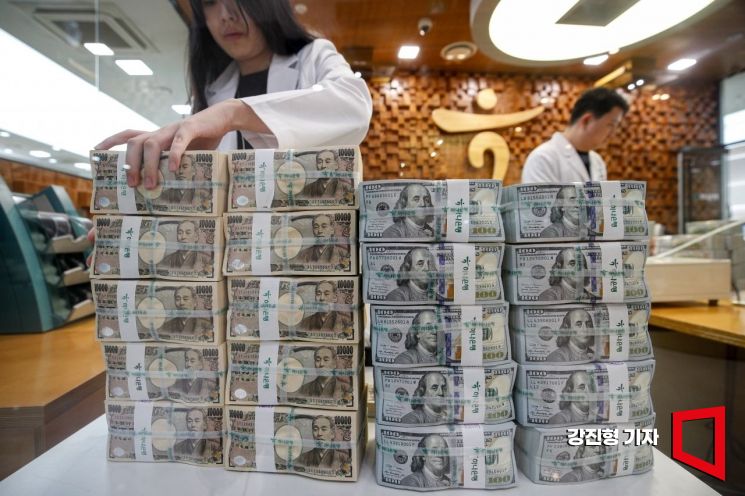 On the 14th, an employee is organizing US dollars and Japanese yen at the Hana Bank Counterfeit Response Center in Jung-gu, Seoul. Photo by Jinhyung Kang aymsdream@
An electronic trading operation guideline (API Rulebook) will also be introduced. This is to prevent potential market instability caused by high-frequency trading enabled by API adoption in the domestic foreign exchange market. To this end, a minimum quote maintenance time, such as maintaining bid and ask prices presented as quotes for at least 0.2 seconds, will be set.
The leading bank system will be restructured to select banks with excellent market-making capabilities and encourage active market making during extended hours. This is because the current criteria for selecting leading banks lack incentives for market making. When selecting leading banks, weights will be given to market quote creation transactions and trades during the extended opening hours. Banks designated as leading banks will receive benefits such as reductions in foreign exchange soundness charges.
Electronic NDF trading by domestic banks will also be permitted. Currently, NDF electronic trading is allowed for overseas financial institutions and domestic foreign bank branches but prohibited for domestic banks, which is seen as weakening their competitiveness. Therefore, to minimize the impact on the spot foreign exchange market, domestic banks will be allowed to conduct NDF electronic trading only during the extended hours after the Seoul session.
An agency system will also be introduced. This considers the difficulty for RFIs to directly perform verification and reporting obligations related to foreign exchange transactions. The agency will be selected from qualified institutions under the RFI guidelines that have signed agency contracts with RFIs, and special benefits such as exemption from reporting won borrowing among agencies and permission for direct won-dollar transactions will be granted.
The government will monitor the implementation plans of banks and brokers by task and the preparation process of RFIs for market participation through the Foreign Exchange Market Council's Steering Committee, and will supplement any deficiencies found during the pilot operation to ensure the smooth formal implementation of the structural improvements in July next year.
© The Asia Business Daily(www.asiae.co.kr). All rights reserved.

















