Ministry of Science and ICT Announces 'Measures to Ease Communication Cost Burden'
New 5G Plan Priced Around 30,000 KRW
Improvement of Selective Contract System
Now, LTE plans can be used on 5G devices as well. Low-cost Galaxy devices priced in the 300,000 KRW range will also be released, reducing the burden of device purchase costs.
On the 8th, the Ministry of Science and ICT announced the "Measures to Alleviate Communication Cost Burden" with these details.
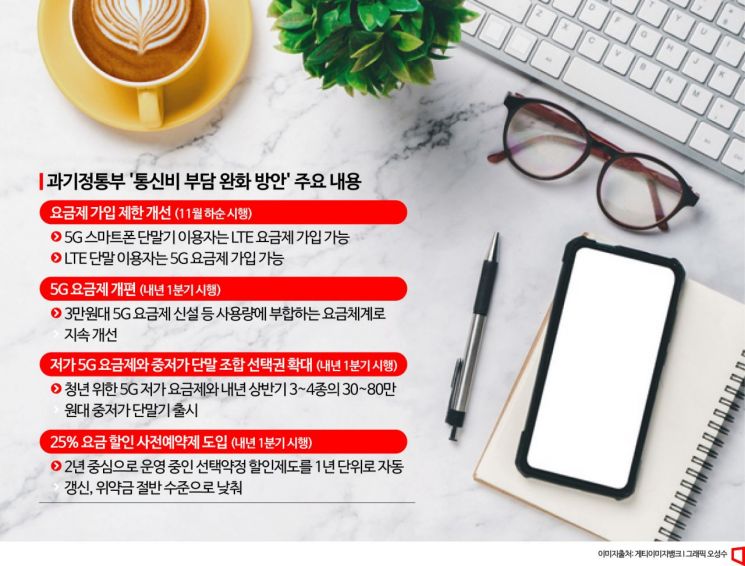
Starting this month, users can choose affordable plans regardless of the type of device. Currently, unlocked 5G devices can subscribe to LTE plans, but 5G devices purchased from carrier stores (carrier-branded devices) can only subscribe to 5G plans. This announcement removes the barrier between device and plan generations. 5G device users can subscribe to LTE plans, and LTE device users can select 5G plans, which are relatively advantageous for heavy data usage, thereby reducing communication expenses. The plan is to implement this sequentially starting this month, with SK Telecom currently revising terms of service and developing IT systems. KT and LG Uplus will also apply the changes sequentially.
The lowest 5G plan prices of the three major carriers, currently in the high 40,000 KRW range, will be lowered to the 30,000 KRW range, and the data allowances for 5G plans under 30GB will be subdivided. The three carriers plan to introduce 5G plans in the 30,000 KRW range within the first quarter of next year. The limited selection of 2 to 3 plans under 30GB will also be diversified.
To ease the communication cost burden on young people, the choice of low-cost 5G plans combined with mid-to-low priced devices will be expanded. Within the 30GB or less range priced between 30,000 and 40,000 KRW, data allowances will be increased up to twice compared to regular plans, and a youth 5G plan with enhanced benefits such as movie coupons will be introduced within the first quarter of next year. Through rapid wholesale provision, affordable 5G plans will also be launched for MVNOs. To reduce the burden of device purchase, in cooperation with Samsung Electronics, 2 mid-to-low priced devices in the 300,000 to 800,000 KRW range will be released within this year, and 3 to 4 models in the first half of next year.
The selective discount system (25% discount on communication fees), which operates on a two-year basis, will introduce a pre-reservation function by the first quarter of next year to allow automatic renewal on a one-year basis. The 25% discount benefit remains the same as the two-year contract, but the penalty for early termination is reduced. Currently, for a 69,000 KRW plan, the maximum penalty under the selective discount system is 138,000 KRW. However, if divided into one-year terms, the penalty for early termination is reduced to 69,000 KRW. This reduces the burden of cancellation, making it easier to switch to cheaper plans from other carriers and can stimulate competition among providers.
To improve the market oligopoly structure, support for the entry of a fourth carrier will be strengthened. To encourage new entrants, frequency allocation fees and conditions will be recalculated to reflect the current situation, and regional allocation (7 regions) will be permitted. To enable new entrants to provide smooth services, expansion of essential facility access will be promoted, and institutional improvements will be pursued to allow joint use (roaming) of other carriers’ networks during network construction. To reduce investment burdens in the early stages, policy financing (up to 400 billion KRW) and tax credits will also be supported.
To foster MVNO operators, the wholesale provision obligation, which expired last September, will be made permanent. Discounts for bulk data purchases will be expanded, and restrictions on the market share of subsidiaries of the three major carriers will be pursued.
Lee Jong-ho, Minister of Science and ICT, stated, “We will strive to substantially expand the choice of plans and devices and reform the rate system to match usage, so that the communication cost burden on the public can be practically reduced. Through fostering new communication operators and MVNOs, we will improve the entrenched oligopoly in the communication market and activate fundamental competition in rates, services, and infrastructure.”
© The Asia Business Daily(www.asiae.co.kr). All rights reserved.

















