Second In-House Data Center Fully Operational
'Gak Chuncheon' 10 Years of Expertise Combined
Largest High-Performance Computing Infrastructure in Korea
Focus on Naver's AI, Robotics Technology Capabilities
"A Forward Base for Technology Export"
"It will become the engine of South Korea's digital industry."
NAVER has officially launched its second proprietary data center, 'Gak Sejong.' True to its name as a hyperscale data center, Gak Sejong boasts a world-class scale and will serve as the foundation for NAVER's technological advancement for more than the next decade.
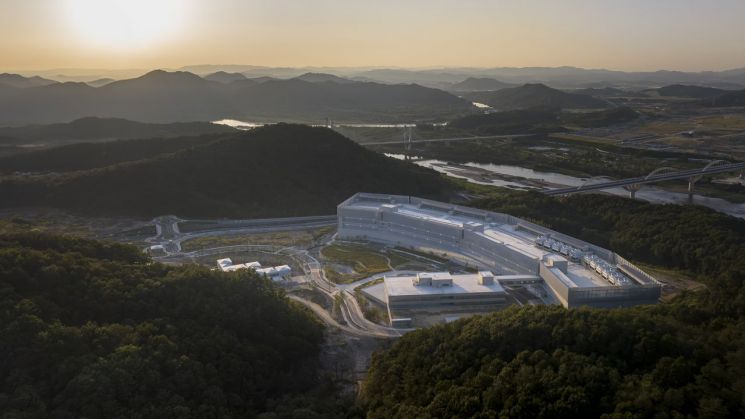
Size of 41 Soccer Fields, 650 Billion KRW Investment... Gak Sejong
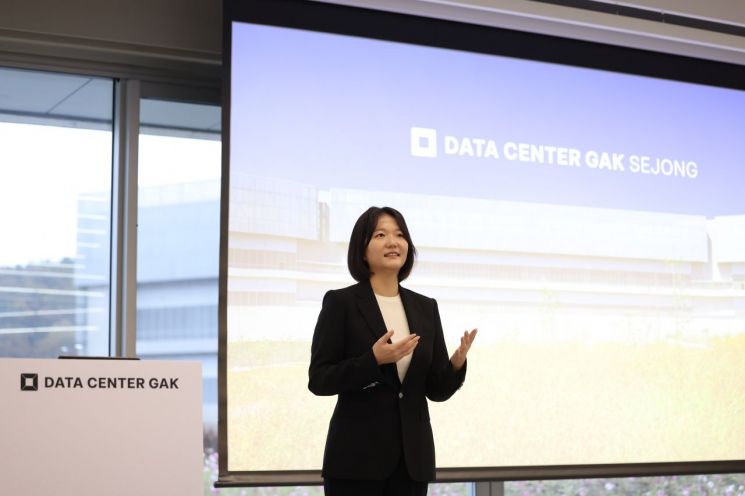
On the 6th, CEO Choi Soo-yeon explained the role of the new data center at Gak Sejong in Sejong City, stating, "Gak Sejong, a hyperscale data center designed with a vision for the next 10 years and beyond, will be the engine not only for NAVER but for all industries and technological innovation."
Gak Sejong is a data center that consolidates NAVER's advanced technological capabilities in AI, cloud, robotics, and autonomous driving, built as a hyperscale data center in line with recent technological trends. It builds on the know-how gained from operating the first data center, 'Gak Chuncheon,' opened in 2013, which was run for 10 years without interruption, accidents, or disasters.
From the site selection contest that began in July 2019 to the approval for use in August 2023, Gak Sejong took about 48 months to complete. Approximately 700,000 personnel were involved. It currently consists of a main building with three underground and three above-ground floors, and a north building (server building) with three underground and two above-ground floors. So far, 650 billion KRW has been invested. Gak Sejong will be sequentially operated in three phases according to data growth speed, with total investment expected to reach the trillion KRW level.
Situated on a 294,000㎡ site equivalent to 41 soccer fields, Gak Sejong has infrastructure capable of housing 600,000 units (a standard height unit for servers), making it the largest single-company data center in South Korea.
CEO Choi explained, "We named it 'Gak (閣)' to inherit the spirit and technology of the Janggyeonggak at Haeinsa Temple in Hapcheon, which preserved the Tripitaka Koreana during the Goryeo Dynasty," adding, "We will carry this great responsibility to become the Janggyeonggak of the 21st century."
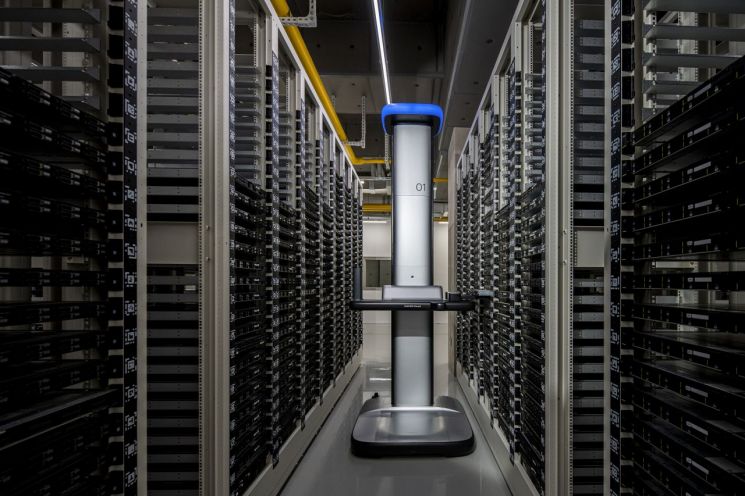
Built with NAVER’s Own Technology... Robots ‘Garo’ and ‘Sero’
One of the biggest features of Gak Sejong is that it was designed from the planning stage to be robot-friendly.
During a tour of the operations and server buildings, no thresholds were found anywhere. This was designed to facilitate the movement of autonomous robots. The corridors are so wide that even ten adult men standing with arms outstretched would not touch each other, allowing robots carrying loads to easily avoid people.
Currently, Gak Sejong operates two 'Garo' and two 'Sero' asset management automation robots. 'Garo' is an autonomous transport robot that moves heavy assets between the server room and the robot warehouse. It can carry loads up to 400 kg. While Garo moves autonomously, it can switch to 'power assist mode' for manual transport. In practice, a Garo carrying a 200 kg server did not budge when pushed, but easily moved when switched to power assist mode.
'Sero' performs the issuance and loading of core assets, such as servers, in the IT warehouse without human intervention, recognizing asset numbers for each server and integrating asset flow management into a single system. It can move servers up to 3 meters high onto racks by itself, minimizing labor.
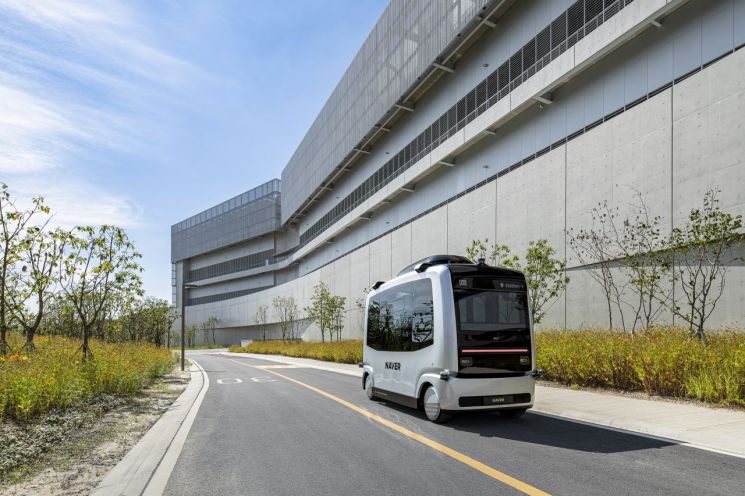
Both 'Garo' and 'Sero' were developed using proprietary technology by NAVER's in-house research organization, NAVER Labs. Going forward, NAVER plans to accumulate operational data from these robots and transfer the technology for robot utilization to external companies.
One of the technologies NAVER is experimenting with at Gak Sejong is autonomous driving. Currently, the autonomous shuttle 'Altbee' is operating across the site, assisting employee transportation. This technology was also developed by NAVER Labs and features 'AltLive,' an independent autonomous driving software that was the first in the IT industry to receive temporary autonomous driving operation approval from the Ministry of Land, Infrastructure and Transport in 2017 and has been developed through operation in complex urban environments.
Data Center Director Noh Sang-min said, "Robots and autonomous shuttles will help workers reduce time spent on repetitive tasks and commuting, allowing them to focus more on specialized facility safety management."
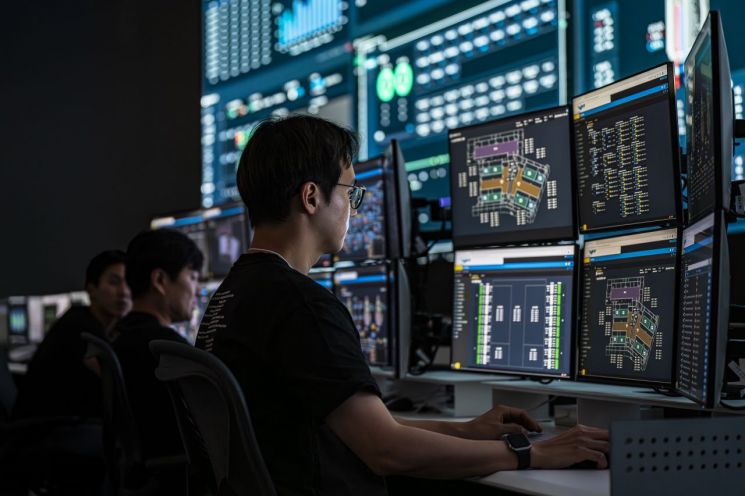
Maximizing Energy Efficiency
Gak Sejong is an eco-friendly data center that applies various natural energy technologies. It uses its self-developed air conditioning system called 'NAMU' to cool the server rooms 24/7 with natural wind.
Maximizing energy efficiency is essential for reducing operating costs. For example, Gak Chuncheon was charged 24 billion KRW in electricity fees this year. Gak Sejong’s power reception capacity is 6.7 times that of Gak Chuncheon, so electricity costs could exceed 100 billion KRW. Therefore, Gak Sejong has introduced waste heat recovery systems, renewable energy sources such as geothermal and solar power, and water reuse systems.
Gak Sejong plans to challenge the 'LEED v4 Platinum' certification, which is stricter than the 'LEED v3 Platinum' certification that Gak Chuncheon received with a world-highest score of 95 points for a data center under the international green building certification system LEED.
Additionally, it has applied top-grade seismic design to prepare for earthquakes. It is rated safe against seismic intensity 9.0 and magnitude 7.0 earthquakes, equivalent to the Fukushima earthquake in Japan.
Going forward, Gak Sejong will serve as a forward base for exporting NAVER’s technology. It is currently training the massive AI model 'HyperCLOVA X,' and cloud and digital twin technologies will also be advanced at Gak Sejong. Digital twin refers to digitally replicating real objects, buildings, or cities. Recently, NAVER secured a $100 million contract to build a 'Digital Twin Platform' in Saudi Arabia. This milestone has laid the groundwork for exporting NAVER’s technological capabilities beyond the Middle East to the global market.
Kim Yoo-won, CEO of NAVER Cloud, said, "Recently, many countries have shown great interest not only in NAVER’s AI technology but also in the scale and stable operation capabilities of its data centers," adding, "Gak Sejong is expected to become a forward base for AI and cloud businesses expanding into various industries."
© The Asia Business Daily(www.asiae.co.kr). All rights reserved.



















