China Exports Are Virtually 'Zero'... Trade of Inedible Pearls and Corals
Despite Hong Kong strengthening import restrictions on Japanese seafood at the end of August in response to the discharge of contaminated water from the Fukushima Daiichi Nuclear Power Plant (referred to by the Japanese government as "treated water"), the import value of Japanese seafood in September actually increased.
On the 7th, Kyodo News reported that the Japanese Ministry of Agriculture, Forestry and Fisheries announced that the total value of seafood exported to Hong Kong last month was 12.6 billion yen (approximately 109.9 billion KRW), an 86.9% increase compared to the same month last year.
Unlike China, which has completely banned imports of Japanese seafood, Hong Kong limited the import ban to 10 out of the 47 prefectures nationwide. Accordingly, Japanese seafood from regions not subject to the import ban can be exported to Hong Kong.
Japan exported scallops, whose sales channels were partially blocked due to China's import suspension, to Hong Kong in September, increasing by 48.8% year-on-year to 1.7 billion yen (approximately 14.8 billion KRW).
The export value of Japanese seafood to Hong Kong continued to rise for the second consecutive month. In August, it was 6.9 billion yen (approximately 60.2 billion KRW), a 15.5% increase compared to the same month last year.
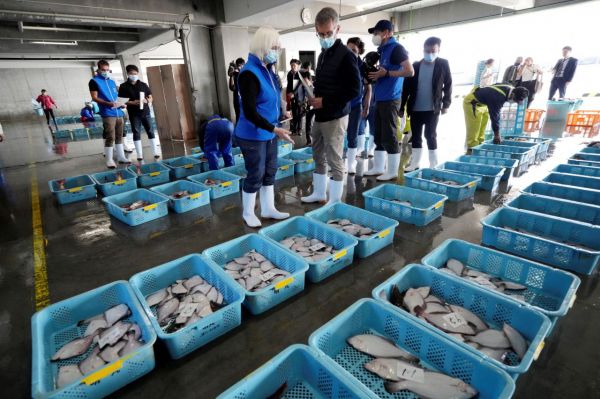 On the 19th of last month, nuclear experts from the International Atomic Energy Agency (IAEA), China, South Korea, and Canada inspected the radioactivity contamination levels of freshly caught Japanese flounder at Iwaki Port in Fukushima Prefecture, Japan.
 [Photo by Reuters Yonhap News]
On the other hand, the export value of Japanese seafood to China in September was virtually zero.
Seafood such as scallops and sea cucumbers, which China imported heavily before the contaminated water discharge, were not traded.
In this regard, the Ministry of Agriculture, Forestry and Fisheries announced that the export value of seafood to China decreased by 90.8% year-on-year to 800 million yen (approximately 7 billion KRW), but this included inedible items such as pearls, coral, and ornamental koi.
Earlier, the General Administration of Customs of China announced in its September trade statistics released last month that there was no recorded import value for Japanese seafood, indicating a complete halt.
Kyodo News stated, "As China continues its import ban measures, the downward trend in exports likely continued in October."
Meanwhile, Japan's total export value of agricultural, forestry, fishery products, and food last month was 117.6 billion yen (approximately 1.026 trillion KRW), a 3.1% increase compared to the same month last year.
© The Asia Business Daily(www.asiae.co.kr). All rights reserved.
![Clutching a Stolen Dior Bag, Saying "I Hate Being Poor but Real"... The Grotesque Con of a "Human Knockoff" [Slate]](https://cwcontent.asiae.co.kr/asiaresize/183/2026021902243444107_1771435474.jpg)











