Samsung Electronics Hosts 'Samsung AI Forum 2023'
Discussing Next-Generation Semiconductor Challenges in the Era of Massive AI
Jim Keller Emphasizes Open Source Concept 'RISC-V'
"Hardware Development Will Continue Through RISC-V"
"Open source is the greatest driving force that allows Moore's Law to continue. Many will develop their own AI solutions (through open source) to solve various problems." (Jim Keller, CEO of Tenstorrent)
"Samsung Electronics will play a pivotal role in strengthening the AI ecosystem as a key component for AI computing systems, including High Bandwidth Memory (HBM)." (Kyung Kye-hyun, President of Samsung Electronics)
Samsung Electronics held an event to share research achievements and development directions for next-generation semiconductors in the era of massive AI. As AI technology rapidly evolves, there was a claim that the advancement of open-source concepts like RISC-V and packaging technology is necessary to support semiconductor innovation.
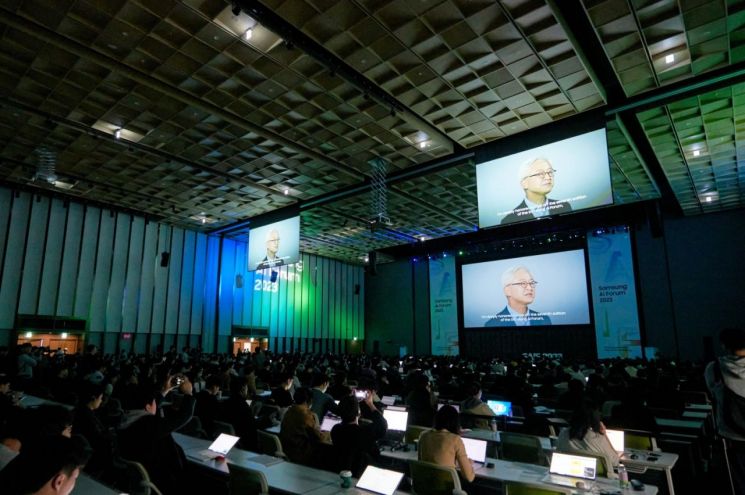 The scene at the 'Samsung AI Forum' held at Suwon Convention Center in Suwon-si, Gyeonggi-do / Photo by Samsung Electronics
Jim Keller: "RISC-V Related Market Growing Rapidly... Regulations Are Not Suitable"
On the 7th, Samsung Electronics held the 7th 'Samsung AI Forum 2023' at the Suwon Convention Center in Suwon, Gyeonggi Province. The Samsung AI Forum is an event where world-renowned scholars and experts in AI and Computer Engineering (CE) gather to share the latest research trends and explore future innovation strategies. This year, about 1,000 people, including students, attended the forum.
This year's forum theme was "Massive AI for a Better Tomorrow." Massive AI refers to large-scale AI systems characterized by processing vast amounts of data and tasks. The semiconductor industry expects that with the advent of massive AI, computing throughput will increase exponentially, requiring high-performance, high-capacity, and low-power semiconductors of a completely different dimension.
RISC-V is being considered as an alternative to address these challenges. RISC-V is an open hardware design asset. It is similar to the open-source concept that opens software design blueprints (source code) free of charge for anyone to use. Google's Android operating system (OS) is also based on open source.
Jim Keller, regarded as a legend in semiconductor design, said in his keynote speech that next-generation AI can be realized through hardware architecture innovation based on RISC-V. The Canadian semiconductor startup Tenstorrent, where he works, designs AI semiconductors based on RISC-V and is gaining industry attention.
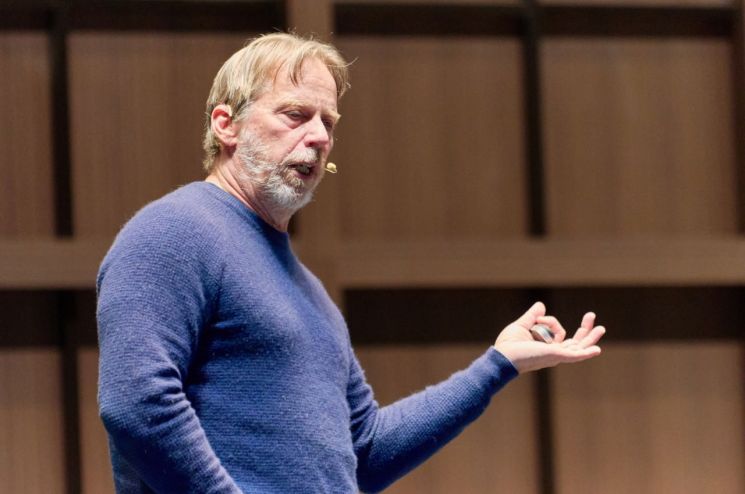 Jim Keller, CEO of Tenstorrent, is delivering the keynote speech at the Samsung AI Forum. /
 Photo by Samsung Electronics
CEO Keller pointed out, "Many people are designing RISC-V rather than architectures," and emphasized, "It is really important that many students are studying RISC-V." He also explained, "The market developing hardware through RISC-V is growing explosively," and "I expect it to continue gaining momentum."
Some voices express concerns about open-source models due to security reasons. Regarding this, he said, "Some say it should be regulated, but technology must be open," and added, "I believe it is right to continue advocating for open source in developing next-generation technologies."
Advancements in packaging technology can also serve as a catalyst for semiconductor innovation. Packaging used to mean a simple task of enclosing semiconductor chips to make finished products. Now, it is considered a key method to maximize semiconductor performance by stacking or combining multiple semiconductor chips.
Regarding chiplets (a packaging method where various chip pieces are produced separately and then combined) implemented through packaging technology, CEO Keller said, "Chiplets will enable solving AI program problems," and "Development is ongoing."
Samsung Electronics stated its intention to continue semiconductor innovation in line with rapidly advancing AI technologies such as large language models (LLM) and generative AI. President Kyung Kye-hyun said in his opening remarks, "We are striving to create a brighter future led by AI and semiconductors," and "We firmly believe we can solve the industry's most difficult challenges."
Samsung Advanced Institute of Technology (SAIT), Samsung Electronics' fundamental technology research organization (formerly the Comprehensive Technology Institute), held detailed sessions in AI and CE fields on the same day. In AI, they discussed plans to utilize AI such as LLM across semiconductor development and envisioned future changes in semiconductors through this. In CE, they discussed the potential for future computing advancements, including process simulation using AI.
© The Asia Business Daily(www.asiae.co.kr). All rights reserved.
![Clutching a Stolen Dior Bag, Saying "I Hate Being Poor but Real"... The Grotesque Con of a "Human Knockoff" [Slate]](https://cwcontent.asiae.co.kr/asiaresize/183/2026021902243444107_1771435474.jpg)

















