Domestic researchers have succeeded in developing a fuel cell catalyst to replace platinum-based catalysts.
Platinum, used as a catalyst in fuel cells, has formed a high price range due to its resource scarcity, revealing problems in mass production and distribution. The catalyst developed by the research team is significant in that it enables the production and distribution of fuel cells using a non-platinum catalyst.
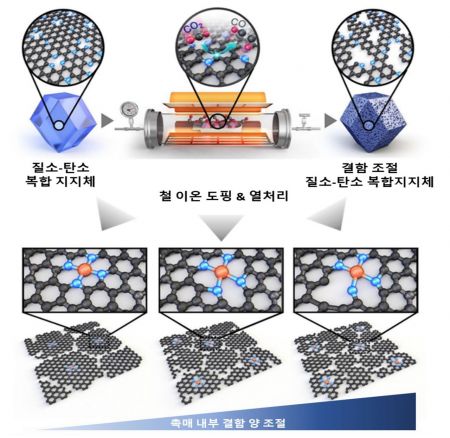
KAIST announced on the 7th that Professor Jinwoo Lee's research team from the Department of Bio and Chemical Engineering collaborated with Professor Segun Jang's research team from Kookmin University and Professor Seoin Baek's research team from Sogang University to develop a high power density proton exchange membrane fuel cell based on a non-platinum catalyst.
The research team succeeded in realizing high performance of a non-platinum ‘Fe-N-C’ catalyst that can replace the existing platinum catalyst, enhancing price competitiveness and the performance of fuel cells with high power density.
The optimized Fe-N-C catalyst developed by the research team showed a 44% higher power density than the previously developed Fe-N-C catalysts in PEMFC fuel cells, opening the possibility of replacing the currently used platinum catalysts.
In particular, the Fe-N-C catalyst, with its high electrochemical properties, is expected to contribute to reducing the stack price of fuel cells by replacing existing platinum catalysts and thereby promoting commercialization.
The study, with PhD candidate Seungyeop Lee from KAIST’s Department of Bio and Chemical Engineering as the first author, was also published online last month on the 13th in the international journal Advanced Materials.
Professor Jinwoo Lee said, "Clarifying the relationship between defects and performance of the Fe-N-C catalyst and developing a high power density proton exchange membrane fuel cell without platinum through defect control is a meaningful achievement of the research," adding, "The developed catalyst and synthesis method are expected to be applied to replace platinum in various types of fuel cells in the future."
Meanwhile, this research was conducted with support from the Korea Research Foundation’s Mid-career Researcher Support Program and the Korea Electric Power Corporation’s External Open Basic Research Support Program.
© The Asia Business Daily(www.asiae.co.kr). All rights reserved.

















