June 6 Accounting Firm CEO Meeting Followed by Backbriefing
Dismissing Criticism of Populism for General Election as "Market Measures Only"
100 KOSPI and KOSDAQ Stocks Subject to Illegal Short Selling
"MSCI Inclusion Not Ultimate Goal... Protecting Individuals"
"It was an inevitable choice for the introduction of an advanced short-selling system. It was unavoidable to protect individual investors."
Lee Bok-hyun, Governor of the Financial Supervisory Service (FSS), directly refuted criticisms and accusations that the short-selling ban was a populist decision aimed at next year's general elections.
On the 6th, after the 'Accounting Firm CEO Meeting' held at the Korea Institute of Certified Public Accountants building in Seodaemun-gu, Seoul, Governor Lee met with reporters and stated regarding the short-selling ban announced the previous day, "Regardless of what is said outside about it being a political decision ahead of the election, we only judged based on the requirements (for the short-selling ban decision)."
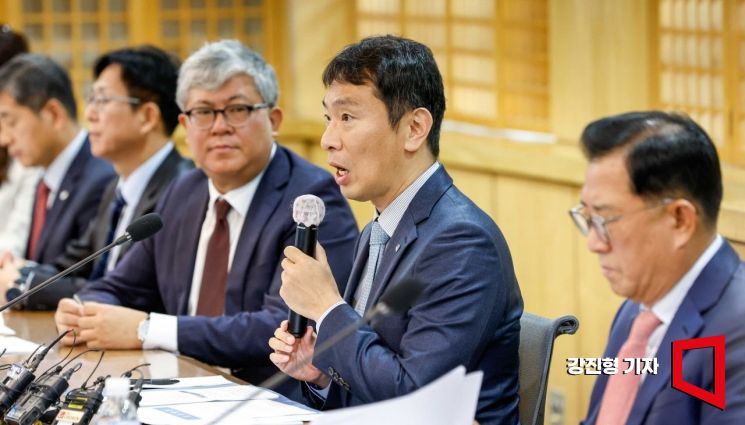 Lee Bok-hyun, Governor of the Financial Supervisory Service, is delivering opening remarks at the 'Accounting Firm CEO Meeting' held on the 6th at the Korea Institute of Certified Public Accountants building in Seodaemun-gu, Seoul. Photo by Jinhyung Kang aymsdream@
Governor Lee said, "Since last year, we have conducted many analyses through inspections and investigations related to short selling and even launched a special investigation team. (Our market is) not just a road with many broken glasses but a market where illegal activities are so widespread that all the glass is shattered," diagnosing that "those deeply involved in the financial industry and in important positions are in an environment where illegal activities are rampant." This statement is interpreted as indicating that the scale of illegal short selling, specifically naked short selling where sell orders are placed without borrowing, is larger than initially expected.
The Financial Services Commission and the Financial Supervisory Service announced the previous day that short selling would be completely banned until the first half of next year, and during this period, measures would be devised to correct the uneven playing field. They also indicated plans to revise the system, noting that the short-selling system has different maturity periods and collateral ratios?the criteria for forced disposal?between individuals, institutions, and foreigners.
Although academia and the securities industry have agreed that short selling does not affect stock price declines, some criticized the financial authorities for the total ban, suggesting it was populism for the general election. In response, Governor Lee strongly emphasized that this was not true and that the financial authorities' ban on short selling was a necessary measure.
Governor Lee said, "(Illegal short selling) greatly distorts investors' decisions due to a loss of trust in the price system," adding, "Considering this, the total ban on short selling was an inevitable choice and unavoidable to protect individual investors." When asked if this was a political decision ahead of the general election, he dismissed the notion, saying, "There are ongoing discussions in the political sphere about this, but this is purely a market measure." He also said, "Especially, it is a big misunderstanding to say that this was suddenly announced without any review just because someone mentioned it; it was decided internally by the government after months of inspection." This is interpreted as emphasizing that this decision was separate from the ruling party's earlier intention to use short selling for election purposes, as hinted by the phrase "After Gimpo, next is short selling."
Along with this, Governor Lee explained, "According to Article 180 of the Capital Markets Act, short selling is generally prohibited, but borrowed short selling is allowed overall for securities market stability," adding, "If it causes market instability or hinders fair price formation, short selling can be banned."
He emphasized, "Just looking at the illegal short selling recently confirmed involving global investment banks (IBs), there were over 100 stocks across both KOSPI and KOSDAQ." Last month, the FSS announced that BNP Paribas and HSBC had submitted naked short selling orders worth about 56 billion KRW over several months for more than 100 stocks including Kakao and Hotel Shilla. Governor Lee said, "Certain IB transactions would be difficult to operate without domestic securities firms acting as channels, and there is strong suspicion about whether securities firms properly operated their systems when accepting short selling orders." He added, "This is just the level we have already identified."
Governor Lee explained that the decision to completely ban short selling was based more on listening to market participants' opinions than on empirical analysis. He said, "When talking with passive investors, they said that the Korean stock market is difficult to invest in due to various reasons and the market is not smooth." Regarding criticism that hedging tools have disappeared, he explained, "Currently, there are individual futures for 200 stocks, and those can be utilized." Governor Lee added, "We will secure a budget so that even illegal accomplices who report illegal short selling can receive rewards worth hundreds of millions of won."
When asked if this measure might negatively affect inclusion in the Morgan Stanley Capital International (MSCI) developed markets index, Governor Lee replied, "Inclusion in the developed markets index itself is not the ultimate goal," adding, "The main objectives are the quantitative and qualitative growth of the capital market and real economy growth through investor protection." He acknowledged that short selling operation is necessary for inclusion but emphasized that the parties from whom they need to gain trust are not only foreigners and institutions but also individual investors.
Governor Lee said, "Last year, when the exchange rate exceeded 1,450 KRW, many investors who lost trust in the domestic stock market took dollars and headed to the U.S. market, which ultimately created competition between markets," adding, "Our stock market can be more attractive than New York or London, or at least it can be in the future, and we need to empower not only foreigners and institutions but also individual investors." He further said, "Considering the medium- to long-term and the ultimate goals comprehensively, we had no choice but to make this decision, and it was inevitable to adopt an advanced short-selling system," adding, "Efforts for various system improvements and on-site inspections during the process will be carried out soon, led by the Financial Services Commission."
Meanwhile, on the 5th, following an extraordinary meeting of the Financial Services Commission, a complete ban on short selling was imposed from the 6th until June 30 next year on all stocks listed on the Korea Exchange, KOSDAQ, and KONEX markets. Whether to resume short selling will be decided around June next year after reviewing the overall market situation.
© The Asia Business Daily(www.asiae.co.kr). All rights reserved.
![Clutching a Stolen Dior Bag, Saying "I Hate Being Poor but Real"... The Grotesque Con of a "Human Knockoff" [Slate]](https://cwcontent.asiae.co.kr/asiaresize/183/2026021902243444107_1771435474.jpg)
















