2023 Financial Trends and 2024 Outlook Seminar
High Proportion of Small Non-Bank Businesses
Risk of Insolvency if High Interest Rates and Real Estate Stagnation Persist
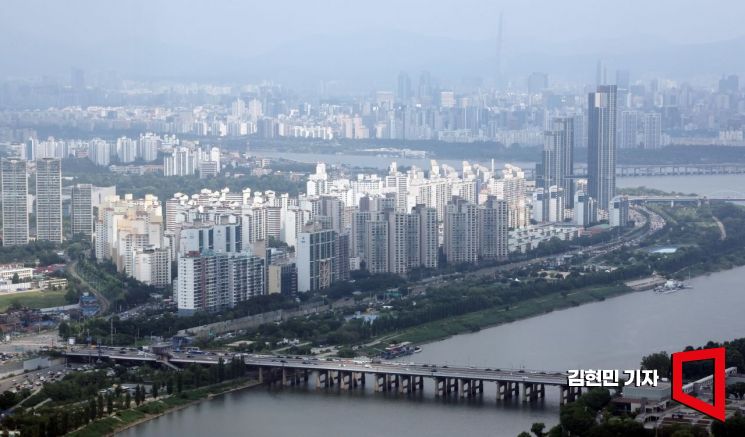 View of apartments in Ichon-dong, eastern Seoul, from the 63 Building observatory. Photo by Hyunmin Kim kimhyun81@
The financial sector's exposure to real estate project financing (PF) has stagnated due to tightening policies and a slowdown in the construction market, but high risks remain concentrated in non-bank sectors such as savings banks.
On the 6th, the Korea Institute of Finance held the '2023 Financial Trends and 2024 Outlook Seminar' and stated, "Looking at the proportion of bridge loans within total PF loans, which significantly affects risk levels across industries, savings banks account for 58%, capital companies 39%, and securities firms 33%." The non-bank sector also has a relatively high proportion of small-scale businesses.
Regarding the capital adequacy indicator for real estate PF risk, measured by PF exposure relative to equity capital, the order is 'securities < capital companies < savings banks,' with savings banks notably lagging behind other sectors.
Research Fellow Shin said, "In the future, the possibility of defaults is expected to increase due to prolonged high interest rates and stagnation in the real estate market," adding, "The delinquency rate on real estate PF loans has risen rapidly since the second half of 2022, especially for credit finance companies and savings banks, where it surged from the low 2% range at the end of 2022 to around 4% by June 2023."
Since 2019, PF loan volumes have expanded mainly in the non-bank sector for high-risk projects with concerns over unsold units and apartment projects with low liquidity and default risk. Research Fellow Shin noted, "Currently, thanks to government policies, a soft landing is underway, but this is not a fundamental solution. If high interest rates and real estate market stagnation persist, defaults are expected to increase, particularly among savings banks, which are at a disadvantage in terms of risk levels, and projects with low viability."
Regarding overseas real estate investments, losses have occurred due to market downturns in major investment countries, and investment contraction and loss expansion are expected to continue. However, the possibility of these risks spreading across the overall market is assessed to be low.
Global credit rating agency Moody's reported that commercial real estate prices in major investment countries have fallen about 20% due to a rapid global tightening shift and sharp interest rate hikes, and suggested an additional potential decline of about 10% due to prolonged high interest rates. Domestic institutional investors are exposed to concentrated risks in specific regions and asset types, a high proportion of B-grade asset investments, a high share of mezzanine and equity investments, and vacancy risks due to short remaining lease terms relative to investment maturities.
Research Fellow Shin stated, "With the possibility of prolonged high interest rates, loss risks are expected to continue beyond 2024," but added, "Considering that overseas investments have mainly been conducted by large securities firms and insurance companies, and that financial institutions' investment proportions relative to equity capital are not high, the likelihood of these risks spreading across the overall market is low."
© The Asia Business Daily(www.asiae.co.kr). All rights reserved.
![Clutching a Stolen Dior Bag, Saying "I Hate Being Poor but Real"... The Grotesque Con of a "Human Knockoff" [Slate]](https://cwcontent.asiae.co.kr/asiaresize/183/2026021902243444107_1771435474.jpg)
















