Ban Until June Next Year... Unlike Previous Three Times, 'Criticism of Political Domain Distortion'
Financial Services Commission, Initially Cautious, Finally Surrenders... Concerns Over MSCI Wish Dissolution and Side Effects
Strict Punishment for Illegal Short Selling... Focus on Future Tasks Like Effective System Improvement
For the fourth time in the history of the domestic stock market, short selling will be completely banned. Short selling was temporarily banned during the 2008 global financial crisis, the 2011 European debt crisis, and the 2020 COVID-19 crisis. Since May 2021, short selling has been allowed again only for the constituent stocks of the KOSPI 200 and KOSDAQ 150 indices, but the ban on short selling for other small and mid-cap stocks has continued to be applied. On the afternoon of the 5th, the government held an emergency Financial Services Commission meeting and approved the 'Securities Market Short Selling Ban' plan, resulting in a complete ban on short selling for all domestic stock market stocks from the 6th until the end of June next year. This applies to all stocks listed on KOSPI, KOSDAQ, and KONEX. However, as with previous full bans on short selling, borrowed short selling by market makers and liquidity providers will be allowed. The Financial Services Commission and the Financial Supervisory Service announced this full short selling ban plan at a briefing held at the Government Seoul Office on the afternoon of the 5th. Short selling is an investment technique where investors borrow stocks they do not own and sell them, anticipating a price drop, then buy them back at a lower price to return the stocks and make a profit.
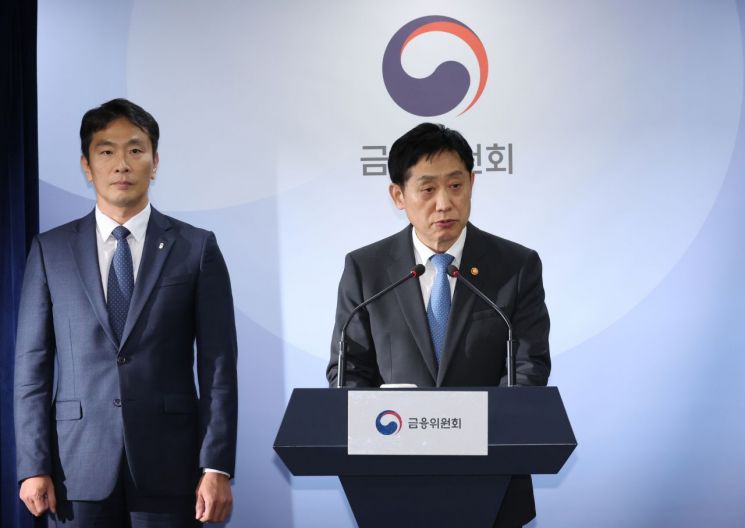 Kim Ju-hyun, Chairman of the Financial Services Commission (right), and Lee Bok-hyun, Governor of the Financial Supervisory Service, are holding a briefing on the short-selling system after concluding an extraordinary Financial Services Commission meeting at the Government Seoul Office Building on the 5th.
 [Image source=Yonhap News]
Concerns over Side Effects such as Foreign Capital Outflow
Concerns have emerged in the market about the side effects of the full short selling ban. The claim that short selling causes stock market declines has not been verified, and short selling has many positive functions. Short selling plays a positive role in removing price bubbles and reducing price volatility in the securities market. During the April CFD (Contract for Difference) incident this year, most of the stocks manipulated by Ra Deok-yeon and his group were stocks where short selling was banned. Also, when short selling resumes, stocks that have not been adjusted so far may instead experience a sharp decline.
Senior Research Fellows Kim Jun-seok and Hwang Se-woon of the Korea Capital Market Institute analyzed, "The short selling ban lowered price efficiency and increased volatility in the stock market," and "it shrank market trading."
The possibility of foreign capital outflow is also a concern. The full short selling ban could lead to backlash from foreign institutions or negative evaluations from global index providers. In particular, it will inevitably have an adverse effect on the government's efforts to include Korea in the Morgan Stanley Capital International (MSCI) developed markets index. MSCI has long required the full resumption of short selling as a condition for inclusion in the developed markets index. In effect, inclusion of the domestic stock market in the developed index next year has become unlikely.
Capitulation to Ruling Party Pressure... Inevitable Criticism of Political Interference
Unlike the three previous bans, opinions are divided on whether a full short selling ban is necessary in the current market. There is a strong view that it was carried out under intense pressure from the ruling party.
In response, the Financial Services Commission explained, "Article 180, Paragraph 3 of the Capital Markets Act requires consideration of whether the short selling ban hinders market stability and fair price formation," and said that the recent market instability prompted this extraordinary full short selling ban. The domestic issue of 'restoring market confidence' was placed at the forefront, even though the situation is not considered a global financial crisis.
According to financial authorities, amid a sustained high-interest-rate environment and slowing global economic growth, geopolitical risks such as the Israel-Hamas conflict have increased, raising uncertainty for the Korean economy, which is highly dependent on external factors. Especially in the second half of the year, volatility in the domestic stock market has expanded to the highest level compared to major overseas markets, intensifying market instability. Despite institutional improvements, repeated detection of illegal naked short selling by foreign and institutional investors has raised serious concerns about fair price formation in the domestic stock market. Recently, large-scale illegal naked short selling cases by global investment banks (IBs) were uncovered, and additional illegal activities are under investigation.
Nevertheless, the Financial Services Commission's position has sharply reversed, acknowledging that short selling is a 'global standard' and warning that if the ban is not lifted, Korea's stock market credibility abroad will decline. This inconsistency has drawn criticism for lacking policy coherence. Despite successive policies aimed at improving capital market accessibility, the credibility and consistency of policies are being questioned.
Ultimately, it is interpreted that the Financial Services Commission capitulated to the ruling party's pressure, which was mindful of individual investors' votes ahead of the general election. The Financial Services Commission reportedly maintained a cautious stance on the short selling ban until the last moment, but the ruling party pushed the temporary short selling ban as an election agenda following the 'Gimpo Seoul incorporation' issue, leading to the surrender.
People Power Party lawmaker Yoon Chang-hyun stated at the National Assembly's Financial Services Committee comprehensive audit last month, "It seems the time has come to completely suspend short selling for three to six months and establish fundamental measures." Following this, lawmaker Kwon Seong-dong said on Facebook on the 1st of this month that he "fully agrees" with the public opinion for a temporary short selling ban. On the 3rd, a scene was captured by the media where People Power Party whip Song Eon-seok sent a message to party floor spokesman Jang Dong-hyuk during a National Assembly Budget and Accounts Special Committee meeting, saying they planned to focus on short selling after Gimpo.
The worsening public opinion due to illegal short selling by foreign investment banks also influenced the situation, with individual investors' voices growing louder. The Financial Supervisory Service recently uncovered illegal short selling worth hundreds of millions of won by HSBC and BNP Paribas. At the briefing, Financial Services Commission Chairman Kim Ju-hyun said, "Repeated detection of illegal naked short selling by foreign and institutional investors has raised serious concerns about fair price formation in the domestic stock market and is undermining market confidence."
Challenge of Comprehensive Reform of the Short Selling System
The Financial Services Commission's position is to first completely suspend short selling and then reorganize related systems. The Commission explained, "We will use this short selling ban period as a starting point to eradicate illegal short selling and, together with related organizations, promote progressive institutional improvements beyond the existing framework to prevent recurrence of unfair issues caused by short selling after resumption." Chairman Kim Ju-hyun said at the briefing that they will seek fundamental solutions to resolve the 'tilted playing field' between institutions and individuals and prevent naked short selling in advance. The Financial Services Commission plans to decide on the resumption of short selling after the first half of the year, considering market trends.
Accordingly, a major task for the Financial Services Commission will be to present a fair short selling system that the market can trust and accept by the end of the temporary ban period in the first half of next year.
First, since criticism of a 'tilted playing field' continues due to differences in loan repayment periods and collateral ratios between individuals and institutions, active consideration will be given to fundamental solutions. Currently, individual investors have a 90-day repayment period for borrowed stocks related to short selling, but foreigners and institutions have no such limit. The collateral ratio is also 120% for individuals, higher than for foreigners and institutions.
The government also plans to discuss various measures, including alternatives to the real-time blocking system demanded by the political sector to prevent illegal naked short selling in advance, and to promote legislation. In addition, following the first detection of large-scale habitual illegal naked short selling by global IBs, a full investigation of global IBs will be conducted. If additional illegal naked short selling is detected, strict sanctions and active criminal prosecution will be applied under a zero-tolerance policy. Therefore, attention will focus on the full investigation of illegal short selling. Financial Supervisory Service Governor Lee Bok-hyun said, "We will apply the zero-tolerance principle with maximum fines and criminal penalties for illegal short selling and strictly punish offenders," and "We will induce global IBs to improve their internal systems to prevent recurrence of naked short selling." He also emphasized that investigations will be conducted on domestic securities firms that accept short selling orders to check for compliance and operational issues.
© The Asia Business Daily(www.asiae.co.kr). All rights reserved.

















