"There is more smuggling than animal abandonment. Through smuggling, up to 100 animals come in at once, and the ratio of smuggling to abandonment is about 9 to 1. Abandoned animals come in one by one, but smuggling can involve more than 50 animals at a time."
The National Institute of Ecology, under the Ministry of Environment and located in Seocheon, Chungnam, celebrated its 10th anniversary on the 2nd by opening its international endangered species (CITES) protection facility. CITES plays a leading role in improving ecological environments, from protecting endangered wild flora and fauna to restoration through investigation and research and development. Currently, a total of 268 species of flora and fauna, including endangered species of levels 1 and 2, inhabit this place. Representative rare animals protected by CITES include the fennec fox, white-handed gibbon, and Indian star tortoise. The fennec fox was seized by customs in 2014 and brought to this National Institute of Ecology.
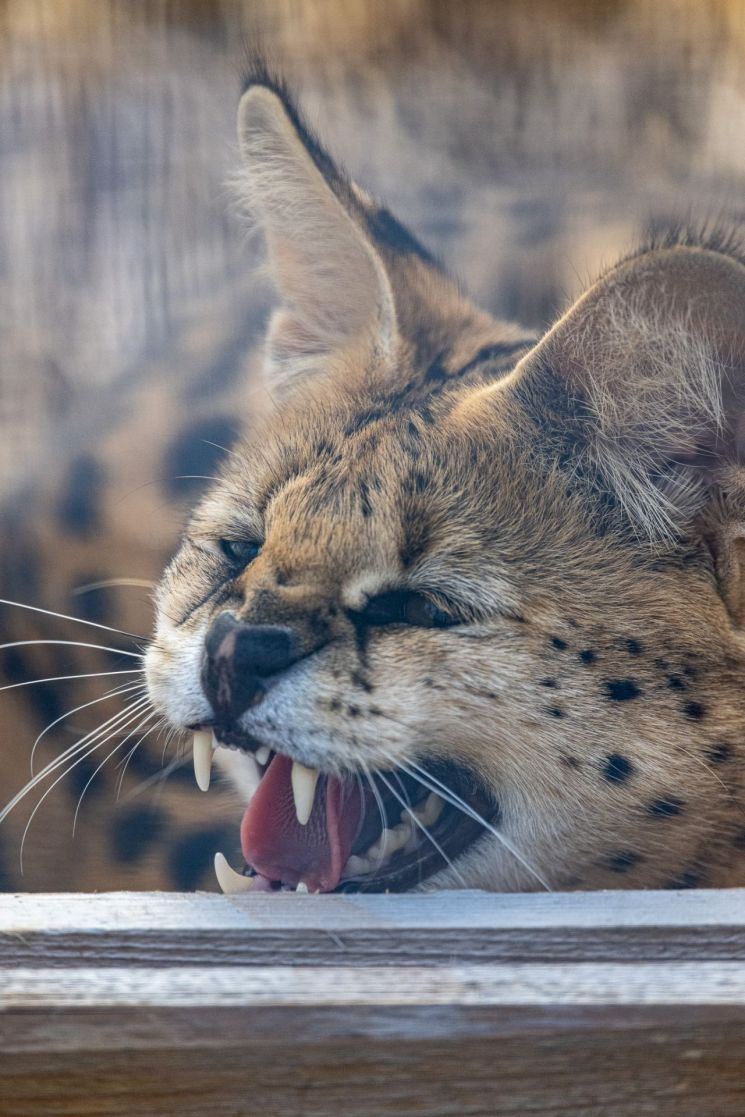 Serval, known as the African wildcat (International Endangered Species Level 2). (Provided by the Ministry of Environment Press Corps)
The majority of international protected species arriving at CITES come through smuggling. They are smuggled via airports or ports and seized by customs before being transferred here. Since its opening in 2021, about 60% of the space at CITES has already been occupied by endangered animals. The CITES protection facility has introduced 441 animals from 53 species. Reptiles account for 399 individuals, making up 90.5%, followed by birds (26), amphibians (10), and mammals (6), showing diversity. At this rate, the facility could reach capacity within just 2 to 3 years.
Kim Young-jun, head of the Animal Management Research Division at the National Institute of Ecology, said, "Animals seized from smuggling can be sent back to their country of origin, but this is not easy," adding, "If they are contaminated with diseases in other countries, the country of origin may refuse to accept them." Even if animals are sent back to their origin, the possibility of re-smuggling cannot be ruled out. Kim explained, "For example, a yellow anaconda was smuggled from Thailand and seized, but its origin was Brazil. Even if it is sent back to Brazil, it could be smuggled again."
Wild animals smuggled in and kept as pets at home, but later abandoned due to the burden, also come here. A representative case is the savannah monitor lizard captured in Yeongju, Gyeongbuk, last July. The lizard has grown continuously and now approaches 1 meter in length. It is presumed that the owner abandoned the lizard as it grew larger.
 Kim Young-jun, Director of Animal Management Research at the National Institute of Ecology (veterinarian), is explaining endangered species at a CITES-protected facility on the 2nd.
Animals protected at CITES are meticulously managed to prevent disease concerns. Kim said, "Even though animals entering the CITES facility have passed quarantine for diseases, if diseases that could affect other individuals are detected, we continue therapeutic approaches," adding, "There are many difficult cases. For example, metabolic diseases and infectious diseases have appeared, some of which are the first cases in Korea, so we are continuously monitoring."
Ana Maria Hernandez Salgar, former chair of the Intergovernmental Science-Policy Platform on Biodiversity and Ecosystem Services (IPBES), who visited Korea for the National Institute of Ecology's 10th anniversary symposium, said, "It is important to note that such trafficking makes these species vulnerable and forces them to relocate their habitats elsewhere, which increases their vulnerability."
© The Asia Business Daily(www.asiae.co.kr). All rights reserved.


















