Active White Hydrogen Mining Activities in the US, Europe, and Australia
Largest Deposit Estimated at 250 Million Tons Discovered in France
Bill Gates Invests 120 Billion Won in White Hydrogen Startup
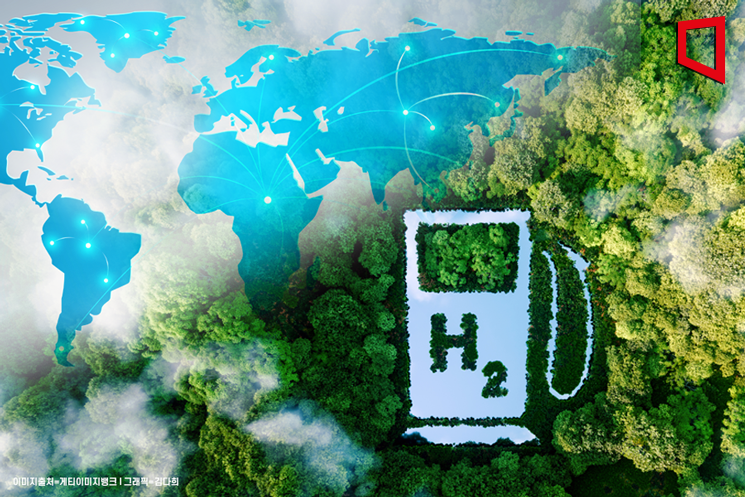
In 1987, in the village of Burakebugu in Mali, West Africa, a worker suffered burns when an explosion occurred while smoking near a well. The well was immediately closed. Later, in 2011, an oil company explored the well and discovered hydrogen with a concentration of 98%. Currently, the residents of Burakebugu village use hydrogen as their main energy source.
Hydrogen, which accounts for 75% of the total mass of the universe, is called the "ultimate clean energy" because it does not produce carbon or other greenhouse gases during combustion. However, since hydrogen is mostly bonded with other molecules at room temperature, additional energy is required to separate pure hydrogen. Depending on the production method, hydrogen is called gray hydrogen, blue hydrogen, pink hydrogen, green hydrogen, and so on.
Recently, interest in "white hydrogen," which is natural hydrogen extracted without artificial production, has surged. This is due to the discovery of hydrogen deposits around the world.
According to foreign media reports such as CNN and The Guardian on the 5th, the French National Center for Scientific Research discovered hydrogen gas while analyzing the gas components dissolved in water in a rock layer 1,200 meters underground in the Lorraine mining basin. They estimated that the amount of hydrogen gas stored here could reach 6 million to 250 million tons. This is the largest hydrogen deposit discovered so far. The amount of hydrogen used worldwide annually is about 100 million tons.
Until now, natural hydrogen deposits in geological layers were considered to have no economic value because they were very rare. However, the discovery of relatively large hydrogen deposits in France has changed the atmosphere. Just as shale layers enabled the drilling of oil and natural gas through advances in science and technology, expectations for hydrogen gas extraction are also rising. Natural hydrogen is no longer a far-fetched idea.
Jeffrey Ellis, a geochemist at the U.S. Geological Survey, estimated in an interview with CNN that the amount of hydrogen stored in geological layers could reach tens of billions of tons. He said, "Most of it is in very small quantities or located in remote seas or very deep places, making economic utilization practically difficult," but added, "Even if only 1% is produced, 500 million tons could be produced over 200 years."
White hydrogen deposits have been found in the United States, Eastern Europe, Russia, Australia, Oman, France, Mali, and other places. As the existence and economic value of white hydrogen become known, more venture companies are trying to explore it. The white hydrogen excavation is being compared to the 'Gold Rush' of the Western frontier era.
Gold Hydrogen, an Australian startup, began natural hydrogen mining operations in October in the York Peninsula in southern Australia. The company expects actual hydrogen mining to be possible by the end of 2024. Records show that hydrogen with a concentration of 80% was discovered here in 1921. At that time, oil was the target, so drilling companies showed little interest in hydrogen.
Koloma, based in Denver, USA, received an investment of $91 million (about 120 billion KRW) from Breakthrough Energy Ventures, founded by Bill Gates, among others. The company remains tight-lipped about drilling locations and commercialization timelines.
Natural Hydrogen Energy in the United States completed hydrogen drilling in Nebraska in 2019 and plans to develop new wells. Viacheslav Zgonnik, the founder of the company, stated, "We are very close to the first commercialization point."
Natural hydrogen drilling is a highly uncertain business that can take anywhere from a few years to several decades. CNN pointed out that regulations and production costs in various countries are obstacles. In Mali, the cost of hydrogen production is only $1 per kilogram. Compared to the production cost of green hydrogen, which reaches $6 per kilogram, this is quite inexpensive. However, this cost can surge depending on the drilling period and location. The World Economic Forum (WEF) analyzed that in the Lorraine mine in France, drilling must reach a depth of 3,000 meters to obtain hydrogen with a concentration of 90%.
In Korea, interest in white hydrogen is still minimal. The government and industry are focusing on clean hydrogen, a concept that encompasses blue hydrogen using carbon capture, utilization, and storage (CCUS) methods and green hydrogen using renewable energy.
© The Asia Business Daily(www.asiae.co.kr). All rights reserved.
![Clutching a Stolen Dior Bag, Saying "I Hate Being Poor but Real"... The Grotesque Con of a "Human Knockoff" [Slate]](https://cwcontent.asiae.co.kr/asiaresize/183/2026021902243444107_1771435474.jpg)

















