[Scrap War]②
For Carbon Neutrality, Electric Furnaces Must Be Used
and Highest Grade Raw Iron Should Be Added,
But Domestic Supply Is Severely Lacking
and Expanding Scrap Imports Is Also Difficult
Steel companies complain that there is no alternative to the increasingly severe scrap steel supply issue amid global carbon neutrality pressures. To achieve carbon neutrality, electric arc furnaces (EAF) must be used instead of traditional blast furnaces that rely on fossil fuels. To produce steel of quality comparable to that made in blast furnaces, the highest grade scrap steel, known as saengcheol (生鐵), must be fed into the EAF, but domestic supply is severely insufficient.
The scrap steel shortage problem is worsening over time. POSCO plans to operate two new EAFs in 2026 (2.5 million tons) and 2027 (3 million tons) in addition to its existing two EAFs. As part of its transition to a low-carbon production system, POSCO has already increased the blast furnace scrap input ratio from 15% in 2021 to 25% currently. Hyundai Steel plans to restart the EAF at its hot-rolling plant in Dangjin, Chungnam, in 2024 (150 tons), in addition to its 10 currently operating EAFs.
UK-based Liberty Steel will also restart the EAF at its Dangjin plant in Chungnam, acquired from KG Steel, in 2025 (160 tons). As the industry leaders expand their EAF capacity, other steelmakers are becoming increasingly anxious about scrap steel supply. Dongkuk Steel (3.6 million tons, last year's EAF production capacity), Korea Steel (1.2 million tons), Hwanyeong Steel Industry (1 million tons), Daehan Steel (900,000 tons), and YK Steel (800,000 tons) also operate EAFs.
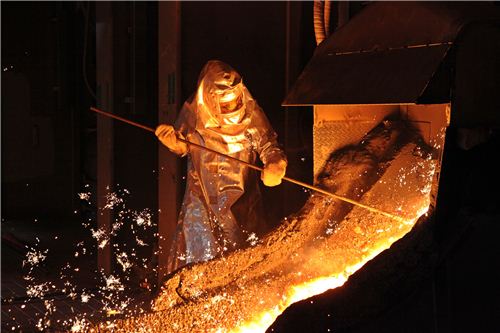 POSCO SNNC 2nd Phase Electric Arc Furnace
If domestic scrap steel is insufficient, the only alternative is imports. However, increasing scrap steel imports is not easy. Securing scrap steel is a common challenge for overseas steelmakers centered on EAFs as well. Major countries have long implemented export restrictions on scrap steel. China, the world's largest steel producer, imposes a 40% export tariff to prevent scrap steel from leaving the country. Russia has responded to scrap steel outflow by imposing export tariffs or designating specific export ports. Recently, the European Union (EU) decided to restrict scrap steel exports to non-OECD member countries. Additionally, Australia began restricting steel scrap exports starting January this year.
Overseas steelmakers adopt vertical integration by acquiring scrap steel companies to ensure stable procurement. ArcelorMittal, the world's second-largest steelmaker, acquired four scrap steel companies in the UK, Germany, the Netherlands, and Poland last year. Nucor, the No. 1 EAF steelmaker in the US, acquired scrap company DJJ in 2008 and purchased two shredder companies in 2021. Germany's ThyssenKrupp and India's Tata Steel and JSW Steel have established joint ventures to collect scrap steel.
Experts say strengthening supply capabilities for stable procurement is urgent. Lee Yun-hee, a research fellow at POSCO Research Institute, said, “The scrap steel self-sufficiency rates of major countries such as China, Japan, and the US are close to 100%, but Korea's scrap steel self-sufficiency rate is around 85%. As Japan and the US, which Korea mainly imports scrap steel from, are investing in EAFs, the conditions for scrap steel procurement have changed.” She added, “It is necessary to seek ways to stabilize imports and promote advanced processing.”

◆ Scrap Steel (Cheol Scrap) = It is divided into the highest quality saengcheol (raw iron) without impurities and processed scrap steel used once for apartment rebar, shipbuilding plates, etc., categorized into heavy A·B and light A·B. Heavy scrap steel is thick and heavy steel with a thickness of 3mm or more, while light scrap steel is steel with many impurities after plating processes. When the steel surface area is thin, slag residue is produced in large amounts.
© The Asia Business Daily(www.asiae.co.kr). All rights reserved.
![Clutching a Stolen Dior Bag, Saying "I Hate Being Poor but Real"... The Grotesque Con of a "Human Knockoff" [Slate]](https://cwcontent.asiae.co.kr/asiaresize/183/2026021902243444107_1771435474.jpg)















